

6 Infant Sleep Training Methods Sleep Consultants Use

After having a baby, most parents know going in that a newborn won’t sleep through the night. What they don’t always anticipate is how overwhelming it can be to navigate all the information, options, and sleep-training methods available to them. Every baby is different, and figuring out which approach is actually right for their child is something many families struggle with.
That’s where a certified sleep consultant makes a real difference. With a solid foundation in infant sleep science, sleep consultants make evidence-based recommendations tailored to the child’s age, developmental stage, and temperament. And when one approach isn’t getting the results a family needs, they adjust.
If this is a career you’ve been considering, understanding the sleep training methods sleep consultants use is a great place to start. In this post, I’m walking you through the most common methods and explaining how each one works. You’ll also get a clearer picture of a sleep consultant’s day-to-day so you can decide if this is the right move for you.
6 Infant Sleep Training Methods Sleep Consultants Use
There is no single sleep training method that works for every child or every family, and a good sleep consultant knows that. Before making any recommendations, they take the time to understand the full picture. This includes the baby’s feeding schedule, developmental readiness and temperament, existing sleep associations, and the ability to remain consistent.
Being able to walk parents through their options clearly and honestly is one of the most important tools for building trust. When families understand what each method entails and what to realistically expect, they enter the process prepared. They understand that sleep training isn’t always linear. And that understanding is what keeps them committed when things get hard.
What Is Infant Sleep Training?
Infant sleep training is the process of helping babies learn to fall asleep independently and return to sleep on their own when they wake during the night. This process ultimately eliminates the need for parents to feed, rock, or soothe them back down.
Most sleep consultants start sleep training with families when the baby is between 4 and 6 months old. By that point, most babies are developmentally ready to self-soothe and no longer need nighttime feedings for nutritional needs.
However, understanding the “why” behind the timing matters, because babies naturally wake briefly between sleep cycles. Sleep training teaches them how to drift back to sleep on their own rather than signaling for a parent every time it happens.
What Do Sleep Consultants Do with Infants?
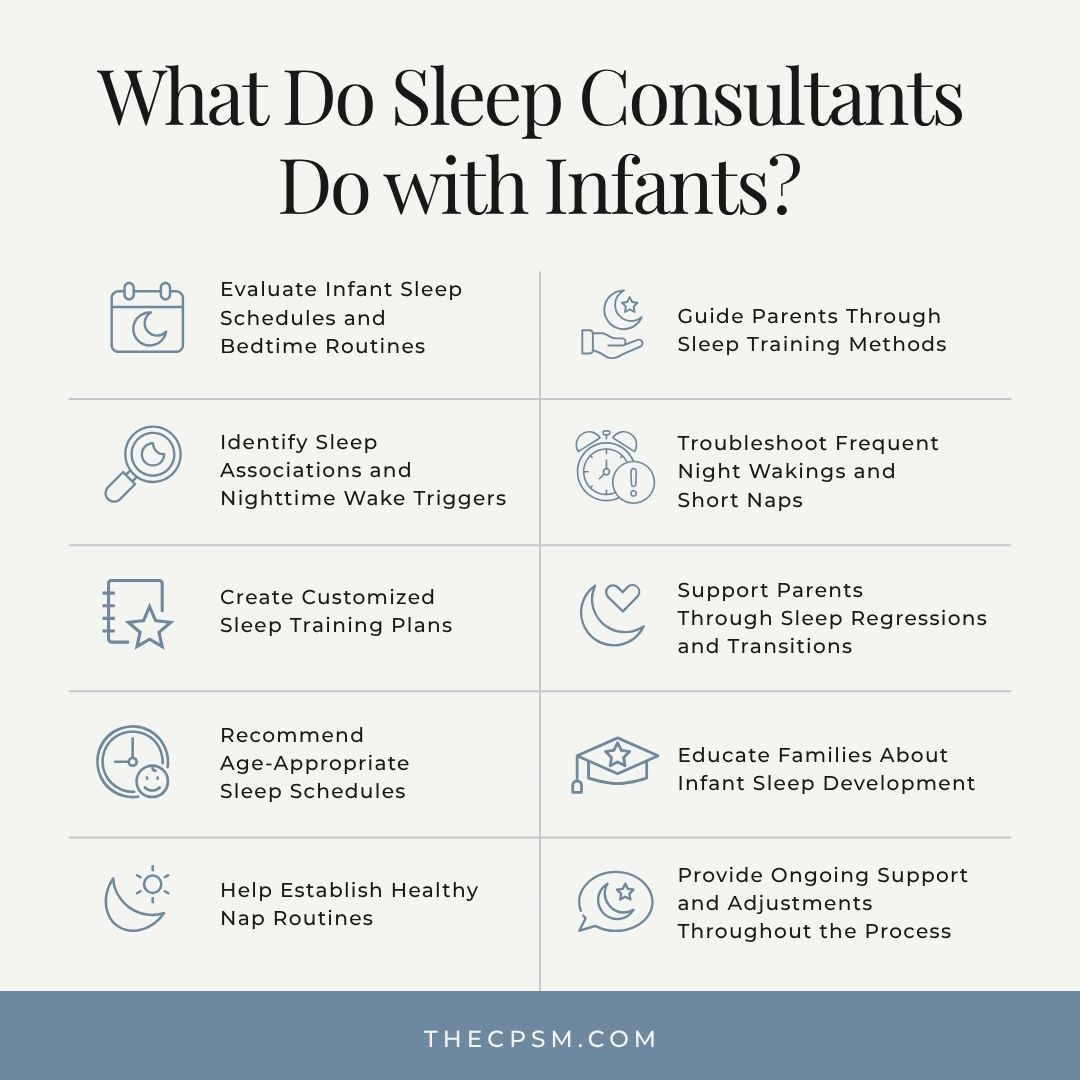
Evaluate Infant Sleep Schedules and Bedtime Routines
Before recommending a specific sleep training method, a sleep consultant starts by looking at what’s already in place. Understanding the baby’s current sleep schedule and bedtime routine gives a clear picture of where the family is starting from. It also gives insight into what adjustments might make the biggest difference.
Consistency in sleep schedules is often one of the first things a consultant addresses. Without it, even the best sleep training method will struggle to gain traction.
Identify Sleep Associations and Nighttime Wake Triggers
Sleep associations, the environmental or habitual cues a baby has come to rely on to drift off, play a major role in how and when a baby falls asleep. This can be rocking, feeding, or hearing a specific sound. As part of building a sleep plan, a consultant needs to identify the associations and how they might be contributing to the sleep challenges.
Understanding what’s waking the baby during the night is equally important. Common culprits include hunger, discomfort, overtiredness, or something in the sleep environment itself. Pinpointing the root cause allows a consultant to recommend a strategy that actually addresses the problem.
Create Customized Sleep Training Plans
With a clear picture of the baby’s sleep habits and the family’s routines, they put together a sleep training plan. From there, it’s about walking parents through exactly how to implement it and help them understand the importance of consistent sleep schedules.
Recommend Age-Appropriate Sleep Schedules
A baby’s sleep needs change as they grow, and a good sleep consultant accounts for that at every stage. Age and developmental readiness are always factored into the sleep plan.
That’s because what works for a four-month-old looks very different from what works for a ten-month-old. Grounding every recommendation in evidence-based practice is what makes plans effective rather than just hopeful.
Help Establish Healthy Nap Routines
A sleep consultant’s work doesn’t stop at bedtime. Daytime naps are a bigger part of the picture, too. How a baby naps during the day has a direct impact on how they sleep at night. So, looking at both together is essential to building a plan that actually works.
Guide Parents Through Sleep Training Methods
The focus is always on helping the baby to sleep better. However, a big part of a sleep consultant’s job is supporting the parents through the process. For virtual sleep consultants, that support looks like regular check-in calls, written instructions, and resources between sessions. Parents need to feel guided and reassured throughout training, not just at the start.
Troubleshoot Frequent Night Wakings and Short Naps
Sleep training doesn’t always go smoothly, and that’s completely normal. When a baby starts waking frequently again, or naps take a turn, a sleep consultant doesn’t just wait and hope things improve. They reassess what’s happening, identify what may have changed, and adjust the plan accordingly.
Support Parents Through Sleep Regressions and Transitions
Sleep regressions and developmental transitions are some of the hardest stretches for families. Having a sleep consultant in their corner during those moments makes a real difference. This is where empathy and patience matter just as much as technical knowledge.
Parents who have been up multiple times a night for weeks need more than a revised plan. They need someone who genuinely understands what they’re going through and can help push them forward.
Educate Families About Infant Sleep Development
One of the most valuable things a sleep consultant offers isn’t the sleep plan itself. It’s the education that comes with it. Parents are better able to stay consistent, handle setbacks, and make informed decisions when they understand how infant sleep develops and changes over time.
The best sleep consultants aren’t just plan-makers. They’re teachers. And the families who walk away with that foundational knowledge see lasting results long after the consultant’s work is done.
Provide Ongoing Support and Adjustments Throughout the Process
Sleep training is rarely a straight line, and that’s exactly why sleep consultants work closely with families over a period of weeks. The work continues until the family has navigated the obstacles, found an approach that works, and feels confident moving forward on their own. That commitment to seeing things through is what makes the difference.
Does learning about what a sleep consultant does make you feel even more passionate about the role? Then make sure to read my step-by-step guide, “How to Become an Infant Sleep Consultant.”
How Early Can You Sleep Train an Infant?
Most sleep consultants recommend waiting until a baby is at least 4 months old before beginning any formal sleep training. Before that point, infants haven’t fully developed their circadian rhythm, and their sleep cycles are still maturing. Pushing structured training too early simply isn’t as effective.
When a baby is ready to begin, parents will usually start to notice some clear signs:
- A more predictable feeding schedule
- Longer stretches of sleep at night
- Early attempts at self-soothing
- More consistent bedtime patterns
- Healthy weight gain and a green light from the pediatrician
Sleep Training Methods for Infants
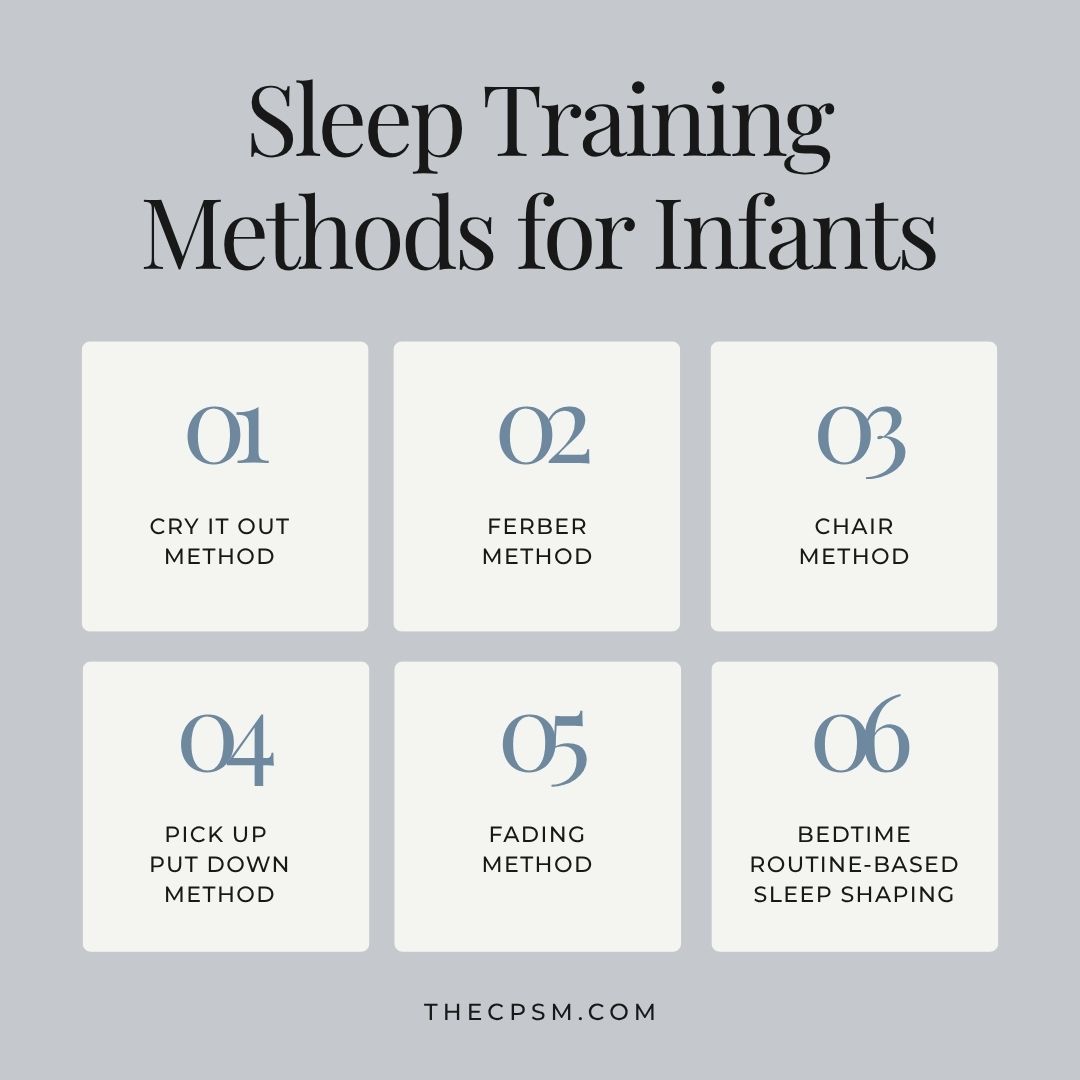
Cry It Out Method
The Cry It Out Method involves putting your baby in the crib awake at bedtime and leaving the room. This allows them to fall asleep independently, even if they cry, without parental intervention. The core principle is that returning to soothe the baby reinforces a sleep association that makes independent sleep harder to achieve.
Research supports it as one of the most effective sleep training methods available, showing babies fall asleep 15 minutes faster. Many babies also begin to sleep through the night within 3 to 7 days. Beyond this, studies have found no long-term negative effects on attachment or emotional development, which is reassuring to concerned parents.
That said, it’s not the right fit for every family, and a good sleep consultant will assess that before recommending it. Parents need to feel emotionally prepared for extended crying. Additionally, it’s important to rule out any potential medical issues, like reflux or ear infections. Ultimately, this method tends to work best for families who are comfortable with clear boundaries and consistent expectations.
And consistency is everything here. Giving in on night two undermines the entire process and can make things harder than if you had never started. A predictable bedtime routine in the lead-up to sleep helps signal to the baby that sleep is coming. This makes the transition smoother for everyone involved.
Ferber Method
The Ferber Method (also known as the Check and Console Method) is one of the most widely recognized sleep-training approaches. It takes the core principle of the Cry It Out method and softens it. Parents can check on their baby at timed intervals, offering brief reassurance without fully intervening.
After the bedtime routine, parents place the baby in the crib drowsy but awake and leave the room. If the baby cries, parents wait three minutes before going in for a short, calm check-in. No picking up, just a brief reassurance that you’re there. The next interval extends to five minutes, then ten, with intervals lengthening each night.
The ideal is to strike a balance between reassurance and independent sleep learning. The baby gets regular signals that their caregiver hasn’t disappeared. However, they are given the space to learn to self-soothe and fall asleep on their own. Most families see meaningful progress within a week, seeing significant improvements in both sleep onset and night wakings.
For sleep consultants, it’s worth noting that this method requires consistent adherence to the intervals. Parents who soothe inconsistently or pick the baby up during check-ins tend to see slower progress and more prolonged crying. The Ferber Method tends to be a good fit for families who want a middle-ground approach. They get something more structured than the gentler no-cry methods but less hands-off than the Cry It Out method.
Chair Method
The Chair Method is a gradual approach in which the parent stays in the room while slowly reducing their involvement over one or two weeks. It tends to appeal to families who find extinction-based methods too distressing, but still want a clear, structured plan.
On the first few nights, the parents sit in a chair right next to the crib, offering verbal reassurance or gentle touching as needed. Every few nights, the chair moves a little further away. First, it moves to the middle of the room, then near the door, then just outside, until the parent’s presence is no longer required.
This method is often a good fit for parents of older infants or toddlers who are more aware of being left alone. It’s also helpful for families navigating bedtime anxiety or transitioning out of shared bedroom arrangements. The gradual nature of it can feel more manageable for parents who need to feel physically present during the process.
In terms of effectiveness, research on the Chair Method is more limited. That said, reports suggest that most families see meaningful improvement and fewer night wakings. Patience is the key ingredient here. Parents who skip stages or revert to picking the baby up can inadvertently extend the timeline and make the process harder.
One thing sleep consultants should address upfront with families is that progress with this method tends to feel slower than other approaches. Setting realistic expectations before starting goes a long way toward keeping families committed when the process feels like it’s dragging.
Pick Up Put Down Method
The Pick Up Put Down Method sits at the gentlest end of the sleep training spectrum. It is built around the idea of offering reassurance without leaving the baby to cry alone.
After the bedtime routine, the parent places the baby in the crib drowsy but awake. If the baby cries, the parent picks them up and soothes them until they’re calm but not fully asleep. Then they put them back in the crib. The cycle repeats as many times as needed until the baby falls asleep in the crib independently.
Many sleep consultants commonly recommend this method for younger infants, ages 4 to 7 months. Older babies often become overstimulated by the repeated pickups and can find the process more frustrating than calming. For babies under four months, some sleep consultants use a modified version that focuses on in-crib soothing.
Sleep consultants recommending this method should be upfront about the time and physical demands involved. It requires consistency from both parents, since one caregiver handling the repeated lifting alone can quickly lead to exhaustion. Ultimately, this method works best for families who prioritize a gentler experience over speed and are prepared to fully commit to the process.
Fading Method
The Fading Method, sometimes called bedtime fading or sleep association fading, is an approach that gradually reduces sleep assistance. It comes in two main variations that are often used together.
The first variation, bedtime fading, involves temporarily shifting the baby’s bedtime later to align with when they naturally fall asleep. Then, parents move bedtime by 10 to 15 minutes earlier each night until they reach a desired bedtime. This builds sleep pressure and helps babies fall asleep more quickly with less resistance.
The second variation targets specific sleep associations like rocking or feeding to sleep. Parents gradually reduce the duration or intensity of the soothing behavior each night. A parent who rocks for 20 minutes might drop to 15 one night and 10 the next. Then, the final step may involve simply holding the baby briefly before placing them in the crib awake.
This approach works well for breaking sleep associations without the abruptness of extinction-based methods like Cry It Out. It tends to be a good fit for sensitive babies, families working through sleep regressions, or parents who have tried other methods without success.
Bedtime Routine-Based Sleep Shaping
Bedtime Routine-Based Sleep Shaping isn’t a formal sleep training method in the traditional sense. It’s more of a foundational practice. Honestly, it’s one of the most important things a sleep consultant can help a family put in place. Grounded in research on infant circadian development and habit formation, the core idea is simple. Consistent routines and predictable sleep cues help babies learn the natural rhythm of sleep over time.
Parents establish a predictable sequence of activities every night before sleep, typically lasting between 20 and 45 minutes. A common routine might include a warm bath, a feeding, a quiet activity like reading, dimmed lights, and placing the baby in the crib drowsy. The exact order matters less than the consistency. Over time, babies begin to associate the sequence with sleep, and their bodies start preparing for rest.
This approach is particularly valuable in the newborn and early infant stages, when babies are too young for formal sleep training. It allows parents to lay the groundwork for easier transitions down the road.
For sleep consultants, this should be framed as the bedrock of any sleep plan. Families who skip the routine-building piece and jump straight into extinction methods often struggle without sleep cues for the baby to draw on. Sleep shaping is a universal starting point that belongs in every sleep consultant’s toolkit.
Dive deeper into sleep training methods and infant sleep science with the CPSM sleep consultant certification course.
Understanding sleep training methods, knowing when to recommend each, and recognizing when to switch approaches are core skills of great sleep consultants. This isn’t knowledge you can piece together from blog posts and parenting forums. It requires real, structured education grounded in sleep science.
The best place to build that foundation is the Center of Pediatric Sleep Management’s sleep consultant certification course. This self-paced online course covers infant sleep science, developmental stages, sleep training methods, and how to communicate with families. It also includes dedicated sections on launching and growing your own sleep consulting business. So, you’re not just prepared to help families, but you’re ready to build something sustainable from day one.
Want to find out if the CPSM certification course is the right fit for you? Schedule a discovery call with me, Jayne Havens, founder of CPSM and experienced sleep consultant.
Not quite ready to commit? Download our free ebook for a closer look at what the career actually involves before you take the next step.