
Jayne Havens is a certified sleep consultant and the founder of Snooze Fest by Jayne Havens and Center for Pediatric Sleep Management. As a leader in the industry, Jayne advocates for healthy sleep hygiene for children of all ages. Jayne launched her comprehensive sleep consultant certification course so she could train and mentor others to work in this emerging industry.

Meet Jayne Havens
Interested in Becoming a
Sleep Consultant?
Join Our Free Facebook Group
Leaning Into What You Already Know with Phyllis King
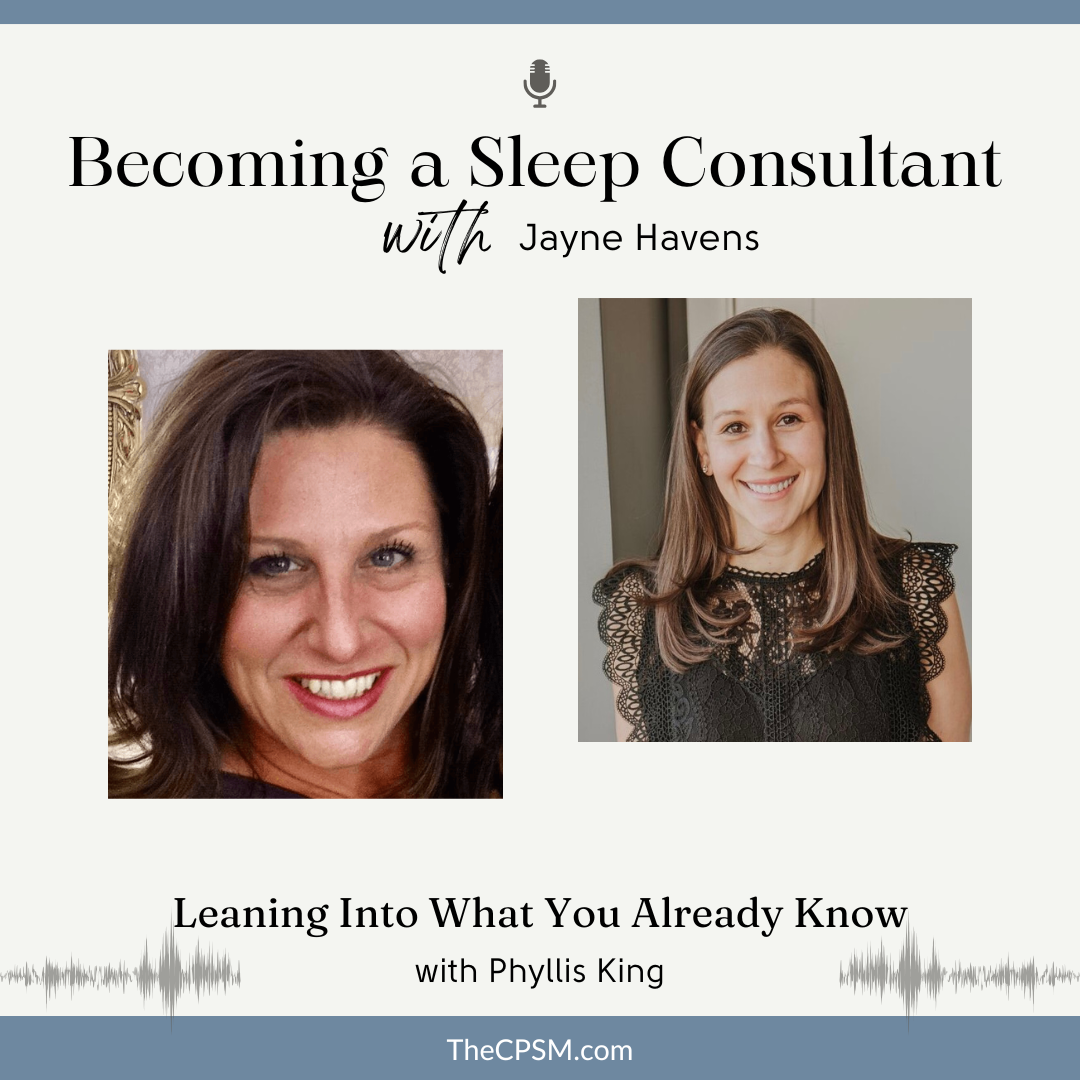

This week on the Becoming a Sleep Consultant podcast, I’m joined by Phyllis, a former teacher, school social worker, daycare owner, and mom of four who is now building a thriving sleep consulting business. leaning into what you already know
Phyllis shares what it’s looked like to start over professionally, how she leaned on decades of experience with children and families, and what she’s learned in her first year of business. We talk about the steep learning curve of entrepreneurship and how she’s grown by leaning into her strengths instead of forcing herself to market like everyone else.
You’ll hear how she’s built her business largely through in-person connections, local partnerships, and referrals, and why that approach has worked so well for her. It’s a really encouraging example of how experience, warmth, and consistency can carry you far in this work.
Links:
Website: Beyond Sleep Solutions
Instagram: @beyondsleepsolutions
If you’d like to learn more about becoming a Sleep Consultant, please join our Facebook Group: Becoming A Sleep Consultant
CPSM Website: Center for Pediatric Sleep Management
Book a free discovery call to learn how you can become a Certified Sleep Consultant here.
Transcript:
Intro: Welcome to Becoming a Sleep Consultant! I’m your host Jayne Havens, a certified sleep consultant and founder of both Snooze Fest by Jayne Havens and Center for Pediatric Sleep Management.
On this podcast, I’ll be discussing the business side of sleep consulting. You’ll have an insider’s view on launching, growing, and even scaling a sleep consulting business. This is not a podcast about sleep training. This is a podcast about business building and entrepreneurship.
This week on the Becoming a Sleep Consultant Podcast, I’m joined by Phyllis, a former teacher, social worker, daycare owner, and mom of four who is now building a thriving sleep consulting business.
Phyllis shares what it’s looked like to start over professionally, how she leaned on decades of experience with children and families, and what she’s learned in her first year of business. We talk about the steep learning curve of entrepreneurship and how she’s grown by leaning into her strengths instead of forcing herself to market like everyone else.
You’ll hear how she’s built her business largely through in-person connections, local partnerships, and referrals, and why that approach has worked so well for her. It’s really an encouraging example of how experience, warmth, and consistency can carry you far in this work.
Jayne Havens: Phyllis, welcome to the Becoming a Sleep Consultant Podcast. I’m so glad you’re here today.
Phyllis King: Thanks, Jayne. Thanks so much for having me. It’s a little exciting being on your podcast. I’m not going to lie.
Jayne Havens: It’s exciting for me too. It’s exciting for me too. Before we get started, tell everybody a little bit about yourself. Tell us what you were doing before sleep consulting came into your life, and then we’ll take it from there.
Phyllis King: Okay. So I started out as a teacher. I taught kindergarten for 12 years. I taught in a very urban district. It was very challenging. Then I was the school social worker in the same school. I worked for some time with students, working with parents, and then I left when my four kids were under five. It didn’t really make sense to put them in daycare and go back to work full time, so I left my career. I left it behind. I was home with my four kids for 10 years.
Then I wanted to get back into the workforce, and my career just didn’t want me, Jayne. I had friends who were administrators and principals in school districts, and they said, “You’re too expensive.” They said, “Your experience, your education, just you’re out of the market. You were looking at kids right out of college.” And so I sort of found myself careerless. So then I started thinking about, what can I do to make money and use the skills and the knowledge that I already have? Because I didn’t want to go work retail, and I didn’t really want to go back to school for something else. I wanted to use what I was already passionate about and what I already knew.
So I opened a daycare. I did that for 13 years, and that was amazing. I mean, it was 13 years of the happiest — it was a great job. So what I knew was that, when my last kid graduated from high school, I knew I wanted to downsize. I knew I wanted to move to a warmer climate, and I knew that my daycare needed to end. So as much as I would have liked it to be forever, I knew that it wasn’t going to be because I needed to go in a different direction with my personal life. So that led me to start thinking about, what kind of an online business can I start?
What can I start now and start putting in place and growing so that in a couple of years, I’ll have an online job? I looked into a lot of different online options, and none of them really landed with me. None of them really felt like this is the one you should do. Then I randomly found Kerri in a Facebook group. She was talking about parent coaching and sleep coaching. And I was like, “Wait a minute.” I said, “This is something that speaks to me.”
Because I’ve been dealing with little kids and parents, literally, my entire life—a career spanning over two decades. And when I ran the daycare, parents would ask me sleep advice about their older kids or their babies. Or they would bring them to me their baby and say, “Well, my baby needs to be rocked to sleep.” And I would be thinking, that’s not really practical. The parents would say to me, “I don’t understand how you get all these kids to sleep at the same time. Are you magic?” And I’m like, “No, I’m just really consistent.” So it was something that I had been doing.
And because I have four kids and a lot of experience, parents would always come to me and ask me other parenting questions and things they needed to know about anything else—potty training or whatever. I had great relationships with all my family. So I would just talk to them and could tell them what they needed to know, or tell them about my experience.
Whether it worked or not, I always had a great rapport. So when I randomly found Kerri in a Facebook group and she was talking about sleep consulting and parenting, I was like, I don’t know why I’ve been wasting my time looking at some other online models. I’m like, “This feels right to me, because this is an extension of what I already know.” And again, kind of like how I started the daycare, how can I use what I already know? I already have transferable skills. I already know so many, so many foundational things. So it just felt right. And so I found you.
Jayne Havens: And so you’ve been in business for about a year. I guess what I want to talk to you about today is what it’s looked like for you to grow your business. You mentioned, when we were talking privately offline, that you’re not into social media. You don’t love to create content. That’s not really your thing. Can you share a little bit about what it’s looked like for you to build a clientele over the past year?
Phyllis King: Sure. I think right out of the gate, I started getting clients from referrals from people I already knew, who knew that I started this business and knew my background. And so my first paying clients came from referrals from friends who knew people with babies. Then it started to take off from there. I mean, honestly, the first year of business, I don’t want to say I struggled, but I certainly learned a lot.
When I became a sleep consultant, the funny thing is, you think you’re going to be really good at the thing. And you could be really good at the thing. Then there’s this whole other thing on the side, about the business building end, that you don’t know. Sure, it’s covered in the course. There’s a lot of great information on business building in the course. But like anything else, the practical knowledge in application can look very different. So when I started to apply that knowledge, it was just — I don’t want to say I was overwhelmed, but I’m like, “Wow. I really have a lot to learn about the business building end of this.” And so I did.
My business grows kind of slowly, but I really want to learn those pieces of the business building before I jump to the next thing. I kind of want to master something, kind of get better at it, be comfortable with it before I jump into the next piece of the business end. Because the business end is what I don’t have the experience with. The parents and the babies, I’m so comfortable. Supporting families, that’s so comfortable and natural for me. It’s the doing the business part for me that’s like, “Oh, I got a lot to learn.”
Jayne Havens: I understand where you’re coming from, where you feel like that’s where your biggest learning curve is, 100%. And I would agree with you. However, I think you’re perhaps giving yourself not enough credit. Because while business building feels perhaps foreign and overwhelming to you, what I’ve noticed about you is that one of your core strengths is just your people skills.
Phyllis King: Thank you.
Jayne Havens: You present so approachable and so warm and so trustworthy and patient.
Phyllis King: Thank you.
Jayne Havens: You’re a listener. These are all things that I’ve noticed have allowed you to get a decent start in your business, even if you feel like you’d rather be double the size that it is now. When I look at entrepreneurs that are one year into their business, a service-based business, many of them don’t have those core skills that you do. I think that that’s what sort of allowed you to get a decent start.
Phyllis King: Thank you, Jayne. I really appreciate that, and I do agree with you. What I don’t know in the business-y world, I learn. If it takes me some time, I learn it. But in terms of building my business, I do lean into what I already know. And I’ve always been able to do that. I’ve always been able to take what I already know. What skills do I already have, and how can I move the needle using what I already have? And on the back burner, I’m also learning the new things. But at the forefront, I’m leaning into what I already know.
Like when I started the daycare, I didn’t know anything about running a daycare. But I knew about children. I knew how kids learn. I knew about structure, and I knew how to support parents. So I started with that. And the rest of it, I learned. So this is the same. I lean into my existing strengths. And then the other stuff, I am quietly learning on the side.
Jayne Havens: Can you tell me a little bit about what putting yourself out there has looked like for you in the first year of your business?
Phyllis King: Yeah. So, again, I hate making content. I’m not going to lie. I understand that there’s a lot. Social media, there’s a lot of influence. People are on it. Particularly, the demographic that I’m marketing to, they’re big into social media. I did work with Allison Henderson, and I love her. I love her energy. I learned so much from her. But I’m not going to lie. Making content, to me, just feels like I would rather stick a pin in my eye.
Jayne Havens: Me, too.
Phyllis King: I do it, but it doesn’t come naturally. I loved her course, and I loved working with her. But for me, leaning into personal connections is really how I am growing more than I am on social media.
Again, that’s also like a back burner piece for me. I’m still trying to learn that. I haven’t thrown that out, but I’m leaning into connecting with people in a parallel niche in my area. Because in my area, people know me as the daycare person. I have a fairly wide reach, and so I use that. I connect with other people in my geographic area who are in a parallel niche, where we’re supporting the same clients, and we can collab and work on some things together. So that’s really what I’m leaning into.
Jayne Havens: Can you share who are these people? Are they pediatricians? Are they occupational therapists? Are they family photographers? Who are these people that you’re connecting with? And if you’re willing to share, what does it look like for you to build these relationships?
Phyllis King: Well, so my first collab was so random. I was in business a few months. I was getting some referrals, and then I was thinking I need to grow. I need to connect with other humans. On social media, things pop up. The algorithm reads you, right? So the new mom school near me was opening, and I thought to myself, “That would be a great collab.” So I just did a little digging, and I did a little research. I just cold emailed the owner. I was like, “Hey, listen. This is what I’m doing. Would you like to meet up?”
She’s like, “Yeah, let’s get coffee.” So we met up, and we met at Starbucks. We connected. She said, “I’m actually looking for a sleep consultant because that’s a component of our classes, our baby classes.” So we went and we met. We talked about what it would look like for me to come on as their sleep consultant. She loved that I am a legit business, that I have training. I’m certified. I have an LLC. Because she’s a franchise. So those things are important to her.
She said she did speak to other sleep consultants who were not certified. They just had read a lot of books and helped a lot of people. So she sort of like that I had all my business docs in a row for her franchise. She also liked that I have a lot of experience, that I could come in and talk to moms in a relatable way.
Honestly, there’s nothing you can say that will frighten me. There’s nothing you could tell me about your baby, or your toddler, or your six-year-old that will scare me. I’ve probably seen it, heard it, done it, parented myself through it. We got really comfortable with each other. And so I ended up being on her staff as the visiting sleep expert. So that was great for me, because it puts me in front of a group of new moms.
Every eight weeks, there’s a new cohort coming in. So I go in and I get to talk to these brand new, fresh-faced moms, and I love it. It’s just amazing. We have great conversations. They can reach out to me. So that was my first. Let me just put myself out there. I mean, it doesn’t hurt to ask, right? It worked out in my favor. I do reach out to people who I know who know people, and I’ll ask, “Could you make a warm introduction? Would you mind connecting us?” Usually, my friends are like, “Sure, I’ll make the connection.” They’ll put us in a group text, and that person will say, “Yes, I’d love to meet,” or they’re not.
Sometimes it works out. Sometimes it doesn’t. If it does, my friend backs right out of the conversation, and that person and I make our own relationship, and then we go from there. So that’s really how I’m sort of building my personal relationships. Now, people are reaching out to me and saying, “Hey, I follow you on Instagram.” And I’m like, “Really?” I’m shocked that somebody would find me on Instagram and might want to work with me. Because I think my Instagram is cringey and horrible and novice at best.
I had a lactation consultant reach out to me, and we’re meeting tomorrow. We’re having lunch, and we’re going to talk about — she runs an agency where she works with lactation consultants, doulas, sort of a whole childbirth and new mom sort of agency. We’ve met a few times on Zoom. We’ve met in person. Tomorrow, we’re having lunch to hammer out what our next collab is going to look like. So yeah, it’s things like that.
I’ve connected with a concierge pediatrician—we’ve had some great conversations. She and I are working on a workshop—preschool owners. So yeah, just if I know somebody, the in between, I make the ask. Sometimes it’s just someone and I will follow each other, and we seem to resonate and be on the same page. Sometimes I’ll just shoot them a message and say, “Hey, how would you feel about collaborating on a post?” That leads to another conversation. It couldn’t hurt to ask.
Jayne Havens: There are so many little nuggets of wisdom that you share that I don’t even think you realized are so great. I sort of want to go through them. I wish I had been writing them down as you were saying them. But I love that, first of all, you are willing to meet people in person. I think that this is something that many new entrepreneurs, especially those in a younger generation, are really uncomfortable with.
There’s so much value in face-to-face connections—sitting across the table from somebody, enjoying a cup of coffee or grabbing lunch, and actually getting to know them as a human being beyond, I think, what you’re capable of accomplishing on a 30-minute Zoom call, right? There’s just a different level of connection when you’re willing—
Phyllis King: Yes, it’s a different level of energy. It’s like going to a live concert. You can listen to the music, and it’s great. You can go to that live concert, and the energy, you can’t match that energy of anything in person.
Jayne Havens: The fact that you’re doing that, I think, is 100% working in your favor. When you actually meet someone in person, all of a sudden, you feel like you know them. They become a friend, or a colleague, or somebody in your circle of trust—as Kerri always says, right? That is so valuable.
The other thing that I think is amazing that you’re doing, that I do as well, is that you’re leveraging your personal connections to make professional connections. I do that all the time. If I have a friend that’s friends with a pediatrician that I don’t really know on a personal level, but I want an introduction to that pediatrician, I’ll ask my friend, “Hey, can you introduce me to doctor so and so? I’d love to meet with them and speak with them about how I can help their patients.” That’s always way more effective than just cold outreach, in my opinion. So the fact that you’re doing that is also super smart.
Then this isn’t really a tip. I think this is just something that’s working in your favor. I want to draw attention to the fact that you have decades of experience working with families and working with young children. I think people always say to me, when women who are not in their 30s come to me and they’re interested in becoming a sleep consultant, and they’re like, “My kids are grown,” or, “I have grandkids,” or, “Am I really a fit for this? Will parents relate to me,” I actually see it as an advantage that you’re coming in in the little bit of a different season of life than these brand-new moms.
Because sometimes, I feel like when super young sleep consultants are going in and telling brand new parents how to parent, there can be a little bit of feeling of judgment.
Not that the sleep consultant is being judgmental. But it’s sort of like having your peer tell you how to parent sometimes feels not great. This is something that I’ve noticed. That if you have more experience under your belt, if your kids are grown, you’re sort of approaching this from a “I’ve seen it all,” there’s no judgment. There’s no shame. I just have a lot of tools in my toolkit. I have a lot of experience, and I’m bringing that collective wisdom to help you. I think that new moms really appreciate that. I think young moms really appreciate that. Do you find that? Do you find that they trust you and almost just want to melt into your wisdom a little bit?
Phyllis King: I do. I do. I find that when I’m speaking with new moms, especially first-time moms. They have moms, but then I have all this other, you know. When I say to people I had four kids in five years, they’re like, “You did what?” I’m like, “I survived. So I just want you to know that whatever you’re going through, this is survivable.” I have a lot of stories. I have a lot of anecdotes. I have a lot of the experience. But I can diffuse an anxious mom pretty quickly. Because I just know when that mom needs a break intention, and she’s really keyed up and really upset about something.
I’ll talk her down a little bit—again, no judgment. Then I’ll throw in an example of, “Listen, when my kid was, you know—” It worked out fine. And they’re like, “Oh, really?” They’re like, “So you think it’s okay?” I’m like, “Yeah, it’s going to be okay.” I feel like knowing that someone else also struggled with something common, or has a comical story—I can add some humor to it—it breaks the ice. It diffuses the tension, and it builds some trust. My kids have done some stuff, so I have a lot of anecdotes. I can speak to almost anything. You give me a situation, it’s on my bingo card, Jayne.
Jayne Havens: Right. Between your own children and all the kids you’ve cared for in a school setting, and in a daycare setting, literally, it’s on your bingo card. I think that’s really reassuring and comforting to parents who are experiencing everything for the first time. And if you are working as a sleep consultant or a parent coach yourself, you’re sort of in that new phase of motherhood, and you don’t have 20 years or more of experience supporting families, sometimes it’s harder to build that trust and really have those moms just melt into you from a comfort perspective. I felt that in the beginning of my career. The fact that you’re one year in, but you don’t have that obstacle, I think, works to your advantage.
Phyllis King: Thank you. Yeah, it is. It is really sweet. I’m a Gen X-er. I’m not old enough to be a grandma. My kids are in college. On the one hand, I’m not that tech-savvy generation that’s creating content and it looks fabulous. But on the other hand, I have something that that generation doesn’t have. I have the gift of experience and wisdom and knowing on the back end that it is going to be okay.
Even when you’re in the thick of it and you think it’s the worst it’s going to be, it’s still going to be okay. Because you love your baby, then everything that you do is going to try to move the needle toward nurturing the baby and taking care of the problem with support. So I lean into that.
What I lack in younger mom skills, in terms of tech, yeah, I do. The moms do. Some of them say to me, “What am I going to do without you, when our two weeks is over?” I’m like, “You’re going to be fine because you learned.” My goal is to teach you.
Teach a man to fish. My goal isn’t for you to be dependent on me. And if you get stuck, you can reach out to me.” And they do. Sometimes they just check in with me just to let me know that their kid is doing great. Or they have a little obstacle, and I’ll say, “Okay, well, your baby is a few months older now. You probably need a schedule change. Pull out that sleep chart that you have, and let’s take a look at that. All right. What can we do?” And they do. They reach out to me for little things and sometimes big things.
Jayne Havens: Are you finding now that most of your clients are coming to you by way of former families that you’ve supported are now sharing your name with their friends? Is that what it looks like?
Phyllis King: Yes, that’s what it looks like now. Many of my clients come to me through referral. All of January came from referrals. So that’s mostly what is happening. Or a mom just reached out to me recently and booked a call because I spoke to her group. I spoke to her mom group back in August, but she didn’t need me back in August. But she thinks she might need me now. And so she remembered that I came out. She remembered that, for some reason, she resonated with me. I just talked. I answered questions. It was really informal, but she remembered me. She kept my information and reached out to me. She booked a call.
It’s funny, because she said, “We’re just in the information gathering stage. I don’t know if we need to hire someone, but I’m just getting information.” I said, that’s fine. I took the time to talk to her. But then we started talking about an unrelated sleep issue with her toddler. I said, “Oh, yeah.” I said I had the same issue. It was constipation, right? So we were talking about that. I said, “Yeah, my daughter was constipated too.” So then we started talking about that.
And so now we’re done with the initial 15-minute call. And when we were done chatting, she said, “It was so nice to talk to you.” She’s like, “It was such a nice conversation. Even if we don’t decide that we need support with sleep, I’m pregnant now. I’m having another baby. I might reach out to you. Can I stay in touch with you?” I said, yeah. I said, “Follow me on Instagram. You can always message me there.” Whether she turns out to be a client or not, she appreciated the conversation. I was happy to tell her what I know about constipated toddlers, because I had one.
Jayne Havens: Right. And so that person, whether she becomes a client or not, remains to be seen—TBD. But I would imagine, if she doesn’t circle back herself, she’ll certainly tell friends about you.
Phyllis King: Absolutely.
Jayne Havens: What you did was you offered value just to serve rather than to sell. I love that. Show up to serve. You don’t always need to be selling. And even if she decides she doesn’t need support, I bet when her friends are complaining that they’re up every 45 minutes with their babies, she’s going to share your phone number or your Instagram.
Phyllis King: Correct. She might not be a sale, but she may lead to a future sale. And if that doesn’t happen, we had a great conversation.
Jayne Havens: You mentioned to me privately that January has been a really big month for you. I hope it’s okay. I’m going to share that you doubled your typical client load for this month than what you’re typically supporting month to month. Do you have any explanation for that? Do you feel like that you’re just gaining momentum? Do you think it’s like New Year’s resolutions? Why are you slammed in January?
Phyllis King: Yeah, you know what? I was thrilled because, coming off the holidays, it’s great to start the new year off with double my client load, what I normally support. I attribute it to momentum; in that I have more happy clients now who are referring me. I don’t want to say I’m not working as hard to gain business, because I’m always working on my business. But my former successes are now working for me, so there’s some of that. And also, January is January. January, it’s a reset. And not so much because the calendar turned the page. But when you think about the holiday season, the holidays aren’t just a couple of weeks in December, with Christmas and Hanukkah. It starts on October 1st, Jayne.
Remember when you were a kid, and Halloween was one day? You looked forward to trick or treating on that one day? Well, now it’s like a hell of blast the whole month of October. It starts on October 1st. There’s a trunk or treat every weekend. I’m watching all this play out on social media. Because I don’t like to create content; I do like to watch. I’m watching parents change a costume—this trunk or treat, this party, this farm has a thing going on. So it starts in October. Forget Thanksgiving. Thanksgiving isn’t even a holiday anymore. They’ve just glossed right over that and gone right into the December winter holidays. And then it’s all of that.
I think parents are exhausted after three months of non-stop holidaying. It used to be Halloween was a Day, Thanksgiving was a day. And then mid-December, you rolled into the Christmas and Hanukkah season, and then you were done. Now it is a non-stop holiday fest. It is three months long. Parents don’t have a break to come up for air. Kids are overstimulated. They need a reset. So January is January. I think people were waiting to say, “Alright—” Not that it was a New Year’s resolution. But let me get through this block.
Also, parents have FOMO. So it’s hard sometimes to say, “You know what? We’ve already done three trunk or treats. Let’s just scale that.” They want to go. They want to make the memories, create the memories, and take the pictures. And so they’re going and going and going. So, January, for me, I think is just a reset. For a lot of my clients, it’s a chance to just slow down, dial down, and then concentrate on reset, refocus. I’d also like to think that’s what’s also my referrals gaining momentum and snowballing a little bit. So maybe a little of both.
Jayne Havens: Yeah, I think it is both. I also had a killer January. It was probably my busiest month ever since starting Center for Pediatric Sleep Management back in 2019. Because once I started training others to do this work, I really tried my hardest to scale back my client support a little bit, just because I needed to manage both sides of my business. This January was sort of like what my business looked like before I was training others. It was wild. And I think you’re right, that families are on overdrive all fall, the entire—
Phyllis King: All fall. Not even a season anymore. It’s a whole—
Jayne Havens: Yeah, all fall.
Phyllis King: All fall.
Jayne Havens: They are out of their routines. The kids are up late every night. There’s treats. There’s outings. There’s all sorts of special circumstances. And you’re right. I think January is when parents finally have a moment to take a breather. And I think, in your situation, absolutely, you’re building momentum. It’s all starting to click. I hope that February looks similar for you, and March, April, May. Where do you want to be a year from now? What do you want your business to look like?
Phyllis King: I mean, when I started this, the goal was — because I knew I was downsizing, I knew I was going to be moving, and I needed to close my daycare, the goal was always to start an online business that would grow and eventually be my full-time income. So I would love to see my business at least double in the next year. I would really love to just get more reach. I would love to connect with more professionals, that we share a niche, and have more referrals coming in from that. I mean, really, I would love to just support more families.
Jayne Havens: Yeah, I think you’re going to. I’m really excited to see what the next year brings. I think the one-year mark is really, oftentimes, where people start to feel like they have it figured out a little bit. It’s starting to happen with a little bit less hustle and a little bit more just word of mouth and referral. I see that happening for you, which is really exciting. I know that you’re not a social media person.
But before we wrap up, I do want you to share your social media, because I am proud of you for stepping outside of your comfort zone and creating an Instagram account. So tell people where we can follow along, and thank you so much for being willing to share candidly your story.
Phyllis King: You’re so welcome, and I was happy to do that. So my Instagram is @beyondsleepsolutions. That’s also my business name. So you can find me there making cringey videos talking about sleep. Although, I will say I get a lot more views and traction when I’m just talking to the camera, as much as I hate it. Because it’s not my thing.
As much as I don’t like it, it does give me more traction. So I’m going to work on that. That is another goal for year two of business. It’s to also get more comfortable with social media. Because I know that I need that as part of my business. But the main crux of it is going to be my personal relationships, because that I feel is really where my strength lies.
Jayne Havens: Yeah, well, I think the reason for why you get so much action and views on your videos where you’re talking to the camera is exactly what I said in the beginning of this episode—that your secret sauce is your personality, your warmth, and just your whole aura and vibe. And so when people see that, whether it be in person or online, people are drawn to that.
So, as much as it feels cringey, I do think that you should keep doing it. You’re really good at it. Keep up the good work. I’m really proud of everything that you’ve done over the past year. This really is just the beginning, right? Entrepreneurship is a long game, and business development takes years. I think you’ve really gotten off to a solid start, so you should be really proud of yourself.
Phyllis King: Thank you. I appreciate that.
Outro: Thank you so much for listening to this episode of the Becoming a Sleep Consultant Podcast. If you enjoyed today’s episode, it would mean so much to me if you would rate, review, and subscribe. When you rate, review, and subscribe, this helps the podcast reach a greater audience. I am so grateful for your support.
If you would like to learn more about how you can become a certified sleep consultant, head over to my Facebook Group, Becoming a Sleep Consultant or to my website thecpsm.com. Thanks so much, and I hope you will tune in for the next episode
Thank you for your message.
We will contact you shortly!