
Jayne Havens is a certified sleep consultant and the founder of Snooze Fest by Jayne Havens and Center for Pediatric Sleep Management. As a leader in the industry, Jayne advocates for healthy sleep hygiene for children of all ages. Jayne launched her comprehensive sleep consultant certification course so she could train and mentor others to work in this emerging industry.

Meet Jayne Havens
Interested in Becoming a
Sleep Consultant?
Join Our Free Facebook Group
Adding Sleep Consulting to Your Doula Business with Deb Pocica
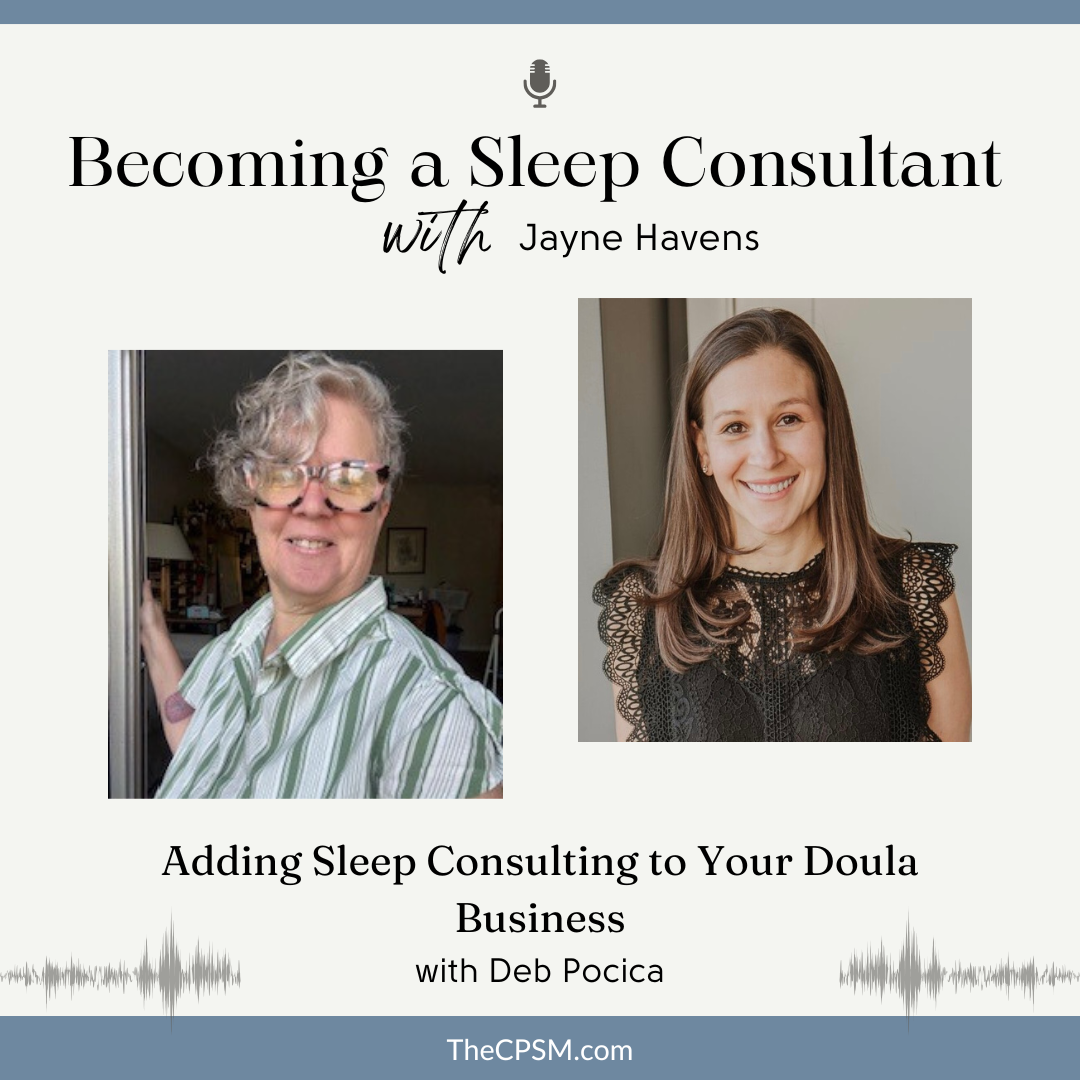
This week on the Becoming a Sleep Consultant podcast, I’m joined by Deb Pocica, a postpartum doula who added sleep consulting to her business and saw an immediate shift in the way she could support families.
In this episode, we talk about:
- Why sleep consulting is the perfect complement to postpartum care
- How sustainable systems can prevent burnout for doulas and sleep consultants
- What expanding your services can mean for both your income and your energy
The truth is, postpartum care often ends right when families need continued guidance the most. Sleep consulting fills that gap. It extends support beyond the newborn phase, strengthens relationships, and positions you as a long term resource instead of a short term solution.
If you are a doula or newborn care specialist thinking about how to grow, diversify, or prevent burnout in your business… this episode will give you a lot to think about.
Links:
Website: Deb Pocica
If you’d like to learn more about becoming a Sleep Consultant, please join our Facebook Group: Becoming A Sleep Consultant
CPSM Website: Center for Pediatric Sleep Management
Book a free discovery call to learn how you can become a Certified Sleep Consultant here.
Transcript:
Intro: Welcome to Becoming a Sleep Consultant! I’m your host Jayne Havens, a certified sleep consultant and founder of both Snooze Fest by Jayne Havens and Center for Pediatric Sleep Management.
On this podcast, I’ll be discussing the business side of sleep consulting. You’ll have an insider’s view on launching, growing, and even scaling a sleep consulting business. This is not a podcast about sleep training. This is a podcast about business building and entrepreneurship.
This week on the Becoming a Sleep Consultant Podcast, I am joined by Deb, a postpartum doula who added sleep consulting to her business and saw an immediate shift in the way she could support families.
In this episode, we talk about: why sleep consulting is the perfect complement to postpartum care, how sustainable systems can prevent burnout for doulas and sleep consultants, and what expanding your services can mean for both your income and your energy. The truth is, postpartum care often ends right when families need continued guidance the most. Sleep consulting fills that gap. It extends support beyond the newborn phase, strengthens relationships, and positions you as a long-term resource instead of a short-term solution.
If you are a doula or newborn care specialist thinking about how to grow, diversify, or prevent burnout in your business, this episode will give you a lot to think about.
Jayne Havens: Deb, welcome to the Becoming a Sleep Consultant Podcast. I am very excited to chat with you today.
Deb Pocica: Hi. I am so excited to be here and to share all the things. Let’s get going.
Jayne Havens: Yeah, let’s. Before we jump in, why don’t you share a bit about yourself and what it looks like for you to support families?
Deb Pocica: So I have been in the doula world for about 20 years. Now, I started out as a birth doula. Then about seven years in, I switched over to the postpartum side. And as I was doing the postpartum side, I started thinking more and more about sleep shaping and sleep training. And so I think it’s probably been about six years now. So that’s really brought some big changes and adjustments. It has made this a little bit more exciting and profitable, too, honestly.
Jayne Havens: I want to talk a little bit about — I know just, from you and I having prior conversations, that you used to have some really strong feelings about sleep training and maybe what you thought it looked like or what you thought it meant. I don’t know. I don’t want to put words in your mouth. But if you’re willing to share a little bit about sort of how you used to feel about it and how you feel about it now, I think that that would be really interesting for everybody to hear.
Deb Pocica: Yes, so I have five kids myself, which I don’t usually talk a lot about. When they were born, my last three were very close together, so I had three under three. I was a super attachment parent, and so I didn’t sleep really. I saw how dangerous it was at times, how unhappy I was, how it really hurt my mental health at times. I mean, I could drive and I don’t even remember where I’m going. So it was not a healthy time for me because of that.
So even when I started out as a doula when they were still little, I was kind of judgmental on people’s choices. I thought that my way was the only way. And so I pushed a lot of things that now I look back on and see how judgmental that was, and started to change my thinking. When I started thinking that I wanted to be non-judgmental, that was when things started to flip for me because I wasn’t putting my thoughts into people heads. That was such a huge shift. And then COVID happened. That also made me rethink some of my own choices and thoughts.
Then I had a postpartum client very early on that said to me that she specifically wanted overnight help, so that she could be the mom that she wanted to be during the daytime. That was a huge light bulb for me that clicked. Because she was a stay-at-home mom. I thought, “Gosh. Why is she even having me?” She can sleep whenever she wants. But that, that was the point that really got me pushed over to the side.
Jayne Havens: Yeah, because you didn’t have that in your own parenting journey, right?
Deb Pocica: Exactly.
Jayne Havens: You didn’t have a full night of sleep so that you could show up as the mother that you probably, in hindsight, would have really loved to have been, right?
Deb Pocica: Yes.
Jayne Havens: And then seeing this mom be so aware that she wanted to get a full night of rest so that she could show up as her best self, that’s really great perspective.
Deb Pocica: Yeah, it was quite the change.
Jayne Havens: Was there a moment, whether it’s a client that you were supporting, was there a moment in your journey as a doula that really allowed you to shift your opinions around sleep shaping and sleep training? I know you said that you decided that you wanted to be less judgmental, which I think is a really big thing to admit out loud. I think that’s very mature of you. But I’m wondering if there was a moment—whether it was a family that you were supporting or something that you saw—that really showed you, like, this is different than I thought it was?
Deb Pocica: One of my early postpartum clients mentioned that they were going to do the Ferber method, and I audibly gasped. She said, “But no, it’s not what you think.” And so I had to read the book because I had tons of information that I assumed were in that book. Once I read it, I had a different perspective on what all of this looks like.
Jayne Havens: Yeah, right? It’s not what all the angry people say on the internet.
Deb Pocica: Right.
Jayne Havens: Okay. I love that. You just took matters into your own hands, and you said, “I’m going to educate myself rather than just having strong opinions that aren’t really grounded in anything other than strong opinions,” right?
Deb Pocica: Right. That’s one of the things that I say now all the time, is read the books that you think you hate.
Jayne Havens: Right.
Deb Pocica: It can completely change your life.
Jayne Havens: Yeah, I think that’s great advice. And you know, even the books that I love about infant sleep or toddler sleep, there’s always something in the book that I don’t love. There’s no perfect book. I mean, I’ve read almost all of them. Some I like more than others, but there’s always something in every book that’s like, “Ugh, really? Are they really saying that?” That doesn’t mean that you have to throw the book in the trash. It just means that you take what resonates with you, and you leave the rest.
Deb Pocica: Exactly. That’s what I get to do now more than anything else. It’s really work on what I think and then what I can share with parents. And they can do the same thing—take or leave what they choose to do.
Jayne Havens: So how has your business, working, supporting families as a postpartum doula, shifted now that you have these tools as a certified sleep consultant?
Deb Pocica: Usually, I am booked at least six months out. I have clients that want me back again for baby number two and baby number three, that I am the first person that they talk to when they find out they’re pregnant. They know and then they immediately call me because they went on my schedule. I don’t have to work as hard on the marketing side now because so many families are kind of doing it for me.
Jayne Havens: Do you think that that really is largely about the sleep piece? I know, from personal experience, that when my babies were little, that was my top priority. I just wanted to know that my baby was going to be able to sleep through the night at a reasonable age, like as soon as possible within the realm of what’s developmentally appropriate. Do you find that that’s what your clients are looking for from you? Do they know you as that postpartum doula that’s going to lay the foundation and get that baby on a good trajectory from the beginning?
Deb Pocica: Absolutely. That is how I promote myself. That’s my special little niche that I have that puts me kind of in a different spot than a lot of other postpartum doulas. So it definitely works for me, and it’s what people know me for. One of the things that I say usually is that, when I leave as a postpartum doula, I want you to be able to do this on your own. So I don’t want to be the doula that just wants to hold babies and rock them all night long. I want them to be established and have as good of a sleep pattern as they possibly can by the time that I leave so that you aren’t crashing when I leave.
Jayne Havens: Yeah, I know that what you do over the course of, what, like a 10-hour shift, is probably pretty involved, and it varies baby to baby. But are you willing to share any best practices, sort of things, that are your top recommendations that other moms maybe listening to would benefit from hearing or even other doulas?
Deb Pocica: One of the big things that I talk about a lot is that I want the baby to be happy and get used to their own sleep space. So we do a lot of work with that. I’m also super supportive of swaddling and pacifiers, which can be a big controversy in new-parent land. And so I help people adjust to those types of things and show them that those aren’t nearly as negative as what they might think they are.
Jayne Havens: And they’re just tools to have in your toolkit, right?
Deb Pocica: Exactly.
Jayne Havens: Nothing is forever. Parents often will say to me, like, “Well, I don’t want to swaddle because then we’re going to have to get out of the swaddle.” It’s like, okay. But you know, this is a tool that’s helping your baby now. And when your baby is a little bit older, they’re not going to need that support as much. And so this is just a for-now thing, and we’re going to transition away from that as they get older. Just like they need diapers now, and they’re not going to need diapers later, right? Sometimes when you give them a little analogy like that, they’re like, “Oh, okay. That makes sense.”
Can you share an example of where combining your postpartum support and early sleep shaping has truly changed the family’s experience?
Deb Pocica: Mm-hmm. So I just had someone sent me a testimonial. They talked about: it made us much more comfortable with the whole process of parenting, and I helped. They had postpartum depression a little bit. And so I made a big difference there. But one of our huge things was the fact that I worked with the baby and helped the baby be able to sleep for much longer stretches than they were able to do on their own without my support.
And for the little newborns, it is truly just sleepscaping. I am doing a lot of put them down, pick them up, put them down, pick them up. So it’s not so dramatic for new parents. But it does amazingly well getting them used to their own sleep space.
Jayne Havens: I think what you do is so valuable because parents honestly are just too tired, I think, to put in that type of work overnight. They just, they’re too tired, you know? You could explain to them in great detail how to implement that pick-up-put-down approach that that you mentioned. The problem is: they just are too tired to actually do it. I also think sometimes they’re just a little too nervous. They’re like, “Is this working? Am I doing this right? I don’t know. I don’t understand my baby’s communication yet.”
There are so many nervous variables or nervous feelings that are swirling around in their mind. And someone like you can come in, remove the emotion from it, remove the anxiety piece and just observe and get to work. I think that that’s truly invaluable.
Deb Pocica: Yeah, absolutely. People don’t realize even just how noisy babies are when they’re sleeping. They grunt and they moan, and they kick and they talk and carry on. And if a parent is trying to, they’re sitting there the whole time just waiting to pick them up because they’re making all these sounds, when they’re really still completely asleep.
Jayne Havens: Right. New parents just don’t know that.
Deb Pocica: Exactly.
Jayne Havens: It’s so special that these families get to have this help from you. I truly believe that. Especially, first-time parents, we just really don’t know. We just don’t understand newborn communication the way that you do. Because you’ve probably listened to hundreds of newborns, right? So your sample size is so much greater, and that gives you, I think, a wider lens and greater perspective. I don’t know. I just think it’s so special. I think parents are so lucky to have this type of support, truly.
Deb Pocica: It is. It’s changing so much. It was not nearly as popular 20 years ago when I first started doing this as it is now. So there’s been a huge shift in parent’s thinking and ability to do this.
Jayne Havens: I want to shift gears for a second. I want to go back to sort of how this has impacted you, not just parents. One thing when I talk to postpartum professionals who are interested in becoming sleep consultants, they tell me that they just feel so tired in their work. You know, in order to have a sustainable career and make enough money to really support themselves, sometimes they express that they have to work more nights a week than what their bodies really are telling them they should be working. And you know, so then they pick up an extra night or an extra two nights.
Or instead of after a contract, instead of taking a break and regrouping, they’re going back to back. And after a few years, they’re toast. I want to understand. I don’t want to put words in your mouth. My guess is that the fact that you’re getting these babies to sleep well helps you to actually do the work without burnout out. But I would love for you to sort of help us understand how having these tools to really lay the foundation for helping sleep hygiene for infants has positioned you to have a more sustainable career in this field.
Deb Pocica: Absolutely. So I don’t do some of the things that other postpartum doulas might do. I don’t do food prep. I don’t do a lot of straightening and organizing and all those kinds of things. Because I’m going to spend my time working with the baby rather than wearing the baby and walking around doing all the tasks. And so, for me, that allows me to rest a little bit while I’m at work so that then during the daytime, I am still functional and awake and can do other things that I want to do with my life—rather than just going to work and then sleeping during the day all day.
Jayne Havens: I would imagine, when you’re with a new baby, what, like the first six weeks are a lot of work? Is that on point? Is it like the first six weeks that are a lot of work? Then if you’re doing your job properly, then it starts to really ease up after that?
Deb Pocica: Yeah, even the first two weeks are rough for everyone involved. Those are the weeks that are strictly survival for parents. Once we move past that, once we move to three and four weeks, then things are stretching out a little bit. we have a little bit of a routine. We have a little bit of a schedule going on, and we’ve got at least one longer stretch at night by then. So it makes a huge difference when I started at the beginning.
Jayne Havens: So you’re saying, by three or four weeks, when you say a longer stretch, are you talking like three or four hours at that point? Or even longer?
Deb Pocica: Yeah, about three, sometimes four hours. The baby that I have right now is just four weeks old. Last night, they had a four-hour stretch, which we were all super excited about.
Jayne Havens: Right. I tend to think that if you’re doing really, really intentional sleep shaping, sleep conditioning, you’re getting about an hour a week, right? Like by five weeks, maybe you’re getting a five-hour stretch. By six weeks, maybe you’re getting a six-hour stretch, give or take, right? Some babies, a little less. Some babies, maybe if you’re lucky, a little bit more. But that really positions you, by week five or week six, you could sleep a six-hour stretch on the job. Or at least close your eyes and rest, right?
Deb Pocica: Exactly.
Jayne Havens: And so that makes it way more sustainable for you long term, I would think.
Deb Pocica: Yes. Yeah, if it weren’t for that, I wouldn’t be able to work as much as I do.
Jayne Havens: It’s funny. I was going to ask you about the boundaries or the systems that you have put in place in your work, which allow you to serve families this way, and you sort of touched on that. That you’re very upfront that you’re not going to be the one folding laundry all night long. You’re not going to be the one making protein muffins in the middle of the night, right? But that’s okay. Because the tradeoff is that they are getting a postpartum doula who is really focused on establishing these healthy sleep habits for the baby. Parents know that. That’s what they’re signing up for. That’s what they’re agreeing to. It works for them, and it works for you.
Deb Pocica: Exactly. Once I started really explaining up front when we are interviewing what I do and what I don’t do, I am happier. The parents are happier. We all are doing what we want to do, so it works for everyone. I used to have families that we had a hard time working together. And for years now, I haven’t had that issue because I spend that time up front laying out what my boundaries are.
Jayne Havens: As I’m thinking about it from the parent side, I’m just envisioning myself interviewing you as a postpartum doula. And if I’m interviewing you and I’m interviewing one other postpartum doula the other doula is like, “Oh, I will fold your laundry. I will make you protein muffins. I’ll put up a pot of soup.” That all sounds really lovely. Then I meet with you, and you’re like, “I’m going to get your baby sleeping through the night by 10, 12 weeks.” — I’m choosing you.
Deb Pocica: Yeah, and that’s what happens. When I start talking about exactly what that looks like and what I do, I can see the switch in their brain to thinking, “Oh, wow. This is really more important than the soup.”
Jayne Havens: Yeah, exactly. Exactly. For doulas who are curious about this and interested in becoming certified, maybe adding sleep consulting to their repertoire, what would you say is like the biggest benefit of having this knowledge?
Deb Pocica: That I get to pick my clients a lot more carefully than I did before I had this knowledge. I know who I’m going to work with. I know that we’re on the same page before I even start. So it really has helped me enjoy what I do a lot more so that I can do it longer.
Jayne Havens: Is this something that you think more doulas should be doing? Of course, I’m sure you love that it feels a little niche for you, right? If all of your — I don’t even like to call them competitors. I don’t even think that. I don’t even really look at it that way. I can see everybody is just listening to us, so they can’t see your face.
But, you know, for everybody listening, Deb is smiling and nodding. I think when you’re in a field that is support-based—whether it’s sleep consulting or doula work—I don’t really look at other people who do this work as my competitors. I honestly see them as my colleagues. I think we all have something unique and interesting to bring to the table. I think there are more than enough tired parents to go around.
Frankly, the more of us that are out there doing this type of work, I think, just advances our fields, right? Like the more parents that know about postpartum support or that know that sleep consulting is available to them, it sort of normalizes the support. It normalizes the profession, and it becomes more mainstream. So I don’t love that I just use the word competitor. That doesn’t feel like the right word. But, you know, for others who are doing this work, do you think that more doulas should have this training? Should they have this knowledge? Should they be adding this to their toolkit?
Deb Pocica: You hit on a really big point there about becoming more mainstream. 20 years ago, doulas were not mainstream. It was not normal. It was very alternative. Now more and more families are wanting this. And they want it because of it being a little bit more mainstream and not so set on one specific thought. And so now, when I’m offering this, it makes a huge difference. And so we desperately need more people that are doulas that can offer sleep support as well. Because it is such a growing field right now. It’s so important.
Jayne Havens: Yeah, and I think this generation of up-and-coming parents, most families that I support are two working parents. There’s not the stay-at-home mom and the working dad. It is two working parents. And, you know, maternity leave is short. Whether we think that’s fair or not, it is what it is, right?
Parents are wanting to function in their jobs and also in the home, and they’re wanting to thrive. And so what I think is so amazing is that parents are willing to open their home and open their hearts to this type of support because they recognize that the village is really important. And having a support system, whether it’s family or paid help, is really, to some degree, somewhat necessary in order to thrive in these early stages of parenthood.
Deb Pocica: Exactly. Exactly. Both parents are working full-time jobs now, and there isn’t family nearby to be able to offer help. We have said forever and ever that it takes a village to raise these babies. People don’t have that anymore. And so sometimes they do have to and want to pay for that support so that everybody works really well. My client right now is a surgeon. And so she is going back to work very, very shortly. She can’t be falling asleep in the middle of a surgery, so she needs her rest.
Jayne Havens: I also think it’s important, you know. I know you know this, but I want to say it out loud that there’s so much sort of like mommy martyrdom in society today, right? When you were talking about the surgeon, I was thinking like, “Oh, that’s such a perfect example.” Because there will be parents out there who will say, like, “Well, she has to sleep train her baby—not because it would just be good for the baby and good for mental health, but because she’s a surgeon.
That’s her only choice. She has to sleep train because she’s a surgeon.” But if she wasn’t a surgeon, she could just nurse her baby all night long and all day long, and that would work fine. But that doesn’t work fine for a lot of parents. It just doesn’t, right? And so, yes, that surgeon sort of like has a pass. We’re going to say, yeah, she definitely needs the support. Her baby should be sleeping as early as possible, because that’s in the best interest of society, right?
But also, what if she just wasn’t? And what if she just values her own rest, her own mental health, and her own physical and emotional well-being, and that of her child as well, you know? And so I think the more of us who are out there saying it’s okay to want to establish healthy sleep hygiene for your child—even if that means they’re temporarily upset about the boundaries that you’re putting in place around this, around sleep. I think it’s so important that there are professionals out there saying, like, it’s okay to put this into place for yourself, for your child, for your family because it’s really helpful. It makes everybody feel better.
Deb Pocica: Yep, so many times, I am in a lot of Facebook moms’ groups. And so this comes up, sleep training. Then we have the people that are very, very against it. I’m the one that comes on and says that, “Okay, this is not for everyone. But if this is important to you for these reasons—you want to get sleep. You’re struggling. You’re having a hard time. Nobody is happy. And if you’re not happy, the baby’s not happy. So we’re really not necessarily doing anything good here by becoming so tired—here’s what we can do. And I get so many, “Oh my gosh. Thank you for just saying that this is okay.” Because they don’t hear that all the time.
Jayne Havens: Yeah, and especially coming from someone like you who once thought it wasn’t, I think, is even more meaningful. Maybe all the moms in the Facebook group don’t necessarily know that about you, but I bet that, in time, your postpartum clients do learn that about you, right?
They probably hear because you have plenty of time to connect with them on a higher level. That maybe they do learn that once you were that mom who thought that this was scary, or bad, or dangerous, or all the things that people say, and then you realize there are many ways to look at this. And it’s okay if you want to make a choice that feels hard in the moment but also is in the best interest of your family.
Deb Pocica: Mm-hmm. Exactly. And then I talk about other things, too. Like putting the baby in the car seat, that’s something that they may not like. They may not enjoy the car seat at first, but it’s something that’s very important to everyone involved. It’s safe. And so sometimes we have to do things that are safe that aren’t necessarily enjoyable in the moment.
Jayne Havens: Right. Yeah, the car seat is a perfect example.
Before we wrap up, I want to give you an opportunity to share a little bit about your mentorship program. I know that you have started supporting other doulas as they grow their businesses. I’d love to hear what that looks like and who your ideal doula client is. Tell everybody where they can reach you if they want to learn more from you.
Deb Pocica: So I have, again, kind of a little niche with the doulas that I support. Generally, it is someone that has started because they love this work, and they’re very passionate. But they’ve never had a business on their own before, so they have no idea how to market, no idea how to get clients. They just take all the classes and then sit there and wait and wonder what’s wrong. So those are the ones that I work with.
We do a lot of about how to get your clients and do it in a way that’s comfortable for you. I am also ADHD, so I’m a little on the neurodivergent side. So I work with that kind of population quite a bit. Because we struggle with some things that people that aren’t neurodivergent don’t struggle with. So it’s putting ourselves out there and being kind of public facing, that is challenging sometimes. So we do it in a way that works for us. It’s not just a, “This way or the highway,” which I still hear a lot.
Jayne Havens: I think that what you’re doing is really amazing. It’s much needed. It sounds very similar to what I do inside of CPSM, right? People want to become sleep consultants, but they don’t necessarily know how to put themselves out there, how to market themselves, how to differentiate themselves from others who are doing this work. I love that you’re doing that for the doula community. I love that you’ve figured that out for yourself and now feel empowered to help others.
I meant to look back to see when you originally enrolled in CPSM. It was so many years ago at this point. I feel like you’re one of my OGs, right? And just to see how you’ve utilized the CPSM training, to really morph the way that you’re both supporting families but also the way that you’re showing up in your business, I think is really exciting. Anybody would be so lucky to be in your circle. And before we wrap up, where can people find you? Do you want to share your website, social media, whatever you want to share?
Deb Pocica: So I am on TikTok @debdoulamentor is my handle there. My website is just my name, debpocica.com.
Jayne Havens: Perfect. Deb, I meant to follow you yesterday on TikTok when you sent me all this information. I don’t post on TikTok or anything, but I do like to scroll. So I’m definitely going to add you to my follow list. I can’t wait to follow. And for anybody listening, please reach out to Deb if you are feeling like you’d benefit from some support in this area. Because she’s a 10 out of 10. Deb, thank you so much. We’ll have to do this again soon.
Deb Pocica: Absolutely. Thank you so much. I appreciate it.
Outro: Thank you so much for listening to this episode of the Becoming a Sleep Consultant Podcast. If you enjoyed today’s episode, it would mean so much to me if you would rate, review, and subscribe. When you rate, review, and subscribe, this helps the podcast reach a greater audience. I am so grateful for your support.
If you would like to learn more about how you can become a certified sleep consultant, head over to my Facebook Group, Becoming a Sleep Consultant or to my website thecpsm.com. Thanks so much, and I hope you will tune in for the next episode
Thank you for your message.
We will contact you shortly!