
Jayne Havens is a certified sleep consultant and the founder of Snooze Fest by Jayne Havens and Center for Pediatric Sleep Management. As a leader in the industry, Jayne advocates for healthy sleep hygiene for children of all ages. Jayne launched her comprehensive sleep consultant certification course so she could train and mentor others to work in this emerging industry.

Meet Jayne Havens
Interested in Becoming a
Sleep Consultant?
Join Our Free Facebook Group
Email Marketing for Sleep Consultants with Catherine Reohorn
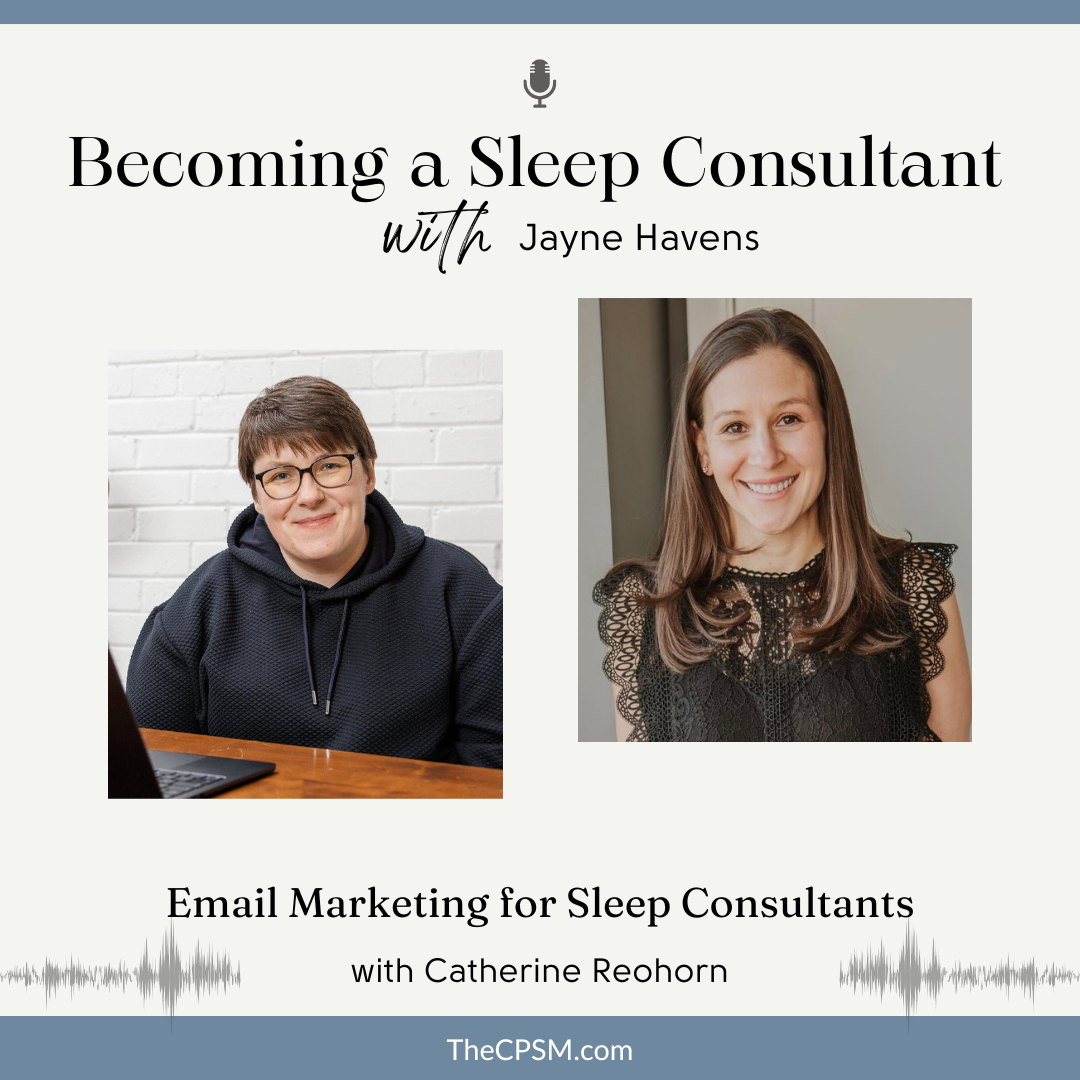

I hired a copywriter to help rewrite my emails, and instead of gatekeeping that experience, I invited her onto the podcast.
Why? Because email marketing is one of the most underused tools I see in the sleep consulting space, and it’s also one of the most powerful when it’s done well.
In this episode, we talk about:
- Why email marketing matters even if your list is small
- Why sounding like yourself is more important than sounding polished
- How consistency builds trust, authority, and referrals over time
One of the things I loved most about this conversation is how much we focused on clarity and voice. You don’t need to sound like a marketer. You don’t need fancy funnels. You need to communicate clearly, and articulate your value.
If you’ve been sitting on an email list without actually putting it to use, or you’ve been overthinking what to say and when to say it, this episode will provide the jumpstart to get you going.
willing to try
Links: willing to try
Freebie: Email Marketing for Consultants
If you would like to learn more about becoming a Sleep Consultant, please join our Facebook Group: Becoming A Sleep Consultant
CPSM Website: Center for Pediatric Sleep Management
Book a free discovery call to learn how you can become a Certified Sleep Consultant here.
Transcript:willing to try
Intro: Welcome to Becoming a Sleep Consultant! I’m your host Jayne Havens, a certified sleep consultant and founder of both Snooze Fest by Jayne Havens and Center for Pediatric Sleep Management.
On this podcast, I’ll be discussing the business side of sleep consulting. You’ll have an insider’s view on launching, growing, and even scaling a sleep consulting business. This is not a podcast about sleep training. This is a podcast about business building and entrepreneurship.
I hired a copywriter to help rewrite my emails, and instead of gatekeeping that experience, I invited her onto the podcast. Why? Because email marketing is one of the most underused tools I see in the sleep consulting space, and it’s also one of the most powerful when it’s done well.
In this episode, we talk about why email marketing matters even if your list is small, why sounding like yourself is more important than sounding polished, and how consistency builds trust, authority, and referrals over time.
Jayne Havens: Catherine, welcome to the Becoming Sleep Consultant Podcast. I’m so excited to have this conversation with you today.
Catherine Reohorn: Thank you so much for having me on. I’m really excited to be here.
Jayne Havens: Tell everybody a little bit about you and what you do professionally, how you help small business owners, and we’ll go from there.
Catherine Reohorn: Okay. Perfect. So I’m going to do my best to speak clearly, because I’m conscious that my accent is quite different from yours. So my name is Cath. I live in Wales, and I run a marketing consultancy called Kind Copy. Our responsibility is to founders who offer services, and our role is to try to help them to get more leads from the audience they’ve already got. I don’t go chasing virality. I’m not into any of that stuff. Generally, we write marketing campaigns, mostly email, so that people who are interested in contracting that service can learn more about the service and we can start having some conversations.
Jayne Havens: So I have to tell everybody listening how we connected. I was just in Facebook groups, doing as I do. I actually don’t even think I was looking for a copywriter, but somebody asked for a copywriter in a Facebook thread. I think somebody recommended you, or you might have recommended yourself. I can’t remember. But something about you—again, details are fuzzy—just made me want to have a conversation with you.
And what I loved about your approach was that you were just willing to help me. You were like, “Send me your emails. Show me what you’re doing. I’ll read through them. I’ll give you some feedback. You can either work with me or don’t, but I’ll share my thoughts.” And I was like, “That sounds lovely. Yes, let’s do that.” And so you read through all of my emails, and you sent me this great little Loom video with lots and lots of thoughts. Most of your thoughts resonated with me. A few of them didn’t. I went back to you with my thoughts. It just was very — it felt so easy to work with you. And I was like, “Yeah, I need that.”
The reason I share that is because I think the people who are listening to this podcast, they’re all small business owners trying to find clients and build a business. And the way that you showed up in your business—just to serve, just to be helpful, nothing else—really, really was very effective. I’m always telling those in my sleep consulting community, stop trying to sell. Just be out there helping people. When you show up, offer support, and do good work, the business comes. I don’t know. It sounds like that’s exactly what you do.
Catherine Reohorn: I think we were so aligned from the jump because of exactly that. When I first started working in my business, I felt really weird about sales. I felt really awkward about having sales calls. I didn’t want to do sales calls. I felt super weird about pitching people anything. I had a lot of hang ups about even selling the service, which, for a marketer, is entirely stupid, right?
But when I replaced the word ‘selling’ in my mind with ‘helping,’ I found that reframe just completely shifted how I showed up, how I approached the process. It became a lot more fun, and I was able to connect with cool people without any real attachment to, what if she doesn’t hire me? I was like, “Well, I’ll just help her and let that be the end of it.” The end of it, in my mind, was helping you. So getting hired was a bonus, but I didn’t assume that that would happen.
And I think you’re right. The more you go into it thinking, “I need to do this so that I get a sale,” the harder the whole process becomes. Because that immediately becomes way more rejection. And if you think, “I’m going to come into this and try to help,” there’s no rejection. You just help all the time. You win all of the time.
Jayne Havens: Yeah, that’s exactly what happened. I think I wasn’t even looking for a copywriter. I just stumbled upon this thread, and you and I had this really wonderful back and forth. I think I remember even saying to you, “I’m not even sure I was looking to hire a copywriter right now, but I really resonate with your business strategy and your communication style.” And regardless of whether or not we work together, I want to have you on the podcast. I want to bring you into the CPSM community. I wanted you to be in my universe regardless of whether or not I hired you. And so now you wrote my emails, and now we’re taking the next step in having this conversation on the podcast.
I guess my first question that I want to ask you is, where do people start when they have a really small list? Is it silly to start sending emails when you have barely anybody on your email list?
Catherine Reohorn: Well, if you think about it, everybody starts with one person on their email list. The way I always think about this is, if you were in a conversation with one single parent who was interested in getting their little one to have a more restful sleep, you wouldn’t ignore them or walk away from that conversation because it wasn’t a little crowd of 10 people. An email is the exact same. You’re just having a personal conversation. You have their attention in private, except you’re able to do this at scale, and you can track their behavior. So think of it in exactly the same way. The way you’d have a private referral conversation, it’s exactly the same.
Jayne Havens: Yeah, and over time, that list grows and grows and grows.
Catherine Reohorn: Of course, yeah.
Jayne Havens: So, obviously, it becomes more fruitful as your email list expands. When you first looked at my emails, what stood out to you about my voice?
Catherine Reohorn: I think the thing that stood out most immediately was the kind and compassionate tone. I think that’s absolutely essential. I won’t write any copy that I think is knife twisting or cruel. It’s in the name of the business, right? Kind Copy. But I think when you speak to people with kindness, you don’t twist the knife and you don’t kick them when they’re down, you empower them with every email, with every interaction, to make the right decision for themselves. They don’t look to you as a rescuer. They are afforded dignity. It’s a powerful exchange. It is full of hope.
So the thing that I really loved about your writing was that you were already aligned with values that I hold, even though we didn’t write particularly similarly. We were quite collaborative, weren’t we, through the process. It wasn’t you’re going to write like me, or that I’m going to adopt your style. It was more that we were both trying to communicate in the kindest way possible to the audience, and I think that’s always an important thing to get on the same page with.
Jayne Havens: One of the business strategists that I worked with years ago said to me something that I’ve held on to it for years. She said, “Rather than digging into a pain point, you should be touching on pleasure points.” I thought that was so great, right? I’ve heard this from copywriters.
I’ve heard it from business strategists. It’s like, “Find the pain point. Dig in. Really lean into why their circumstances are so hard, and that you’re the solution to that problem.” The way she framed communication is that, why not paint the picture of what it could be? Rather than digging into the problem, why not just paint the beautiful picture? So if we’re talking about a baby who’s up every hour in the middle of the night, instead of beating the dead horse how horrible it is that your baby’s up every 45 minutes to an hour, why not talk about what it might look like if your baby slept 11 or 12 hours at night? What would that change for you?
How would your relationship with your spouse look? How would your family dynamic look? Would you be able to watch a Netflix show or clean the kitchen if you wanted to? Would you have time to do all the things if you were getting rest? And I’ve just always held on to that. I don’t like to make people feel bad in emails. I want them to feel hopeful and trusting and that they want to be in my circle.
Catherine Reohorn: Absolutely. I think the more your audience is aware of the pain that they’re in — parents are so aware that they’re not getting a full night’s sleep. They’re so aware that their baby is distressed. They’re so aware of the stress it’s putting on their relationship. You don’t need to remind them. They’re already in a pain state when they come to you. One of the things that is my pet hate about marketing, and email marketing is guilty of it, is find the pain and amplify it. Find the pain and agitate it. Twist the knife.
My entire business is built on the commitment to not doing that. Don’t make the problem bigger than it actually is. Because by the time someone has reached out to you and they’re prepared to solve that problem, if you then pull the rug from under them and you say, “Actually, this is causing even bigger problems,” you look like an absolute horror bag when you’ve only had two hours sleep and you haven’t even thought about that. The problem that that’s really doing is, they were prepared to solve a small problem. Now you’re telling them they’ve got a big problem. That doesn’t make it more urgent. It just makes it feel paralyzing. So that was the first thing I wanted to touch on.
The second thing is the idea that you can empower someone. If they are in a pain state, if you think about it, if you had a friend who was going through a painful time but all they ever talked about was the painful time, eventually, hanging around with that person probably wouldn’t make you feel great. You might try to find a way to cut that time short.
Your marketing is there to help people spend time with you. If everything you talk about makes them want to avoid you, it becomes really difficult to get your message through to them. That’s why pain point marketing has to become so acute and so aggressive, because they’ve only got a small little window to get somebody to make a decision. Whereas if they are moving towards a pleasure state or solving a very reasonable problem, that is exactly how they perceive it, you can take your time with it because they know there’s an issue. That’s why they’re consuming your stuff.
Jayne Havens: Let’s talk about using your own voice versus being effective in communication from an email marketing perspective. This is where you and I, I think, had the most back and forth, because I really wanted to make sure that my tone and my voice and the way I communicated was resonating. But also, from your professional perspective, there’s just a certain way that you want to craft your email so that they’re easy to read and so that people don’t skim them, right? And so how do you balance the two?
Catherine Reohorn: I think there’s a couple of things to distinguish between here. Voice is really about how you put ideas together, whereas making sure somebody doesn’t skim, or that they can skim—this was something that we went back and forth on quite a bit—is more of a formatting thing. So it’s got to be readable, and it’s got to be readable on a small device. But ultimately, what we want is for it to feel like you. That isn’t just about talking in email like you talk with your voice. That’s about the intent and the structure of how you speak.
This is actually a really fun activity, if anybody was trying to write their email marketing themselves. Think about someone who’s got a really distinct pattern of speech in your life. And if you were to do an impression of them, what would you include versus what would you exclude? The simplest hack I can give anybody listening to this who’s writing their own emails is to fire up your Notes section on your iPhone or open up a Google Doc. You can literally use voice dictation to speak your thoughts into existence. So it will write out what you say, and you can actually see what your voice looks like.
The difficulty that I’ve got is, when I come to write my own emails, people say write like you talk, but I wish I could talk like I write. Because I feel like my ideas are so clear in writing, and when I start talking, it’s hard to organize the thoughts in quite as clean a way. So I’d encourage anybody to do that activity, just to see just how jumbled your thoughts can become on a topic you think you know really well. It’s actually a very humbling exercise.
Jayne Havens: Yeah, I really enjoyed the back and forth, because I felt like you were sort of taking my thoughts and making them more concise—not simplifying the message, but simplifying the communication around the message. That is something that I just wasn’t skilled enough to do on my own, you know. It was just not a skill that I had.
Catherine Reohorn: The irony of that, though, Jayne, is the reason that’s difficult for you is because you’re such an expert. So when you have got a level of real expertise and you want to communicate a lot of information to someone, you were generous. I could feel the generosity in your words. So you wanted to give more.
Any pruning, like a bonsai tree, was just to take the shape of what you were saying and clear out some of the leaves so that everybody could focus on the core message. Because you had such clarity and expertise, it was actually very easy to do that, because you had so much meat in the email. It was super easy then to strip back and say, this actually could be a separate email.
Let’s just think about this one idea for now. That’s a lot easier than staring at a blank page and not knowing what to write. Your expertise is the thing that gave us so much material to work with, and then it was just a case of doing the bonsai thing and trimming it back. But it was a wonderful collaboration. I really didn’t feel like either of us were trying to overload the other one or impose our will on the other one. It felt very collaborative to me.
Jayne Havens: Another thing I learned from you, and I’m already seeing the fruits of this, by the way. So I made a little bit of a mistake, what I should have done. Because I’ve had the same emails for, I don’t know, six or so years. Rather than setting up a new automation, I literally just replaced the emails. It’s going to be hard to get data on it because I have so much data from six years. But I can already see it with my own eyes that my call to action is more effective now in my emails than it was previously.
One thing that I learned from you is that my initial email automation was, I think, seven emails, and every single email had a different call to action. The first email was: download my e-book. The second email was: take a listen to the podcast. The third email was: join our Facebook group or whatever, book a call with me. Every call to action was different. And what you said to me is really, just pick one call to action and be consistent with that. Because if you’re pointing people in five or six or seven different directions, that can be overwhelming and confusing.
And so we just decided to stick with the call to action being to get onto a phone call. I am already seeing that I’m getting more calls. So that was great. I’m really excited about that. I really am mad at myself for not setting up a completely fresh automation so that I could really track the data a little bit better. But I can see it with my own eyes, so I feel good about it.
Catherine Reohorn: That’s awesome. I’m so glad that that worked. Because I think when I saw the emails, it’s easy to think about as any one email in that sequence as a standalone email. And so you think, “Well, this is the call to action for this email.” That’s fine if you’re sending out a broadcast.
So for anybody listening to this who maybe doesn’t know and isn’t familiar, there are two sorts of emails that you can send. You can send out an automated sequence, which is a bunch of emails that get sent in a very particular order. They always get sent in that order. You can pre-load them, and they go out automatically. Then there are sort of broadcast emails that you write a one-off email, and you send that maybe on a Monday or a Wednesday or whatever. That does exist on its own.
Those two types of emails do different things. One of the most important sorts of automated sequences you’d have is a welcome sequence, which is what I helped Jayne with. The reason why you want the same call to action all the way through is because you want to be able to measure the effectiveness of that email sequence. So if you’ve got, let’s say, for the ease of math, 10 emails and you make 10 invitations, you’ve got 100% of your traffic getting directed towards the call booking link. So you can measure, of the people who saw this, how many people clicked the link? Of the people who clicked the link, how many booked the call? So you can measure it in a really clear way.
If you’ve got a selection of links, even though it might feel like you’re hedging your bets, what you end up doing is having almost individual singular data, which becomes less effective. Because the emails in a sequence build on each other over time. So there needs to be a congruence in a sequence that maybe is less important in a one-off broadcast. But as I recall, you were super receptive to that correction. You were really on board with, let’s make sure we’re pointing everybody in the right direction. Because when they’ve joined this list, they really needed our help. And so a clear place to go and get that help will help them the most.
Jayne Havens: Look, at a certain point, I have to accept that I am not the expert in everything, and you had really made me feel confident that you know more about this than I did, right? This is why we hire people to help us in our businesses, right?
There are certain things that I feel really confident that I can do on my own, and then there are other things that I feel like I need support with. I think it’s really important in business when you’re trying to grow, to accept the fact that you don’t know what you don’t know, and to trust the people in your circle who you’ve brought on board to get you to the next step in your business. I’ve always been really comfortable with that.
Sometimes you win. Sometimes you lose. But if you’re going to put your trust in somebody to help you, then I’m of the camp that you listen to them. That doesn’t mean that there can’t be respectful dialog. I think I did push back a little bit and say, like, “But what about this,” or, “How come we can’t do it this way?” Every time you explained it to me, I was like, “Okay, that makes perfect sense. This is why I hired you.” Right?
One thing that I hear from sleep consultants often who are thinking about utilizing email marketing in their businesses is, they’ll say like, “Well, how often should I email?” Or, “What’s too many emails?” Do you have any thoughts on cadence? What’s appropriate?
Catherine Reohorn: In my opinion, too much doesn’t really exist, but if it did, it would be about twice as much as what you think it is.
Cadence is more important than volume. So having a structure and a rhythm that you feel like you can stick to while you are running a sleep consultancy business, maybe while you are also working a full-time job, while you’re managing your family and your other commitments. Cadence is more important. In the beginning, when you just start, just send one a week. When that feels easy, you can up it to two. But it’s more important that you send regularly than you send loads.
More important than too many is too boring. That’s the thing to watch out for. When you write a lot of content, or you write a lot of emails, it might feel like you are going over the same ground, that you’re repeating yourself a lot, and you have run out of ways to make it feel new and interesting. One of the best tips I could give you is to write daily, but you don’t have to send daily. I love this practice. This is something that I’ve put in place in my own business since last year.
Wake up, write an email. Sometimes that email gets scheduled and sent a month in advance. But sometimes I scrap it, and I decide I don’t like that email. That’s not good enough yet, or I come back to it and rework it.
So if you are marketing your own sleep consultancy business, the best gift writing will give you is not sales. It’s really clear thinking in how you present the values of your business, how you take a stand and think, “This is the stuff that really matters to me in my consultancy. This is the stuff that I’m going to talk about over and over again.” Because you can practice telling the same stories over and over again. That’s probably the best advice I can give in terms of cadence. It’s not so much that you have to be sending a volume of emails, but having a practice where you make time for this in your life is a really important thing.
Jayne Havens: This is why I knew I loved you so much from the very beginning. What you just said is exactly what I tell my CPSM graduates all the time—not necessarily specifically for email marketing. What I say to them all the time is that it takes time to develop your voice. It takes time to learn how to communicate your expertise, to communicate your authority, to build trust.
When you first start talking about the service that you provide, usually, you’re not that good at talking about it. You might be good at the service, but you’re not good at talking about it. You’re not good at communicating your value yet, right? This is why people, in the beginning of their businesses, they get so frustrated and they think, “I’m not finding any clients. I’m not building a successful business.” I always interject the word ‘yet.’ Because it takes time for you to be able to figure out how to talk about something in a way that resonates with the people who are watching and listening, right?
This can be true whether you’re communicating on social media, whether you’re meeting somebody for coffee or on Zoom to talk about your work, or whether you’re sending emails. It’s all the same thing. It takes time to figure that out. And so the more you write about your business or the more you talk about your business, the more comfortable you become with what you actually want to say. Then that develops your brand identity, who you are, and the value you provide. It just doesn’t happen overnight. So I love that your advice is just to get people writing. I always say, just get talking. It’s the same thing.
Catherine Reohorn: Same exact thing. And you know, what’s funny is that, for anybody listening to this podcast now, behind the scenes, I spoke to Jayne before we recorded and said, “Give me a rough idea of what we’re going to be talking about so that I can have my thoughts organized, and I can talk around these ideas in a coherent way.”
I’m not following a script or anything. If I can have a think about this beforehand, I can maybe write some frameworks or mental models that will help me to communicate how we structure these things inside the business. Because although you know, if I was writing, I’d have time to sit and think and plan it. But off the cuff, it can be difficult not to communicate the idea, but to not stray off and start talking about something else. So to narrow my focus, that’s what I did. Hopefully, I’m doing a good job of that.
Jayne Havens: Fantastic.
Catherine Reohorn: I’m fully on board with you. The more time that you can spend getting in reps and practicing, talking about your expertise, because you can already do the job. It’s just about explaining how you do it, why you do it, where you do it, your methods, all of those things so that they become a top of mind, readily-accessible thing that you can refer to. Rather than going home afterwards and thinking, “I should have said that,” you’ve got that top of mind, and you’ll be able to communicate it easily.
Jayne Havens: You know, I think as I’m listening to you speak, I’m actually getting more and more excited about email marketing for brand new consultants, because I think it’s less pressure. You can write it out, edit it, delete it, start fresh, and try again. It’s different than when you actually get onto a phone call or a Zoom with someone, and it just has to roll off your tongue. None of this has to roll off your tongue. You can plan. You can have somebody proofread. You can crowdsource it a little bit. And once you feel confident, you can put it out there. And so I think it’s a really sort of low barrier to entry way of communicating with your audience without so much pressure.
Catherine Reohorn: Absolutely. But also, please don’t fall into the trap of thinking that you have to polish it until it’s absolutely a shining diamond. What you’re doing here is just taking an idea that exists in your mind and broadcasting it to people at scale.
You don’t have to communicate perfectly. What I would recommend you do, as if you’re going to have a first thing to practice, I would recommend that you write out whatever you want to write out. Then make sure that you are talking about the same thing by the end of the email as you were in the beginning. So I’m calling this the singular principle. So you’re talking about one idea, and you’re talking about it from top to bottom. You haven’t let any other ideas sneak in. The more expertise you got, the more likely that is to happen.
This was something that I fell into this trap in my own business. My mentor called it dog legging. So you’d start off talking about one thing, and by the end of the email, you were talking about something completely different. Probably, for the first six months, that was the only thing I practiced. So don’t feel like you have to have it perfect. You can just write another one tomorrow.
Jayne Havens: Right. They really don’t live forever. I mean, people read these emails and then they hit delete, right? It’s not such a big deal. People read it and then they delete it. Or they reply, if you’re lucky, or they accept your call to action. But it’s a 30-second thing, and then we’re moving on.
Catherine Reohorn: Absolutely. Yeah, you’re not engraving it in stone.
Jayne Havens: Yeah, so let’s talk about when it makes sense to DIY this process versus when it makes sense to actually hire a professional. Do you have any thoughts on when it makes the most sense to really seek professional support?
Catherine Reohorn: I think my rule of thumb with this is: hire when you can afford it. Don’t put yourself in any kind of financial pressure to get outside information. Hiring a pro saves time and reduces stress, like hiring a sleep consultant would. If a parent could get their baby into a great sleep routine without outside help, yeah, they probably can. But will it take longer and give them more sleepless nights and more hassle? Also, yes.
So one of the ways I like to encourage people to think about marketing specifically, and email marketing in particular, is that it brings an ROI. So don’t think about this as an expense that you’re incurring in your business, but rather, you’re just taking that cash out of circulation for a little while. So if you’ve invested in any part of your business, how quickly are you going to be able to get that money back? The better the marketing is, the less time that cash is out of circulation.
Think to yourself, I can have a runway of a year on this money, or a month on this money, or I need to get this money back within a week. Think about it more in terms of, “When do I need the money back in circulation in my business,” rather than, “I’m never going to get an ROI. That’s just an expense.” That sort of shift, thinking about taking it out of your sort of mini economy almost, is a much safer way of thinking about it than, “What if I spend this money and it doesn’t work? I’ll never get that money back ever again.” That isn’t how money works. You can always just make more money. There’s money to be made.
Jayne Havens: When I signed on with you, I think it was the end of 2025, if I remember correctly. In my mind, every single year, I like to make an investment in my business. Some years are bigger, some years are smaller, but I always like to make a really purposeful investment that is going to position me to grow. And so, in the past, that’s been hiring a business strategist, maybe working with someone on Google ads, email marketing, whatever it may be. But I make a very purposeful investment.
When I came across that thread and you had commented and we connected, I just kept thinking, “Oh, it’s about to be 2026. I hadn’t decided on what my 2026 investment was going to be.” And I was like, “Oh, let’s make it email marketing.” I was a little off, because I paid for it in 2025-2026. But it was my 2026 project. So, in my mind, it was, I am going to focus on shifting the way I communicate in emails in 2026 and do whatever necessary to make that happen.
I think when you attach an investment to some sort of goal, it doesn’t always need to be a financial goal. I didn’t have a money amount, like, “Oh, I need to make a certain amount of money in order for this to be worthwhile.” I just wanted to see a shift in the way that I was communicating in emails, and I was committed to working on that. And if there was an investment that needed to be attached to that effort, then so be it.
Catherine Reohorn: For sure. I think it’s easy to start thinking about this in terms of money that goes out. But if you think about any investment that you make in your business, offset it against the service you provide, you can measure the investment in terms of how many clients do I need to get to pay for this thing.
Based on my track record, roughly, how long is it going to take me to get that many clients based on when I had worse marketing than I have now? Not that I’m saying that about yours. I’m thinking about any investment in marketing, right? Any upgrade that you make. That should mean that you recoup your money faster, because it’s smoother. There are better calls to action. It’s got a better structure. But measure it in terms of, how many clients will I have to onboard for this to be worth it?
One of the smart things you did was that you invested in probably the most important email sequence that you could possibly have in your business—the welcome sequence. That means that that will run and run and run and run indefinitely. I won’t ask you if you’ve made your money back yet, because it’s still quite new. But realistically, over a long enough timeline, how many clients do you need to make that money back? Are you likely to make it back within 12 months? Is it going to be 12 weeks? Is it 12 days? That sort of timeline can give you a lot of comfort in terms of, when is this money going to be back in circulation that I can put into something else?
Jayne Havens: Well, lucky for me, I have a lot of systems in place that help me to keep my engine running, you know. I have a whole sort of ecosystem, and email marketing is just one piece of that puzzle. But I would say for certain, at this point, I already feel like I’ve gotten a return on investment from the time that we spent together, 100%. I mean, I definitely can say, financially, I’ve gotten an ROI. But I also just feel better about my emails.
I think when you’re communicating with your audience, you have to feel good about the way that you’re communicating. Because if it doesn’t feel good, then it’s not you and it’s not going to resonate with others. And so even just like the feeling that I get when I re-read the emails that we worked on together, I just feel at peace with them. That’s a really good feeling.
Catherine Reohorn: I’m glad you brought that up, actually. Because anchoring it to finances makes sense, and it’s measurable. But anchoring it to a brand or a feeling can be much harder to measure. When you read something and think, “Yes, that’s me. This business is an extension of me, and I feel like that represents us well,” that is such a comforting thing. But it’s also an exciting thing, because you get to send those emails out into the world at scale and think, “I’m spreading the message for something that’s going to change people’s lives on autopilot, 24/7, 365 days a year.”
I have a client who came to us a while back, like 2022 maybe. I wrote an email sequence for her. It was literally five emails long. She came back in 2024 to ask for a bit of a refresher. She said, “Don’t change too much about it, because it’s printing cash. It’s working really, really well.” She told me that it made £2 million, that she could directly attribute to that one email sequence, that she doesn’t involve a sales team, doesn’t involve any outreach. That’s just working away in the back.
But the most important thing was that, now that no longer reflected the brand values and the voice. She was not as excited about it anymore. So the refresh was not because it wasn’t working. It was just because they were fresh things that we had to update, cool stuff that she’d done in the business. She was ready to have an extra layer of update on top. Now, she’s a big client. Please do not hear that and think, “I need to be at that level before I start email marketing.” Because I’ve also got people who are making £1,000 a month and nothing more. But it works at literally every level, which is an extraordinary part of anybody’s marketing ecosystem.
Jayne Havens: Well, that’s to some degree, I think, how I felt. My emails, it’s not that they weren’t working for me, you know. When I sent you my stats, my open rates were really strong. My click-through rates were really strong. Everything was working. It just didn’t feel like me, and it didn’t feel like my brand. Every time someone would reply to one of those emails, and I would see it down at the bottom, and I would read it, I would be like, “Oh, that’s not how I communicate anymore. That’s not really what I would have said.”
And so, for me, I guess, same thing. It was less about, “Am I going to see more money out of this?” I just wanted it to feel more like me. And so I’m so grateful that you were able to do that for me. Because my previous emails were written by somebody else—but without taking into consideration my voice, my tone, my communication style. I was so much more green in my business when I worked with someone for the first time, that really they didn’t ask for so much input, and I didn’t understand the value of pushing back where it didn’t feel like me. And so this just feels so much better.
Catherine Reohorn: That’s awesome. I mean, your business is a growing thing. It grows with you. So these are things that can’t be a one and done necessarily. They’re good long-term assets, but they’re probably not one and done.
You’ve touched on something that’s really important there. It’s the courage it takes to adjust something which is already working. It wasn’t broken. It doesn’t take a lot of courage to think, “Well, this isn’t even performing. I’ll just scrap that and do it again.” When you’ve got stuff that works okay, it takes massive courage to think, “Despite that, this still isn’t me.” That does need addressing. That takes skill and nuance and maturity as a business owner. So credit to you for having the courage to adjust something that was already performing pretty well.
Jayne Havens: Well, thank you. I am told almost every day that people connect with me because they feel like I’m real. That’s what they say. Like, “You’re just so real. You’re an honest person. I appreciate your transparency.” They just appreciate that I’m honest with them, and that I show up as myself and I’m not trying to be anything bigger than who I really am. And so I never want my emails to feel like anything other than an extension of that.
Catherine Reohorn: Absolutely. And I think anybody who has got a clear brand and a clear set of values in their business is going to want to lead with that, because that’s the most important thing.
Jayne Havens: Yeah, agree. 100%. Where can people learn more about you? If they want to work with you, or maybe just hop onto your email list, tell us how to connect with you.
Catherine Reohorn: Thank you for the opportunity to do this. I actually made a little gift for the listeners as a thank you for listening to me today. You can grab it. It’s the anatomy of a welcome sequence. I knew we were going to be talking about a welcome sequence. So please take that as a freebie with my sincere gratitude. I will put a link. I’ll send you a link, Jayne, and you can put it in the show notes.
What you’re going to get is a breakdown of exactly what should go into a welcome sequence, what order to send your stuff in, some example subject lines, the psychology behind the email, even some example text that you can maybe swipe and work with. But if nothing else, you’ll see an example layout. You can adapt that as you see fit, as a thank you for having me on.
Jayne Havens: This is why you’re just the best. Again, showing up just to help people. “Take this. I made something just for you.” I think that totally speaks to your character and your personality, and I’m just so grateful that we connected. Now I really need to take a moment and look at everything else that I write and see what else you can help me fix.
Catherine Reohorn: Well, you know where I am.
Jayne Havens: Thank you. This was fantastic. We’ll do it again soon sometime.
Catherine Reohorn: Amazing. Thank you so much for having me on. This is great.
Outro: Thank you so much for listening to this episode of the Becoming a Sleep Consultant Podcast. If you enjoyed today’s episode, it would mean so much to me if you would rate, review, and subscribe. When you rate, review, and subscribe, this helps the podcast reach a greater audience. I am so grateful for your support.
If you would like to learn more about how you can become a certified sleep consultant, head over to my Facebook Group, Becoming a Sleep Consultant or to my website thecpsm.com. Thanks so much, and I hope you will tune in for the next episode. email marketing for consultants
Thank you for your message.
We will contact you shortly!