Interested in becoming a sleep consultant?

Jayne Havens is a certified sleep consultant and the founder of Snooze Fest by Jayne Havens and Center for Pediatric Sleep Management. As a leader in the industry, Jayne advocates for healthy sleep hygiene for children of all ages.
Jayne launched her comprehensive sleep consultant certification course so she could train and mentor others to work in this emerging industry.

Meet Jayne Havens
Ready to Start?
Become a Certified Pediatric Sleep Consultant
Turn your passion for helping families into a flexible career you can build from home.
Free Guide
A closer look into what sleep consultants do, and how this career could fit into your life.
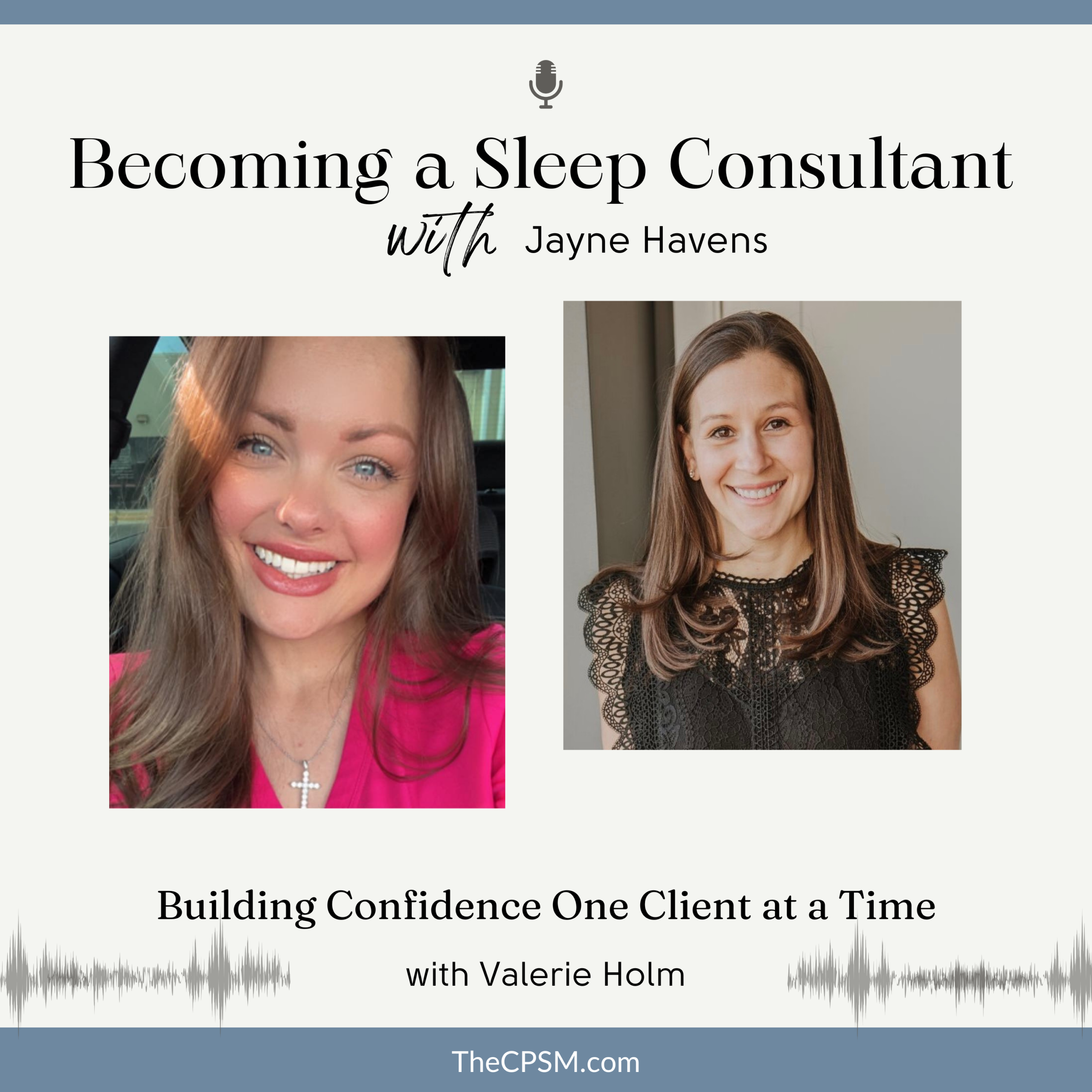
Building Confidence One Client at a Time with Valerie Holm
What actually happens after you get certified?
How does confidence grow?
When does it start to feel real?
And what does it look like to build this business alongside motherhood and a full-time career?
In this episode of the Becoming a Sleep Consultant Podcast, I’m welcoming Valerie back for an honest conversation about what her business looks like one year in.
We talk about:
- How confidence is built through experience, not just training
- How she has refined her process to instill greater confidence in the parents she supports
- How she has successfully built a sleep consulting business while juggling young kids and a demanding full-time job
Links:
Instagram: @valerie.sleep.consultant
Podcast: Get your baby to sleep with Restful Rhythms
If you’d like to learn more about becoming a Sleep Consultant, please join our Facebook Group: Becoming A Sleep Consultant
CPSM Website: Center for Pediatric Sleep Management
Book a free discovery call to learn how you can become a Certified Sleep Consultant here.
Transcript:
Intro: Welcome to Becoming a Sleep Consultant! I’m your host Jayne Havens, a certified sleep consultant and founder of both Snooze Fest by Jayne Havens and Center for Pediatric Sleep Management.
On this podcast, I’ll be discussing the business side of sleep consulting. You’ll have an insider’s view on launching, growing, and even scaling a sleep consulting business. This is not a podcast about sleep training. This is a podcast about business building and entrepreneurship.
What actually happens after you get certified? How does confidence grow? When does it start to feel real, and what does it look like to build this business alongside motherhood and a full-time career?
In this episode of the Becoming a Sleep Consultant Podcast, I’m welcoming Valerie back for an honest conversation about what her business looks like one year in. We talk about how confidence is built through experience, not just training; how she has refined her process to instill greater confidence in the parents she supports; and how she has successfully built a sleep consulting business while juggling young kids and a demanding full-time job. If you’re exploring sleep consulting and wondering if you could actually do this, this episode is for you.
Jayne Havens: Valerie, welcome back to the Becoming a Sleep Consultant Podcast. I’m so excited to chat with you today.
Valerie Holm: Hi, Jayne. Good morning. Thank you so much for having me again. I’m super excited to be here.
Jayne Havens: So for anyone who didn’t hear your first episode, can you give us a really quick rundown of who you are and why you decided to get into sleep consulting?
Valerie Holm: Sure. So my name is Valerie Holm. I am a wife of 12 years. I have two toddlers, Emma and Zoe. Emma is five, and Zoe is three. Emma kind of turned my world upside down in the best way and most exhausting way possible. So when she was a baby, she would only sleep if someone was physically holding her. So, for months, my husband and I took turns in the night holding her while we stayed awake and trying to find things on Netflix to watch. It was one of the most brutal experiences of my life.
Fast forward a few months, I am desperately looking at things to do because this isn’t sustainable. And so we looked into sleep training, and we did it. It was the most life-changing thing of all time, so then I became obsessed. I just started to help friends or random people on the internet or Facebook groups and friends of friends. Word got out, and I kind of became known as my town’s sleep person.
So I did it just casually for a while and then decided, when I got pregnant with my second — I’m a respiratory therapist as well, so I work 12-hour shift. So having a second baby doing that was going to be very difficult. So I was looking at ways to earn income in a new way. And I was like, “Well, I already love this, and I’m pretty good at it, so I might as well make it a career.” So that’s kind of the backstory.
Jayne Havens: Yeah, I love that story so much. Actually, it’s very similar to my own, where I became obsessed with infant sleep just through my own journey of sleep training my son 13 years ago. And so whenever I hear you share that, I’m like, “Oh, that’s exactly what happened to me.”
So last year when we spoke, I feel like you were still sort of in the mindset of having to prove to yourself that you could do this. I’m wondering how your confidence has evolved over the past year.
Valerie Holm: I think that’s pretty accurate. I was in my first year getting my footing, kind of finding the language that I was trying to use and things I was trying with my clients. I think that my confidence has soared, and I think that comes from the experience of just working with clients and seeing how you move through things. Now I’ve been through a lot of different scenarios and the different clients and things that they go through, so I know how to coach them better. It comes from just experience and a deep-rooted thing of, “I got this. I know how to help them,” and to just do that.
Jayne Havens: Are there situations that arise in your work that used to intimidate you and now they don’t?
Valerie Holm: I think yes. I love working with infants. They are my bread and butter. They are just my favorite. And so when I get a toddler inquiry, it kind of intimidates me a little bit. I actually had a 23-month-old in a bed, and that was my youngest client that I’ve had in a Montessori-style floor bed. She really intimidated me. I almost was like, “Oh, should I take this one? Am I the right sleep consultant for this client?” And I was like, “Yes, just do it. You know how to do this.”
And so I ended up doing it, and it ended up being amazing. It soared my confidence even more of maybe or maybe not I might take more toddler clients. But yeah, that was a scenario where I thought it would be extremely difficult, and we got through it. She did amazing. She slept like 12 hours on the second night and just did that since.
Jayne Havens: Yeah, isn’t that the best?
Valerie Holm: Yeah.
Jayne Havens: Actually, when I first started supporting families, when I first got certified to do this work, I thought I was only going to work with infants because that was my own life experience. Even though my children — I had a toddler at the time, but he was not climbing out of a crib or not staying in bed. I didn’t have any personal experience with that. And so in my mind, I was like, I’m just going to sleep train infants. I’m not even going to take on toddler clients. And then my first paying client was a six-year-old in bed.
Valerie Holm: Oh my gosh.
Jayne Havens: And then my second client was a two-and-a-half-year-old. And so, right away, I was like, “Oh, okay. Just kidding. I’m not going to only support infants.” And I do think that being willing to step outside of your comfort zone is ultimately what positions you to grow. I mean, how are you supposed to grow if you don’t ever try?
Valerie Holm: Exactly. Yeah, and that’s kind of where I am right now. I think I’ll take more toddler clients as they come. But I sleep trained my kids when they were little, like babies, like four or five, six months. And so that’s what I know personally. And so since I did that, they don’t have a lot of sleep challenges. So yeah, it’s kind of like the same thing. But we still work through it. I still know what to do, even if my own kids don’t do those certain things.
Jayne Havens: Yeah, sure. Sure.
As far as your process for supporting families, has there been an evolution with that as well? Whether your sleep plans look different or your coaching style is different, are you setting boundaries around communication in different ways? How has all of that evolved?
Valerie Holm: Yeah, so I will say yes. I think that is my goal: to always evolve and to always, even if I feel like my client experience is good, I want it to be better at all times.
And so I think that one of the things that I have started doing in my sleep plans and on my calls is going over a lot more expectation and going over what I specifically do with the clients. On my calls, I will go over kind of the process that I like to walk clients through to make sure that this is a good fit for them. So part of this is like, you know, in order to teach your baby how to fall asleep independently, we have to give them a chance to try. And if that is the most terrifying thing of all time to this person, maybe we’re not the best fit. So I’ve gone over that.
In my sleep plans, I have started to, over the last several months — the sleep plan has sections of bedtime, the sleep training method, what to do for naps, stuff like that. So after any guidance or recommendations that I give, I will give my reasoning why, like why this works, so that it builds their confidence a bit and they can understand why I’m telling them to do XYZ. It’s not just like, “Oh, do this with your baby,” and that’s that. So I feel like them understanding the process a little bit better helps them, helps their confidence, and makes the process a lot easier, and they’re not stepping into night one like, “Oh my gosh.”
As far as boundaries and communication, I try to be really open and communicative to my clients. So if I am doing something, I will let them know. Because they are hiring us for support, right? I think that’s the biggest difference of Googling something, “How do I do this,” and having an expert with you to, one, tell you what to do, but two, support you through the whole thing.
They don’t want to feel ghosted, or they don’t want to feel like they’re trying to get a hold of you and they can’t. So I outline my hours. I’m like, hey, if I’m working today, I will send them a text in the morning. Like, “I’m working today. If anything’s delayed, I’m very sorry. But I will get back to you.
I, also, in the mornings will send — I think I call this an anchor text. It is kind of like the flow of the day. If we’re working on something specific, we’ll go over that. It gives them kind of an outline to go back to in case that I’m just not as prompt as I want to be on the text. I think that is really important. So those are just a few things. I mean, there are probably others, but just off the top of my head.
Jayne Havens: Those are really fantastic. I actually might borrow your anchor text suggestion, especially for days when I am busier myself. Like today, I’m recording three podcast episodes. Those are 30- or 45-minute blocks on my calendar where I’m not available to respond in real time with my clients. And I do always let families know in advance if I’m going to go radio silent for an hour. I say, “I have an appointment. I’m not able to have my phone,” or whatever that looks like. So I manage expectations.
But I love the idea of giving them sort of an anchor text with instructions or information or reminders for the day so that we can set them up for success, even if we’re not going to be able to respond in real time in the moment. I love that.
Valerie Holm: Yeah, I love it. I find it helps them not panic, and it helps them know what to do. I do this sometimes if I will be busy for their bedtime. So I’ll screenshot their bedtime routine. I’ll screenshot what they’re supposed to do and send it to them if I’m going to ever be delayed. And so I think it helps them kind of not panic and just keep knowing what to do.
Jayne Havens: Yeah, I think that’s fantastic.
Talk to me about how you’re juggling your day job and then also sleep consulting.
Valerie Holm: Honestly, it’s a lot. So again, I have my two little kids. My five-year-old just started TK, so it’s like pre-kindergarten, this past year. She’s in school five days a week. But that is new. That just started happening a few months ago. My youngest goes to a little preschool for six hours a week. So it’s very limited. I work as a respiratory therapist, so those are 12-hour shifts. And when I’m working, obviously, I can’t work on other things.
And so, honestly, I sometimes wake up really early in the mornings. I work, I hustle during nap time. I work when the girls go to bed at night. So that gives me like 7-ish till 9-ish P.M. That’s kind of what I’m doing to balance all of these things.
And I do work part-time in the hospital. So I only usually work maybe two days a week, but that is 12-hour shifts. The other Monday through Thursday, I’m solo parenting 11 hours a day because my husband is at work. So it’s full right now. I’m just doing what I can do. But I don’t feel like it’s hindering anything, or I don’t feel like my work is work. I feel I’m enjoying it. So I don’t mind using nap time to work on sleep plans or get some content up or get whatever it needs to get done. I love it.
Jayne Havens: What is a comfortable amount of families for you to support at any given time, whether it’s actually at a time or over the course of a month? What does that look like for you?
Valerie Holm: I think the most I’ve had in a month would probably be like eight-ish so far, and that was really manageable. I think I could do a little bit more than that if it would happen. I think at a time, like in a week, I like to have not more than maybe three or four. After that, it got a little much, just because of everything going on right now. But that’s comfortable for now. But when the kids get a little older and they’re in school a little bit more, I think that will change.
Jayne Havens: Can you think of any families that you’ve supported recently that feel particularly memorable?
Valerie Holm: Yeah, I have a few, but I’ll go over one. So this was a local mom who reached out to me. She lives in the same town that I do. She was pregnant, and her little baby was 19 months old and had co-slept for every day of his life. She was at her wit’s end, and she was not sure how to do this. She didn’t have a crib. She didn’t have anything for him other than her bed. She asked me if she should get a floor bed or a crib. And I was like, “Please get a crib. This will make everything so much easier.”
He ended up falling asleep in his crib for the first time ever at 19 months old in, I don’t know, maybe 33 minutes or something. Part of this was a little cry, and part of this was little fussing. Part of this was exploring the crib a little bit because he’s like, “I’m not sure where I am.” He ended up sleeping 14 hours on night one, and I texted the mom. So I do my morning check-ins at seven. I texted her, and there was like crickets until 10:30. And I was like, “Oh my God. What happened? I’m wondering, does she hate it?”
She wasn’t writing me back. She wrote me back finally at like 10:30. She was like, “Oh my gosh. He finally just woke up.” It’s like 10-something because he went to bed at like 8:30. So they woke up at like 10:30. She’s like, “I didn’t set an alarm because why would I do that? Because I’ve never had to do that before. We literally just slept until 10:30.” That was the most amazing needed thing ever, and I can’t even — she was so excited.
Jayne Havens: Yeah, I love that.
Sometimes these babies and these toddlers, they just need a little bit of space, and they so desperately want their sleep. And it sounds like that was one of them.
Have any of your clients taught you anything? Obviously, we’re teaching our clients things all the time, right? But are you learning anything from the families that you’re supporting?
Valerie Holm: Patience, I would say. Patience, compassion. You know, I have these things already, but they exercise them sometimes. They’re teaching me how to be a better coach.
Jayne Havens: One thing that I’m really working on in my work, I don’t know if you have noticed this as your business has grown. But as you get busier—at least I’ll speak for myself—sometimes I’m just quick to fire off a message, and I forget to include the empathy piece first. I just respond with feedback or advice. And then I read it back, and I’m like, “Ugh.” If I had only just taken a moment and started the sentence with, “That sounds really hard,” or, “I know this is tough.” Right? And so I’m being really mindful lately to slow down and always start my feedback or my communication with just a sprinkle of empathy. That’s something that I’m really working on.
I also have started saying to my clients on kickoff calls—so when we’re running through the plan and I’m talking them through everything that’s going to happen—I say to them that I want them to know that sometimes when I reply by text message, sometimes I’m just trying to give them the answer the quickest way possible. I’m just trying to give them feedback as quickly as I can.
And so if ever anything they read reads as cold or harsh or rushed, I want them to know my heart—that if I actually was talking to them about it or if I had taken the time to send a voice note instead of a text, they would have heard my tone and my compassion. I always want to just share that caveat, that if you ever read something via text that just sounds like, “Oh, she could have said that nicer,” please know that the intention is there for me to be kind.
Yeah, and I think that’s helped. It sort of set the stage and set the tone that even if Jayne says something a little quickly, she’s not trying to be harsh or mean or anything. She’s just trying to get back to you as quickly as possible. So that’s something I’m working on.
Valerie Holm: Yeah, I think that I’m guilty. I mean, sometimes, especially when I’m in a rush, or sometimes bedtime falls when I’m trying to get my kids bathed and I’m trying to wash hair and text back at the same time. I’m getting better at that too of taking a minute and saying, okay, I remember where she is right now because I’ve been there too. The empathy piece is really big, for sure.
Jayne Havens: I want to talk about marketing for a minute. I know that when you were first getting started, you were leaning heavily into Instagram. I’m wondering if that’s still sort of your main platform for connecting with families or if you’ve veered off in other directions.
Valerie Holm: Sure. Instagram is still my main one. I will pop into Facebook groups here and there. I mostly do Instagram just because it is fun for me to do that. I have a podcast now, so that is reaching more moms, hopefully. And yeah, I have a website, but I don’t use it very often. I don’t update it very often. Just in the DMs of Instagram, yeah.
Jayne Havens: What made you want to start a podcast?
Valerie Holm: You know what? I thought it would be fun. I thought it would be a cool way to reach more moms, share stories. My goal with my podcast is to answer questions. So I’m answering questions that I see a lot on Facebook groups, or people would DM me over and over again or whatever. I try to answer those questions via a podcast episode that they can listen to and kind of give my approach to how I would solve whatever question it was.
Jayne Havens: Yeah, I’ve listened to your podcast, and I think it’s fantastic.
Valerie Holm: Thank you.
Jayne Havens: I think that the key to showing up in that avenue—as somebody who’s been doing this for four years—is really to lead with value and also just to stick with it.
I think I sent you a message when you first launched your podcast and basically said, like, “This is great. Don’t quit.” Most people who launch onto a new platform—whether they were on Instagram and they try to create a TikTok, or they were on Facebook and they try to launch an Instagram or start a podcast—I think people try things for a couple of months maybe, and then they get sick of it and they stop. I actually think your podcast is great, and you got to stick with it. I think it’s building authority.
I mean, from what I listen to, you’re showing up confident, authoritative, really having your stuff together. The more ears we can get on that podcast, the more people are going to know who you are. I don’t know. I think it’s all good stuff.
Valerie Holm: Thank you so much, Jayne. I really appreciate that.
Jayne Havens: Yeah, I mean it 100%.
Where do you want your business to be in the next year or so? Are you looking for this to take over and become more full-time, or are you happy to juggle? No, you’re not wanting to juggle.
Valerie Holm: I know people can’t see my face. But yeah, it’s kind of a lot to juggle. I do have a plan. So in the next 18 or so, less than 18 months, we are actually moving out of California. And I do not plan to renew my respiratory license at all. And so I think that gives me kind of not a deadline, but kind of something to look forward to of leaving my hospital job and not getting another one.
Just at the same time, my youngest will be going into school. So it’s going to be a crazy time for me. So I’m not going to be working in the hospital anymore. And my youngest will be in school, which I’ve never experienced such time. So I think I’m just going to full-blow go into sleep consulting with everything.
Jayne Havens: I think you’re going to find it to be really doable to build your business up to be full-time level when you actually have full-time to work on it. Because you’re kind of really close to doing that even while juggling it all. And so without being in the hospital, having your kids being in school, really sitting down every day to treat this like your full-time job, I have no doubt in my mind—I know you’re going to be able to do that.
Valerie Holm: Thank you.
Jayne Havens: Before we wrap up, do you want to share where people can follow you? Definitely share your Instagram, your podcast, whatever you’d like to share.
Valerie Holm: I would link my website, but it’s kind of broken right now, and I don’t really use it.
Jayne Havens: That’s okay.
Valerie Holm: But my Instagram is @valerie.sleep.consultant, and my podcast is Get your baby to sleep with Restful Rhythms.
Jayne Havens: I love it. Valerie, great to check in with you. You’re doing amazing stuff, and keep up the good work.
Valerie Holm: Thank you so much, Jayne.
Outro: Thank you so much for listening to this episode of the Becoming a Sleep Consultant Podcast. If you enjoyed today’s episode, it would mean so much to me if you would rate, review, and subscribe. When you rate, review, and subscribe, this helps the podcast reach a greater audience. I am so grateful for your support.
If you would like to learn more about how you can become a certified sleep consultant, head over to my Facebook Group, Becoming a Sleep Consultant or to my website thecpsm.com. Thanks so much, and I hope you will tune in for the next episode

Considering A Career in Sleep Consulting?
Download our free e-book filled with information on what sleep consultants do and how running a sleep consulting business might fit into your life.
FrEE DOWNLOAD
Thank you for your message.
We will contact you shortly!