Interested in becoming a sleep consultant?

Jayne Havens is a certified sleep consultant and the founder of Snooze Fest by Jayne Havens and Center for Pediatric Sleep Management. As a leader in the industry, Jayne advocates for healthy sleep hygiene for children of all ages.
Jayne launched her comprehensive sleep consultant certification course so she could train and mentor others to work in this emerging industry.

Meet Jayne Havens
Ready to Start?
Become a Certified Pediatric Sleep Consultant
Turn your passion for helping families into a flexible career you can build from home.
Free Guide
A closer look into what sleep consultants do, and how this career could fit into your life.
Serving First, Selling Second with Jenna Mazzillo
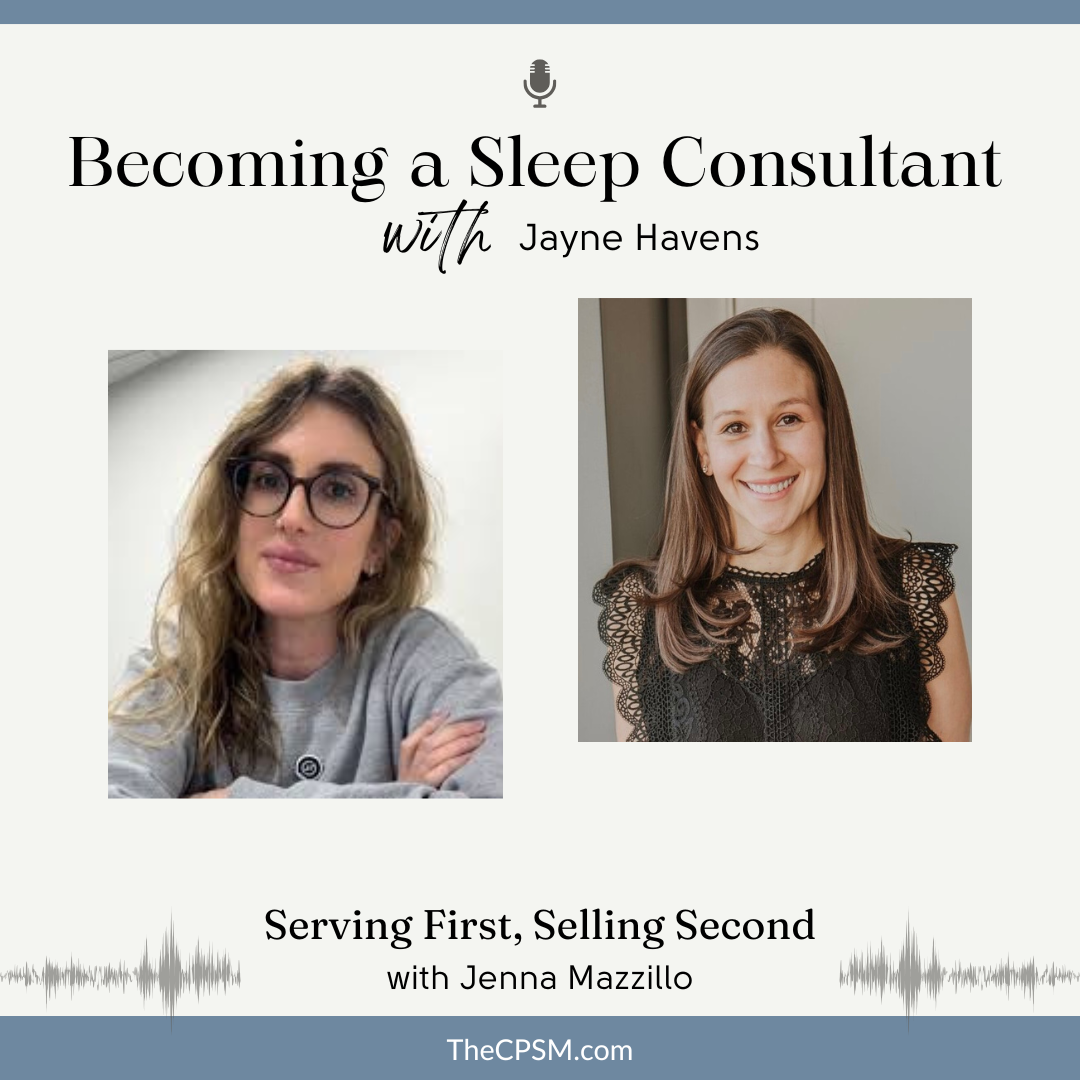
Serving First, Selling Second with Jenna Mazzillo
When Jenna Mazzillo started sharing parenting content online, she wasn’t trying to build a business. She simply wanted to help parents.
Fast forward a few years, and she’s built an audience of more than half a million followers, launched a successful parenting course, and recently left her career in education to pursue her business full time.
In this week’s episode, we talk about parenting, boundaries, business building, content creation, and why serving people at the highest level is often the best marketing strategy there is. We discuss the mindset shift that helped Jenna become comfortable selling her course, why providing massive value for free has become a core part of her business philosophy, and why showing up consistently matters more than waiting until you feel ready.
Whether you’re a parent, sleep consultant, entrepreneur, or any combination of the three, this conversation is packed with practical advice and a refreshing reminder that the only way to succeed is to be humble enough to be new at something again.
Links:
Instagram: @ABAnaturally
TikTok: @ABAnaturally
Stan Store: ABA Naturally
If you would like to learn more about becoming a Sleep Consultant, please join our Facebook Group: Becoming A Sleep Consultant
CPSM Website: Center for Pediatric Sleep Management
Book a free discovery call to learn how you can become a Certified Sleep Consultant here.
Transcript:
Intro: Welcome to Becoming a Sleep Consultant! I’m your host Jayne Havens, a certified sleep consultant and founder of both Snooze Fest by Jayne Havens and Center for Pediatric Sleep Management.
On this podcast, I’ll be discussing the business side of sleep consulting. You’ll have an insider’s view on launching, growing, and even scaling a sleep consulting business. This is not a podcast about sleep training. This is a podcast about business building and entrepreneurship.
Today, I’m joined by Jenna Mazzillo, a board-certified behavior analyst, educator, content creator, and founder of ABA Naturally. Jenna has built an audience of more than half a million followers by sharing practical, evidence-based parenting strategies that help families create calmer, happier homes. Along the way, she’s built a thriving business and recently made the leap from education into entrepreneurship full-time.
In this conversation, we talk about parenting, boundaries, business building, content creation, and why serving people at the highest level is often the best marketing strategy there is.
Let’s dive in.
Jayne Havens: Jenna, welcome to the Becoming a Sleep Consultant podcast. I’m so excited to speak with you today.
Jenna Mazzillo: Thank you for having me.
Jayne Havens: So before we get started, why don’t you share a little bit about yourself for those who don’t know who you are?
Jenna Mazzillo: Sure. So my name is Jenna Mazzillo. I’m a board-certified behavior analyst. I was a teacher up until February, and I just left to pursue my business full-time. I’m also a mom of a three- and a seven-year-old. I’ve been working in the field of education for 15 years as a teacher, district behavior analyst, Committee on Special Education chairperson.
Three and a half years ago, I launched my Instagram, YouTube, TikTok, and Facebook account, ABA Naturally, where I share practical, evidence-based tips for parents that help teach your child to listen the first time, but while still maintaining that warmth and structure that parents often worry about. And then, a year and a half ago, I launched my course, Practical Parenting.
Jayne Havens: I was so curious whether you had this program that you were using Instagram to sell, or whether you had this Instagram and then created your course. It sounds like you had your content first and then decided to develop an online course.
Can you share a little bit more about that journey? Did your Instagram just sort of take off? Did you feel like there was just this need for more than the free content that you were providing?
Jenna Mazzillo: When I created my Instagram account, I had no intention of making a course whatsoever. I didn’t even know that monetizing was a thing. I was just so sick of seeing advice out there that wasn’t working and parents who were struggling. And I saw how effective everything that I’ve learned over the last 15 years worked in my classroom and for other students and worked so well in the home. And I felt that this is something that should be shared and not kept behind closed doors, or you have to go to school for it. So I created that account, again, with no intention of making a course.
About, I would say, a year and a half later, I was contacted by a book publisher who asked me if I was interested in writing a book. And after meeting with them, I decided it wasn’t something that I was ready to do right now. It requires a great, you know, like a year of only doing that.
They left me with a piece of advice and said, “If you do ever want to write a book one day, I highly recommend making a course first.” And so, that piece of advice, paired with parents always asking me questions that a voice memo or a video under three minutes just couldn’t articulate what needed to be said—I do my best in that short amount of time, but there was a need for it—and so that is what led me to make that course.
Jayne Havens: Where would you say along the line you gained traction? It sounds like at first it was a passion project, and you were just doing it for fun. At what point did you notice that, wow, people are really paying attention? This is really resonating.
Jenna Mazzillo: I posted for 15 months with no traction whatsoever, and I was prepared to do that because I understood, just from listening to a lot of business and entrepreneur podcasts, what goes into creating something like this and that I was going to be facing a ton of rejection. Essentially, when I say rejection, I mean that not all my posts are going to do well, and being comfortable with that. And so I was prepared for that.
I also have the mentality of, “I won’t give up, and I understand that doing this is not easy.” And so I was ready for that. I also think that when you decide that you won’t quit, you will be successful if you’re willing to continue doing the work.
I gained some traction. I think I had like 5,000 followers the first time I had a video go viral, and then that video brought in like 5,000 followers. But I would say, overall, over the last three and a half years, I’ve, of course, had videos that have taken off. But more than anything, I would say it’s been more of a consistent and slow-and-steady process. It’s not one video that got me most people. There’s been a few that have done well, but I would say it’s also important for that slow, steady, and consistent process.
Because if you have a video that goes viral, you might get a lot of people that follow you from that one video. But then if your content doesn’t necessarily, let’s say, align to that, then they’re not going to engage with your other posts.
And then, in regards to the course, oh my gosh, when I launched my course, I had absolutely no idea what I was doing when it came to selling anything. I didn’t even know that you had to sell it. I didn’t know you had to talk about it. I did not even announce it when it came out. I just said in my stories, “Hey, I have a course.” I felt gross talking about it. But slowly, over time, as people started taking it, I started seeing the results. Well, number one, I learned that you have to talk about it. So I got over that.
But two, I started seeing the results that people were having and how it was changing people’s lives. And I realized that if this is changing someone’s life, their home is getting better, and their relationship with their child is getting better, it’s my duty to tell people about it. Because I always want to know about the best things that are out there for the things that I love. And so why wouldn’t I? It’s a disservice not to. And so that’s how I sort of became more comfortable talking about it. But I think, more importantly, the results that I got, the testimonials, and the messages that I continue to get are now at a point where it almost sells itself.
I just had a conversation with my husband about this last night. I said to him, “I think something that has separated me from a lot of the online courses out there is that people are always looking for the best marketing hacks, the best sales hacks, and what’s the latest gimmick or headline to get.” Those things are all important. But at the end of the day, having a really good product is what is going to sell it, and the word of mouth that it then begins generating. And so I think that’s what has separated the course from others.
Jayne Havens: I really wish that we had known each other a few years ago because I think we could have been like business besties along this journey together. I think you and I had so many of the same realizations as we were trucking along. I also, you know, I didn’t know what was what when I first started my business, literally. I had to learn everything. I didn’t know what email marketing was. I didn’t know what a funnel was. Someone was talking to me about, “Well, what’s your funnel?” and I’m like, “What’s a funnel?”
Jenna Mazzillo: Right. Same.
Jayne Havens: And I love that you said—you said what I say to my students all the time—that the only way to fail is to quit, right? I tell people all the time that it may take you longer to gain traction. It may take you longer to build momentum than whatever you had projected. That doesn’t mean that you’re failing. It just means that you haven’t gained momentum yet. I love that it took you— I mean, I don’t love that it took you 15 months. But I love that it took you 15 months to feel like your Instagram was really growing.
Because I think a lot of brand-new business owners who might be listening to this podcast, just launching a sleep consulting business or just launching a parent coaching business, they might think to themselves, “Oh, if I just get on Instagram, I’ll just have followers. I’ll just have clients, and my business will just grow.” No. Actually, it’s very often a slow burn.
I love putting people like you on a pedestal to share your story because what you have built is so impressive and incredible, and you literally started without knowing anything about anything to grow a business. And so what that means is that it’s possible. Just like it’s possible for you, it’s possible for anybody who’s listening and learning from this conversation. What I love most about you is that you are unapologetically yourself.
What would you say is the biggest difference between the way that you’re coaching families versus what was online that maybe wasn’t working for parents? What’s the difference?
Jenna Mazzillo: I think there’s two ends of the spectrum right now that is happening. I think there’s the gentle parenting movement, which is on one side, which has now leaned too far to that side. But then there’s also, of course, the authoritarian.
Jayne Havens: Yeah, authoritarian.
Jenna Mazzillo: I mean, I suppose what is different is, number one, I am sharing evidence-based tools. But also, everything that I teach is in the well-being of the child. It’s not about, “I’m choosing to gentle parent,” or “I’m choosing to be authoritarian.” It’s, “What is going to be best for my child?” That is the way that I look at it. What are going to build the skills in my child that they are going to need to be successful, independent, and happy?
And whether that means being in a position in which I’m uncomfortable in the moment because maybe I do have to hold a boundary right now, or knowing when it’s not a big deal and something can be let go. And so there’s that balance of— I feel like I’m always looking many years ahead when I’m in a moment. How is this moment going to shape my child’s life?
Jayne Havens: I often say— I work, again, with a lot of two-, three-, and four-year-olds. One thing that I’m regularly saying to parents of two-year-olds is that the behaviors that you’re seeing from your two-year-old are entirely age-appropriate. There’s nothing wrong with your child. Your child is behaving exactly the way that we would sort of expect them to. That being said, if you don’t parent with purpose and with intention now, your two-year-old—you’re going to literally blink your eyes, and they’re going to be four, or they’re going to be five, and they’re still going to be acting like a two-year-old a little bit. Right?
Jenna Mazzillo: Yeah, for sure.
Jayne Havens: We need to teach our children. You know, my kids are 9 and 13 now, so I’m a little bit out of that season. But still, I have to teach them. You know, 13-year-olds can be a pain in the butt sometimes. Right? And that’s, on some level, age-appropriate. It’s also my job to help him shift his behaviors and change so that he can be better next year. That’s our job as parents. And as uncomfortable as it feels in the moment, it’s really important. I love that you’re out there every single day empowering parents to hold the line, for lack of a better way of saying it.
Jenna Mazzillo: Thank you. I want to just say one thing about that because I think that this is so important to understand, too. Because some parents will stumble upon my account and say, “This is harsh,” or however, whatever they might feel.
I had a post—maybe this is in my head because of something I posted yesterday—and all these people are coming on now to comment that don’t follow me. But the other piece to this, too, is that something that I teach—and I teach this in my course, and I teach this online—I’ve had so many people that take my course. And after they take my course, and I think to myself, maybe I need to articulate this better online, they’ll say, “I didn’t realize how kind you were to your kids,” or “how much time you spend with them,” and “how much love you give them.”
I think that holding boundaries, being consistent and having high expectations is all important, and you must do that. But with that being said, if that’s the only thing you do, and the only thing you do all day is give your child orders and instructions and corrections, and you’re not depositing anything in the bank account of positive interactions and spending time with them simply because they’re your child—not to correct them, and to just be with them, and to love them.
I mean, I think physical affection is something that’s very underrated. Not just kissing your child goodnight, but giving them a hug or winking at them. Regardless, without that, none of the other stuff is going to work. That’s why the first half of my course is all about proactive things. Because by the time parents get to the second half—which is why they think they’re taking it, “What do I do when my child says no?” “What if they can’t transition?”—I have all that in there. But by the time they get there, it’s unlikely that they’re in the same situation they were in.
Jayne Havens: I think that’s really important, especially for my listeners to hear. I also place a big emphasis on that in my work as a sleep consultant.
One thing I tell parents to do when they come home from work— a lot of my clients, it’s two working parents. They’re racing in the door at 6 or 6:30, and they’re trying to get their kids to bed by 7:30 or 8. They have to eat dinner. They have to clean up dinner, give their kids a bath. They have an AirPod in their ear, they’re fielding emails. And the first thing I tell them is: “During the two weeks that we work together, you’re going to walk in that door, you’re going to put your phone down in another room, and you’re just going to be present with your kids.”
And in the hours leading up to bedtime, even if it’s a Focus 15, even if it’s literally 15 minutes, you’re going to play a board game, or you’re going to build a fort. You’re going to actually connect with your child. Because, when you haven’t done that and then you try to set the boundary of putting them to bed, they’re longing for that connection. You didn’t give it to them. And now they want it at the end of the night.
And if you can show up and give them that connection and show them and tell them—for kids who are old enough, you know, for three- and four-year-olds. I have these parents telling their kids, “Look, I am going to do everything in my power to make sure that our night is a good one—I’m going to do my part, and I’m going to ask you to do your part too.” Shake on it, right? We’re going to make a truce. We’re going to sign a contract even, if the child is old enough, and really set some expectations around not just what the boundary is, but what the whole evening looks like.
And I love that you say that because I think that’s the part that gets missed when parents just Google “how to get your kids to sleep at night,” or, “how to handle when I say no and my kid has a meltdown.” When you just Google it, you’re not getting that piece of the puzzle. And I do believe it’s a very important component to the entire process.
Since I brought up sleep, I’m wondering if you have any thoughts on why limit setting or putting boundaries into place at bedtime feels so much harder for parents than it does setting a boundary around, like, it’s time to get out of the bath? Parents are comfortable with their kid having a little bit of a meltdown when it’s time to get out of the bath, but why is bedtime so triggering for parents?
Jenna Mazzillo: I mean, I suppose, if I had to think about it, there’s a few things. I mean, number one, it’s a high-stakes moment where it’s a big deal if they go to bed or not, and there’s probably a lot of pressure on the parent to actually get their child to go to bed. I think parents also, if we’re dealing with challenging behavior before bed, parents want to go to bed too.
Jayne Havens: Yes.
Jenna Mazzillo: I think also, if you do have to deal with, let’s say, it’s three in the morning and your child calls you in, a parent is not in the right frame of mind either. Because they’re waking up at 3:00 A.M., whereas during the day you have more time to, you know—
Jayne Havens: Think clearly. Yeah, you had your head on straight.
Jenna Mazzillo: —think about it. I think, at the end of the day, the day has been long. And so by the time it gets to bedtime, it might be harder. But I also think maybe parents think that they’re abandoning their child.
Jayne Havens: Well, that is language. That is language that’s thrown around, right? That is language that, you know, when I get on a call with parents and they say, “My child…” They use language like, “My child needs me to sit with him while he falls asleep,” or “My child can’t fall asleep unless X, Y, and Z.” This is all language that they use that really makes it seem like their child is either entirely incapable of doing this or just, you know, they won’t, right? Like, they either can’t or they won’t.
In my work, I do a lot of reframing for parents. And when they say that, I’ll say, “Well, it’s not that they can’t. It’s that they don’t want to.” Right? And then parents come back with, “Well, I just don’t want them to feel traumatized,” or “I just don’t want them to feel abandoned.” And I do think that that is language that gets thrown around specifically around sleep, for whatever reason.
Obviously, there are parents who feel really, really strongly around whether you do sleep train or whether you don’t sleep train. And if you hang out for 45 minutes on Instagram following parenting accounts, you’re going to hear all of it, right?
Parents, especially busy working parents who have that limited time with their kids before bed, I think they just don’t want it to be bad. So they just do whatever so that there’s no misery. And, you know, there’s a lot of emotional baggage and emotional weight around it that I think just feels different than, “I’m going to expect you to sit in your chair at the dinner table.” It just feels a little different.
I’m wondering if your course covers that. Are you talking about bedtime? Are you going into the mindset piece, where you’re really shifting perspective and helping parents realize that it’s okay to set these boundaries around bedtime, even if your kid is not thrilled about the rules or plans that you’re putting into place?
Jenna Mazzillo: One of the modules in my course is called Everyday Routines, and it goes over everything involved within that. There’s a lesson on the moments before bed, like getting your child in pajamas, the routine, getting your child to stay in their bed. So I do go into that.
But again, if you were to come into my course and say, “How do I get my child to go to bed,” I would say, “Well, there’s a lot of other things we need to learn as well first. We need to learn how to set effective expectations that our kids actually follow.” And like you said before, a lot of this work is done during the day.
For example, I don’t go over potty training in my course. But every parent that takes my course after says they were able to successfully potty train their child because they just learn how the principles of behavior work—why my child does what they do? How do I get them to listen? How do I reinforce them? How do I get that behavior going? And when you have those skills, you can apply them to anything.
Jayne Havens: One thing that really stands out to me about you is really how much value you’re providing online completely for free. Tell me about why you’re so comfortable sharing all of the goodies online for free. I’m always telling my students inside of CPSM that you’re never going to lose business because you gave too much value. Is that your mindset as well?
Jenna Mazzillo: Yes, 100%. The reason that I did create my account was to help parents. That is truly the purpose behind it.
Whether I have a course or not, I care very deeply about kids’ well-being. That’s just who I am as an educator. Then I do feel that it’s my duty to provide parents with the amount of information that’s required to know in order for them to be successful. But then, I suppose, if we’re looking at that selfishly now that I do have a course—and I do listen to entrepreneur podcasts—not selfishly, but what I have learned is that, number one, your free content should be better than people’s paid content. Number two, give so much value that it would be unreasonable not to purchase something from you.
Jayne Havens: I actually think that your whole mindset around all of this is exactly what I want my students inside of the CPSM community to hear, and other sleep consultants that have taken other programs who are listening to this podcast. What I want them to hear from your messaging is that your whole goal is to be out there to serve. Like, you just want to help parents. You want to help families. And even if your free content makes a difference in a family’s life, that is good enough for you.
And I do believe that with that mindset and with those intentions, the money comes. I’m a firm believer that when you show up to— you know, a lot of female entrepreneurs are really uncomfortable with selling. I think you even said it felt gross, I think was your word, right? It feels really uncomfortable for people. But if you show up without that sales mindset, but more of a serving mindset, I think it feels less yucky. And then it all works out in the end.
Jenna Mazzillo: Yeah, and when you do give that much free content, I do feel okay when I do have the ask in there, or I do say, “By the way…” Because it’s not like I’m—
Someone messaged me recently, and they said, “You know, I really appreciate the fact that even though you have a course, you still give all of this.” That resonated with me. Sometimes I even feel like I talk about it too much, and I probably don’t. I put one sentence at the bottom of my captions. It really hit home once when I made one video about it specifically to say, like, “Hey, I have a course.” This was in the winter. And someone wrote back, “You have a course?”
It just got me thinking about, wow, I really have no idea that, you know, I’m not talking about it. I feel like I am, but no, not everybody consumes all of your content. That’s the first thing that we need to know. People don’t see everything you post. And so you might think that you’re saying something a lot, but it’s unlikely that you are. But also, if you’re giving that much for free, it’s okay to put that in there every once in a while, you know.
Jayne Havens: Have you accepted that you are an entrepreneur now? I know you started this just to share and to serve, but you’ve now accepted, like, “I’m a business owner. I’m running a business. I’m making money. I feel good about that.”
Jenna Mazzillo: I’ve accepted it. I love it. It’s so exciting. It’s fascinating. I actually recently started doing some individual coaching for people about this sort of thing. That’s why I was asking you before this podcast started how your business works, because I am truly loving this side of it too. And so it’s definitely something I hope to pursue more.
Jayne Havens: What would you say is your favorite part of your business, or just the entrepreneurial journey?
Jenna Mazzillo: I guess my favorite part of my business is, I suppose, seeing the impact it has on people’s lives and the messages that I get, that will never, ever, ever, ever, ever — that won’t get old to me. I think part of the journey is the journey. That’s what’s exciting.
I always say to my husband— my husband is more like, “Congratulations. You did this,” or “We should celebrate.” And I always say, like, I never want to— I never celebrate. To me, you never know what tomorrow is going to bring, and I just want to continue hitting the ground running and working hard because that is the most exciting thing for me, truly. It’s nice to have a final end-all, be-all result, but without putting in all this work that I’ve done, I don’t think it would mean anything. And so it’s sort of like a game—not a, you know.
Jayne Havens: No, no. Like literally, we should have been hanging out years ago. I always talk about my business. I say that it feels like I’m playing a video game against myself. I’m just trying to get to the next level in a really fun way, and I’m just in competition with myself. I actually do have competitors in my field. I have no idea what they’re doing, and I really don’t care.
I am literally just doing my thing. I have my podcast. I have my email list. I have my course. I have this. I have that. I don’t know what anyone else is doing. I don’t care. I’m just figuring out what works for me and having fun along the way.
And I agree with you. The exciting moments are like the text messages that you get from— for me, it’s like when a family— I’m working with a nine-month-old right now, and they haven’t slept, other than I think they had like three or four nights in her life where they just got lucky and she slept through the night. We’re working together. Last night was night two. She slept through the night, and she went to bed really easily. You know, I’ve been supporting families for 13 years, and those messages do not get old. That stuff is just as exciting, if not more so. That is exciting, and so is figuring out how to make a new button on my emails.
Jenna Mazzillo: Yeah, exactly.
Jayne Havens: Like, it’s all exciting. You have to find joy and excitement in, I think, as many different components of your business as possible. Otherwise, it just feels like a grind, and nobody wants that.
So if you’re willing to share, give me a little bit of an insider’s look on the inside of your business. What does it look like to create content? Are you supporting your student community? What does your business look like?
Jenna Mazzillo: It depends, I suppose, on what we’re going through. When it comes to creating content, I’m not the most organized person. I am trying to be. You know, I kind of just post what I feel in the moment, which, again, is not so— If anyone’s listening to this, there are better and more effective ways to do things.
Jayne Havens: I actually don’t think so. Because I’m the same way. I’m not a content creator in the way that you are by any means, but I actually think that is the way because that’s where the feeling and the emotion comes from. And if you’re just trying to create content because you think somebody might be interested in something, but you don’t have a story to share, or you don’t have a way to make it relatable or feel personal, I think it falls flat.
So when I see you sharing a story about your daughter not willing to take turns while playing a game, it’s like I know that that happened to you that day or the day before. I think that when it actually happens and you feel it in your life and in your heart, I think your audience feels it on a higher level. So I don’t know. I think scheduling is for the birds. I don’t do that either.
Jenna Mazzillo: No, I don’t schedule it, but I guess when it comes to making content, I suppose, it would be— I have a folder of thousands and thousands and thousands of videos that I have never posted before that are just ready to be edited. And so there are certain days where it would be beneficial if that is all I did. And again, this is something that I am learning about business and now having my own business. I’m trying not to get pulled into too many things. It’s very easy to.
What I’ve learned is that you want to be working on your business, not in your business. And so I’m trying hard to do that. I actually just started working with an agency who’s now managing me. This happened like a week or two ago. And so we just had a meeting today. We meet once a week. What we’re planning right now is I’m going to be giving a free workshop at the end of June. So that’s the big thing we’re working on, and I’m working on getting them everything that they need from me.
During the week, when I have a course work, those parents are allowed to ask me questions whenever they want, so I will talk to them. I’ll try to answer DMs. If I don’t get to it that day, then more builds up. I can’t answer everybody, but I try.
It’s funny. When I first started doing this full-time, I was like, “What am I supposed to do?” When I first got into my office that day and I had now nine hours, I was like, “There’s so much to do.” I think learning that you cannot do everything, and if you try to, you will not be successful. You’ve got to stick with a couple of things at a time, become really good at that, do that, and then you move on.
Jayne Havens: So your girls, they are the ideal age for all of your content, at least right now. But they’re getting older. They’re growing up. I felt this in my sleep consulting business. I started supporting parents when my kids were really little and at that age where they needed so much more support around sleep or even just boundaries, whatever. And now, that’s just not the season of life that I’m in.
I’m wondering if you have any plans for how your content and the way that you talk about all of this stuff is going to evolve once your kids are older and they aren’t necessarily of the age to be in all of the videos.
Jenna Mazzillo: I think this is a common misunderstanding of many people, that when they first come to my pages, let’s say, that what I have is for a toddler. But again, that just so happens the age of the children that I have.
If I could share somebody else’s 10-year-old, I would. I’m just working with my children that I have now. When Grace was seven months old and I started my account, I was teaching how to work with babies and how to increase their language. And so the principles of behavior apply for every single age. It just looks a little bit different depending on the age. So older kids are still going to be upset and have a tantrum, but it might not be as loud. It might be a silent treatment or an eye roll or the attitude. And so the foundation really doesn’t change.
I have a lot of parents in my course that have teenagers that say how helpful it was. I share videos that I haven’t put out yet because I haven’t had time to edit the 3,000 videos that I do have. My older daughter is seven. I’m not going to share a video of her. You know, the stakes are a little bit higher now with what I share about online. And so I am trying to be sensitive of that.
I also get a lot of inspiration from other people. Like last night, I was talking to my brother. His child is going into sixth grade. He’s got a second grader and a kindergartner. And so just working with parents and talking to parents that have older kids is also helpful for me when I do come up with situations or carousels.
I remember I came up with a carousel once of— I was talking to my friend Alex, and I put the name Alex in it. It was a make-believe name. It was actually my brother, who turns out doesn’t care at all if I share his stuff. And so now I do. But someone posted, like, “Yeah, I’m sure this conversation happened. Alex is probably made up.” It’s actually funny. It’s always somebody. It’s always a friend or a brother. There’s always somebody with a child that is a different age that I can draw upon.
Sometimes, honestly, I’ve gone on Reddit, and I like to see what parents are dealing with right now. What are they going through? That’s helpful for me to know what I can help with. The questions that I get from parents guide what I make content about as well. I’m kind of just taking it day by day.
Jayne Havens: And you know what? Your audience may expand as your kids grow older. I think that’s what happened with me as a sleep consultant. When I first started, I really was working with infants. And then as I gained years of experience, my kids were getting older, and also my clients’ kids were getting older. And so those six-month-olds that I was working with became three-and-a-half-year-olds who were climbing out of their cribs. And, you know, now those three-and-a-half-year-olds are eight-year-olds that are giving pushback on doing their homework, or whatever it looks like.
And so I’ve had to expand my knowledge and my skill set and also learn new ways to talk about things. It’s great because now I can cast a wider net, and parents don’t think of me anymore as that sleep consultant that just sleep trains babies. They think of me as somebody that is able to handle a wider range. And so I think as your kids get older, if right now your audience is mostly parents of younger kids, as your kids age, it’ll probably open doors for you to more easily connect with parents who are having different challenges with older children, which I think will be great for you.
Jenna Mazzillo: Yeah, I’ve worked for school districts for so long that I’ve had that experience as well. I just obviously can’t put those children in my videos. I suppose because people can’t see it, they might not realize that it applies to them as well. Some people say, “Can you make videos for a nine-year-old?” I’m like, “This is for a nine-year-old.”
Jayne Havens: Yeah, I always say that. I mean, inside of Center for Pediatric Sleep Management, the course is geared zero to four. But I always tell people who are interested in enrolling in the course, whatever you do with a four-year-old, you do that with a five-year-old. And whatever you do with a five-year-old, you do with a six-year-old, and whatever you do with a six-year-old, you do with a seven-year-old.
So you ultimately get to decide where you feel comfortable the cutoff is. And if you feel like you need new tools and more talking points, then you get out there and you learn. You figure it out, and you take a couple cases. You know, maybe you take a case pro bono, and you just see, like, can I handle this? Do I feel comfortable with this? You push yourself outside of your comfort zone a little bit, and you see what happens.
My very first client as a sleep consultant— I thought I was going to be sleep training babies. That’s why I got into this. My very first client was a six-year-old little girl who was bed sharing. And I was like, “Oh my gosh.” At the time, my kids weren’t even six years old. I didn’t even have a six-year-old. And so I really had to just lean on my education and my knowledge and also my willingness to just support them at the highest level. And we got it done. So, you know, on to the next.
Jenna Mazzillo: Yeah, I think that’s important, very important, to put yourself outside of that comfort zone. Because if I stayed doing what I started my career doing, I’d still be working with kindergartners with autism because I was comfortable and really good at that. Now I can work with neurotypical kids, children that have other needs besides that, any age. And I think that it just makes you a better practitioner. The only way you get there, though, is by being humble enough to be new at something again.
Jayne Havens: Oh my gosh. I love that. I was just going to ask you. What advice do you have for entrepreneurs that are just getting started? I think that’s really good—to be humble enough to be new at something again. Anything else? Any other sort of words of wisdom to share with people who are just getting started on this journey?
Jenna Mazzillo: Yeah, I would say if you’re waiting for the perfect moment, there’s never going to be one. You just have to start. If you’re worried about failing or what other people think of you, I will always say, can you imagine if, let’s say, Jeff Bezos—if he didn’t start Amazon because he was worried about what the people he went to high school with would think of him? Or that’s not a good example.
Jayne Havens: That’s a great example, yeah.
Jenna Mazzillo: But you’ll never know. And the funny thing is that people will think it’s funny at first. People will think it’s all fun and games until it’s not. And I love that sweet success story of the people in the beginning, who you slowly learn who your real friends are when you become a content creator. There are certain people who weren’t as happy for me as I thought that they would be, and there are certain people who are very happy for me. And it’s been eye-opening.
But what I will say is, it’s such a sweet— not revenge, but it’s like, I know I will be successful, and I know I will do well. I don’t give a flying you-know-what what you think about me. Because one day you’re going to be, you know, “I shouldn’t have ever thought that. I shouldn’t have said that.” But that’s not why I’m doing it. That’s not why I’m doing it.
Jayne Havens: But it is fun on the other side.
Jenna Mazzillo: Oh, it’s so fun.
Jayne Havens: Before we wrap up, where can people find you? Definitely share your social media accounts, and if you want to share a little bit about where they can find your course.
Jenna Mazzillo: Sure. So my social media account is ABA Naturally. I’m on Facebook, YouTube, TikTok, and Instagram. My course is called Practical Parenting: No Fluff, Just Results. And that course is really about, if you want to stop leading from the lens of putting out fires all day and managing your child, and actually teaching them the skills proactively. So number one, you’re in these situations less to begin with, but then hopefully they rarely happen because you’re teaching behavior change that will last for life. Maybe we could put that in the show notes, I guess.
Jayne Havens: Definitely. Definitely. Thank you so much, Jenna. I’m so excited to have had this opportunity to speak with you today. We’re going to keep in touch because you and I are kindred spirits when it comes to mindset around both, I think, parenting and entrepreneurship. And so I’m just so excited to have connected with you. I’m really grateful for your time.
Jenna Mazzillo: Thank you for having me.
Outro: Thank you so much for listening to this episode of the Becoming a Sleep Consultant Podcast. If you enjoyed today’s episode, it would mean so much to me if you would rate, review, and subscribe. When you rate, review, and subscribe, this helps the podcast reach a greater audience. I am so grateful for your support.
If you would like to learn more about how you can become a certified sleep consultant, head over to my Facebook Group, Becoming a Sleep Consultant or to my website thecpsm.com. Thanks so much, and I hope you will tune in for the next episode.

Considering A Career in Sleep Consulting?
Download our free e-book filled with information on what sleep consultants do and how running a sleep consulting business might fit into your life.
FrEE DOWNLOAD
Thank you for your message.
We will contact you shortly!