Interested in becoming a sleep consultant?
Jayne Havens is a certified sleep consultant and the founder of Snooze Fest by Jayne Havens and Center for Pediatric Sleep Management. As a leader in the industry, Jayne advocates for healthy sleep hygiene for children of all ages.
Jayne launched her comprehensive sleep consultant certification course so she could train and mentor others to work in this emerging industry.

Meet Jayne Havens
Ready to Start?
Become a Certified Pediatric Sleep Consultant
Turn your passion for helping families into a flexible career you can build from home.
Free Guide
A closer look into what sleep consultants do, and how this career could fit into your life.
From NICU Mom to Sleep Consultant with Kenyon Gatlin
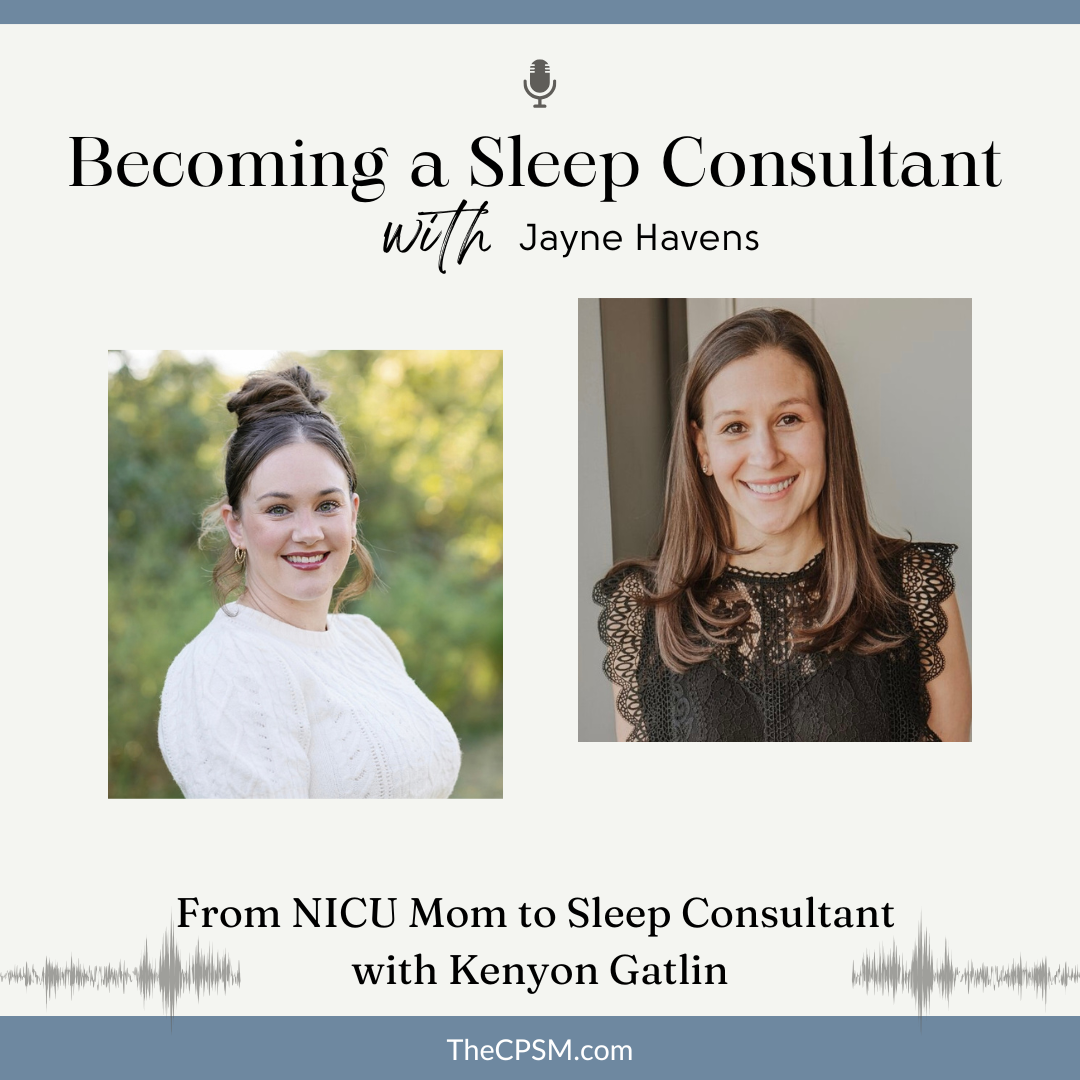
From NICU Mom to Sleep Consultant
with Kenyon Gatlin
This week on the Becoming a Sleep Consultant podcast, I’m chatting with CPSM graduate Kenyon Gatlin, a NICU mom who turned her own life-changing experience with sleep training into a career supporting other families.
Kenyon’s daughter spent 59 days in the NICU and came home with a feeding tube, airway complications, and a long list of medical appointments and therapies. When Kenyon eventually decided to work on her daughter’s sleep, she had to approach things differently, with guidance from her medical team and modifications to accommodate her daughter’s needs.
That experience shaped so much of how Kenyon supports families today, especially those with medically complex children. She understands firsthand that healthy sleep habits don’t require a perfectly controlled schedule, and that families can make meaningful progress even when life is complicated and unpredictable.
We also talked about Kenyon’s first year in business, during which she’s supported approximately 40 families! She shares how she went from trying all sorts of marketing strategies to building relationships with local professionals, getting out into her community, and developing a steady stream of referrals.
One of my favorite parts of our conversation was hearing Kenyon reflect on how much she’s grown personally since starting her business. She was caring for a medically complex baby, navigating a cross-country move, and trying to figure out how to build something of her own. She didn’t exactly have an abundance of free time, but she was determined to make it work.
I think so many of you will relate to Kenyon’s story, whether you’re already running a sleep consulting business or you’re still trying to figure out how to make space in your life for something new.
Links:
Website: Nite Nite Baby
Instagram: @nite.nite.baby
If you would like to learn more about the Becoming a Sleep Consultant, please join our free Facebook Group or check out our CPSM Website.
Book a free discovery call to learn how you can become a Certified Sleep Consultant here.
Transcript:
Intro: Welcome to Becoming a Sleep Consultant! I’m your host Jayne Havens, a certified sleep consultant and founder of both Snooze Fest by Jayne Havens and Center for Pediatric Sleep Management.
On this podcast, I’ll be discussing the business side of sleep consulting. You’ll have an insider’s view on launching, growing, and even scaling a sleep consulting business. This is not a podcast about sleep training. This is a podcast about business building and entrepreneurship.
Jayne Havens: Kenyon, welcome to the Becoming a Sleep Consultant podcast. I’m so glad you’re here today.
Kenyon Gatlin: Thank you. Me too. Thank you for having me.
Jayne Havens: Before we get started, why don’t you share a little bit about yourself and why you decided to become a sleep consultant?
Kenyon Gatlin: Yeah, I love that. So, I’m Kenyon. I am a NICU mom. I was in school while I was pregnant with my daughter to actually become a nurse. We ended up having kind of a traumatic birth situation happen, which resulted in my daughter being in the NICU for 59 days. Coming home from the hospital, she had a feeding tube. She had a ton of therapies that she needed. And I just kind of was like, “I’m not going to be able to go back to school and finish this because I need to actually be my daughter’s nurse now and take care of her.” Funny how life happens that way.
I pretty much devoted all of my time to just caring for my daughter, making sure she got the support that she needed to reach the milestones that she was likely going to fall behind on. And in that process, I just felt like I was losing myself. And I just— I love being a stay-at-home mom. I do, but I also felt like, “Oh my God. This is a lot.” It’s a lot, and I feel like this is all I do. I need to do something for myself.
Funny enough, when I actually got to sleep train my daughter, that experience was so life-changing for me. Like, I can’t even put words around it sometimes, but just the experience that I had, I knew that I wanted to be able to help other parents experience that exact same thing. And so that actually led me to— I didn’t know sleep consulting was a thing. My husband actually said, “You should see if you could, like, do this professionally.” And that’s when I started Googling it. I found you, and that was just kind of where it all started. We hopped on a call, and the rest was history.
Jayne Havens: How old was your daughter when you sleep-trained her? And if you’re willing to share, can you speak into her medical situation, both at the time, what that looked like then, and what it looks like now?
Kenyon Gatlin: Sure. Yeah, 100%. So coming home from the NICU, she had something called laryngomalacia and tracheomalacia, which are both, like, lots of airway issues. Her airway was very immature, and so it would collapse on itself.
Crying wasn’t a huge— I wasn’t allowed to really let her cry it out. I had to mitigate a ton of her crying in order to successfully sleep-train her. But I had to do something because I was drowning with the amount of medications I was pushing. I mean, we were on continuous overnight feeds for 10 hours, and I was pumping and trying to figure out how to even manage all of this stuff. Because coming home from the NICU, there’s a really big gap and not a lot of support.
Parents are taught, like, the day before you leave the NICU, how to do all of this stuff, and then they’re like, “Okay, goodbye.” And so it was just really overwhelming. And processing it all, I just was so overwhelmed, so anxious.
Around, like, the five-month mark is when she started going through a lot more sleep issues. But I had to get clearance from her medical team in order to actually sleep-train her, and so that’s what I did. I went to her ENT, and he felt like she looked a little bit better. He wasn’t as concerned about her airway issues. He thought that it would kind of resolve itself on its own as she got older, and it has, thankfully. But he just was like, “Take it slow. Do whatever modifications you can because crying it out is not going to be, or even allowing her to cry a lot is not going to be great for her airway.” Right? And so we did.
It honestly wasn’t as bad as I had anticipated it to be. I knew sleep training worked. I had worked with families in the past as a nanny. The kids were sleep-trained, and I just was like, “Wow, this is… I mean, it’s a miracle.” The difference between non-sleep-trained kids and kids who are sleep-trained is night and day. I mean, I think it probably took us maybe four or five days with modifications and the check-and-console method. But yeah, I mean, it was great, and I think it helped her a ton, too, just to be able to heal and get the rest that she needed for all the stuff she was going through.
We had lots of physical therapy and OT and all of that, but now she’s doing so good. She’s almost completely weaned from her G-tube. She’s running around, bossing everybody around, and just, like, defying odds over here. So I’m just so proud of her.
Jayne Havens: I think it’s really great that you were able to figure out a way to implement sleep training, minimize crying, which it sounds like on some level you still took a pretty traditional approach. Which suggests to me what I’ve always felt, which is that the more traditional sleep-training techniques often produce the least amount of crying overall, right?
Kenyon Gatlin: Yes, 100%.
Jayne Havens: If you actually can just get it done quickly, they’re not crying that much, and then they sleep. Whereas if you had done it really gradually and been really hands-on, I think she would have been so much more frustrated. It would have produced so much more crying, right? So it’s interesting that you were told to, like, not have there be that much crying, and that was your approach, and you were right.
Kenyon Gatlin: Yes, 100%. I agree. Even with families today, I’m like, “Okay. We can do these other methods. I’ll support you, but it’s going to be more crying than you want.” Ultimately, most parents are like, “Okay. I can’t do this. I want to pivot to the other option of CNC,” and they’re like, “Oh my God, this is great!” So, yes, 100% agree with you.
Jayne Havens: And how old is your daughter now?
Kenyon Gatlin: She’s two and a half.
Jayne Havens: And so, somewhere in between, she was five months old, you sleep-trained her, and she’s two and a half now. I know you’ve been in business about a year, right? So you had this transformative experience on your own and then pretty quickly realized, “I got to get out there and help others.” I love that it was like you did it, and now you’re moving on to help others right away.
Kenyon Gatlin: Absolutely, yeah. I didn’t know at first. And I actually didn’t even, I think, connect with you until she was 10 months old, and we were right in the middle of a move from California to Texas. And so that was already a lot.
But I just knew that this was something I was really passionate about. Especially just moms in general, I think so many moms— man, I could talk all day about this. I won’t, but there’s just such a pressure on moms these days and such a— just like the ugliest stigmas around sleep training. And so I wanted to be a voice to be able to bring peace to the anxiety that so many moms feel about sleep training, so that they know your attachment is not going to be broken just because you do this. Your child is still going to love you and know that you love them, and that’s okay. So I hate all the fear-mongering around sleep training.
And so that’s really what I wanted to do, was be able to help moms and dads that are involved in just advocating for them and supporting them through that process.
Jayne Havens: What did it look like for you to go through the course, get your business up and running, while caring for a child that had a lot of medical needs?
Kenyon Gatlin: Oh, man, it was a lot of late nights. I really had to make a decision early on. Okay, if I’m going to invest in this course, it’s not like chump change. I had to be committed. That meant, okay, when my daughter’s napping, I’m not watching TV. I’m not scrolling on Instagram. I’m working on my business. And every free moment, I mean, my family will tell you, like, I would put my daughter to bed, and I’m working on my business, figuring it out.
I think it just came down to wanting this and wanting to be successful in my business and wanting to have something for myself to be able to provide for me and my daughter and bring an income to my family. I think that was just, like, my motivation. I just wanted to make myself feel proud in that aspect. But it was tough. I was sleeping like four or five hours a day, just making it work and trying my best. I don’t know how I did it, but I just kind of pushed through.
Jayne Havens: I think you are just committed to your own success. I see there’s a certain personality trait of people who operate this way, and it’s just sort of like, “I have to get it done. I have no other option,” right?
Kenyon Gatlin: Yes, totally.
Jayne Havens: Like, I’ve committed to this, and I want to do this. It’s not that I have to, but I want to. Nobody’s forcing me, but this is something I’m really passionate about. This is something I’m really excited about. This is something I want for myself. And so then you just don’t get in your own way, right?
Kenyon Gatlin: 100%.
Jayne Havens: I think that people who don’t finish or don’t start a business or don’t grow their businesses, they just sort of— they stop, right? And then there are these other people like you who just, like, you don’t stop, right? Even if your hands are full, even if you’re busy, you’re not the type to stop. I think that that’s the difference.
Kenyon Gatlin: Yeah, I agree. Yeah, it comes down to we all have a choice at the end of the day, and whichever one, you can choose to be successful or you can choose to stop. I just didn’t want to disappoint myself. I don’t know. I just wanted to reach those goals and definitely be committed to this because I do love it. It’s great. It’s the best business, I think.
Jayne Havens: One thing I’ve heard you talk about is how, with your daughter, you didn’t have to have a perfect schedule. You didn’t have to implement sleep training perfectly for her to thrive, right? You had to take into account a lot of very specific, unique circumstances that you guys were up against and just sort of put into place what you could to optimize her sleep to the best of your ability.
Are you bringing that attitude and that mindset into your work with your clients?
Kenyon Gatlin: Absolutely, 100%. So many families come to me, and they are hesitant to start sleep training because they don’t feel like their life is going to fit into the traditional mold of, “Oh, my baby has to be on this schedule. I can never leave my house. I can never do anything ever again for the first whatever, however many years,” right? I love when parents tell me that because, from lived experience, I can tell them that’s not true. Yes, you should have some sort of schedule, right? There should be a routine. But life happens, and this is not— like, sleep is a skill. It’s not meant to shackle you to your house.
That’s really been a wonderful thing in my business. And so many families have found such peace in that because they’re able to actually go to a pediatrician appointment without feeling so nervous that all the progress that they’ve made is just going to unravel because the wake window didn’t work perfectly, right? And that’s just how it was with my daughter, too. So I love it.
Jayne Havens: It’s one of my favorite things to talk about with families. Because I really do see the same thing. I see parents coming to me and saying, “Well, I’m hesitant to start this because we have this, this, and this going on,” or, “Because I have a three-year-old, and we’re always carting the baby around with the three-year-old.” My lived experience is not with a medically complex baby. But I do support so many families whose kids are in daycare, where they have no control over the schedule, or I support families that have babies who are the second, third, fourth, or even fifth child.
Kenyon Gatlin: Absolutely.
Jayne Havens: Those children are not getting all of their naps in the crib every single day, right?
Kenyon Gatlin: Totally, no.
Jayne Havens: I just sort of subscribe to the idea that getting good naps really is most important just so that the baby is happy. That’s what I think it’s all about, right?
Kenyon Gatlin: Yes.
Jayne Havens: Like, if your baby has three good naps a day, or however many naps they’re supposed to take based on their age, I find that that just leads to them being content, happy. They’re just more at ease. Whereas a baby that isn’t on a great schedule, they’re perhaps going to be a little bit cranky. They’re going to be frustrated. They’re going to be tired, and you’re going to hear it from them, right? But that doesn’t mean that they can’t sleep through the night.
I love that you show up with that mindset in your work. I do as well. I think it is sort of a breath of fresh air. It is a relief to these families who, you know, I think right now everybody goes online and they see these master sleep charts or schedules, or you have to follow this or you have to follow that. I think that what we sleep consultants bring to the table is the gray area, right? Like, it doesn’t need to look like that.
How can we look at your lifestyle and your baby’s temperament and everything else you have going on, and how can we optimize your day so that you have a good day, your baby has a good day, everybody has a good day? That’s how I look at it.
Kenyon Gatlin: Absolutely. I 100% agree. I recently worked with a mom who was struggling to feed her baby. She was still triple-feeding him at 10 months old, and she was like, “I don’t know why he won’t eat more. I’m on this schedule, I’m on this schedule, and this schedule, and this schedule.” And I’m like, “Whoa, you need to throw all those schedules away, girl! Like, you’re on too many different people’s schedules, and none of them align.”
He really wasn’t gaining weight. That’s because he wasn’t taking any full feeds, and he was eating every 30 minutes or so. And I’m like, “Girl, we got to get this kid on a schedule.” And once we did and she saw that, okay, this is the schedule that he needs now versus something that worked for him when he was a month old, I just think the value of working with a sleep consultant is— it’s unmatched. There’s no ChatGPT in the world or sleep tip page that’s ever, ever going to amount to how a sleep consultant can actually support you in real time. Oh my goodness.
Jayne Havens: I know that you support families that have babies or children who are also medically complex. I think this is so important because a lot of us sleep consultants don’t feel comfortable providing that type of support. It feels out of scope, so we feel very grateful for people like you who are willing to step in and support these families.
One question that I have is how you determine whether something that’s going on with this baby or child is really more behavioral or it’s being driven by something more medical or complex.
Kenyon Gatlin: Yeah, that’s a great question, too.
I recently had an ask-me-anything call with a mom that I had met on Instagram. She’s a mom to a medically complex little girl. She has a G-tube. She is blind as well, or almost completely blind, and so there’s that lack of melatonin that’s happening. She also has some adrenal stuff.
And so figuring out, okay, what part of that is the medical things? I will talk to the medical team if I need to, to figure out, okay, what is this child actually capable of doing realistically? And setting those expectations from the beginning with the family of what we can actually accomplish probably together. And then just taking a look, I think, at—
Specifically, with this family, she was like a year old, and she was sleeping like five hours in the day. I explained to her, you know, this, to me, sounds more like she’s getting too much sleep during the daytime for her age. And that’s why she’s waking up at night so much, right? Because the past history, which is why I love intake forms, is understanding: When did these issues start? Did your child ever sleep well? And so, based on those kinds of answers, I’m able to discern, okay, could this be more medical, or is this probably more just the schedule’s off, they’re sleeping too much, or behavioral issues going on?
But usually, when I’m working with medical kiddos and their sleep is all wonky, I like to get a good background information on if they ever slept great, when did sleep fall apart, and go from there as far as figuring out what’s going on now.
Jayne Havens: I think the example that you gave of that one-year-old that was sleeping five hours during the day is actually a perfect example of how somebody like you, or another sleep consultant who does feel comfortable supporting these more medically complex cases, can really get to the bottom of it, right?
When a family comes to me and they say, “My two-year-old has always been a great sleeper, but I think his canines are coming in,” and all of a sudden, whatever, they blame it on something, teething or something, completely random. Or they might say, like, “I’ve noticed he breathes with his mouth open when he’s sleeping,” which is a legitimate flag for concern, but he was sleeping well his entire two years of life. Okay, what is going on here that sleep unraveled, right? Can we attribute this sleep regression or the sleep struggle to something that’s very obvious that’s going on during the day or at night, right?
And so, as we dig into these situations, the parents will often say to me, like, “He started stalling at bedtime, and he was asking for one more book and a Band-Aid and more ice in his cup,” and then it turned into he’s scared. And now we’ve got to the point where we’re rocking him to sleep again, and we haven’t done that since he was four months old, or whatever, right? And it’s like, okay, I hear you. I hear that teeth are coming in. I hear that he sleeps with his mouth open, and there’s all this other stuff that is behavioral. And so let’s address that and see where we land, right?
It doesn’t mean that two things can’t be true at the same time. But, you know, as long as it’s safe to work on the behavioral piece, finding those little clues of things that we can work on safely first, I think, is a perfect first line of defense.
Kenyon Gatlin: I agree, 100%.
Jayne Havens: So you’re only about a year into your business, and you’ve supported, I think you told me, about 40 families, which is amazing. Can you paint a picture of what that first year looked like? Where did your first few clients come from? Are you starting to get referrals? Are former families sharing your name with their friends? Give me a picture of what business looks like for you in the first year and moving forward.
Kenyon Gatlin: Oh my goodness, I took the longest way to get clients. I just, I don’t know. I just didn’t. And so I was trying anything and everything. I was taking out ads on Facebook and trying to become, like, a Pinterest person or whatever, and I wasted a lot of time. And so, if you’re listening to this and you’re trying to figure out, don’t do that. Don’t do that, people.
What I really did, once I kind of figured out that that was leading me nowhere, was get on Facebook in the Facebook sleep training groups, which were great at first, and I got several clients from there. I did. I liked it, and I didn’t like it. I feel like with sleep consultants, just anyone and everyone, especially with the rise of ChatGPT and just AI, anybody and everybody can give advice very quickly. And so I did get a few clients from there. Quickly, I realized that it was just a constant fight, basically all day long, to try and get one person to kind of reach back out to you or want to actually work with you versus free advice.
And so, at that point, I really took to something I learned on here, actually, with Liza. She had a podcast episode with you, and she was talking about cold outreach. And so I actually ended up reaching out to her, and I was like, “Hey, I heard your podcast with Jayne. One, I’d love to work with you, and two, can you walk me through how you actually reached out to these businesses and whatnot?” And so she chatted with me a little bit. And so that’s what I did.
Every night, I would go up into my office, and I would research doulas, pediatricians, newborn care specialists, whoever it was in my area, and I would just cold email them over and over and over again. I was so surprised at how many people actually emailed me back, and I was so grateful. And so I just started hopping on calls with all of these people and just networking with people in my actual area.
At first, I didn’t get a ton of referrals, but now I do get a good amount of referrals from them. I’ve actually gone into the new mom school and done events and little things like that, finding those niche events or just anywhere that your ideal client is going to be. Sometimes you have to invest to have a booth at these places, but I’ve always found that I’ve made my money back and more just in the connections that I’ve made.
And so that’s primarily how I really started to do it, just connecting with my community and meeting people face-to-face. I think that’s the biggest thing that I’ve learned, is that when people can get to know you as a human being, they’re much more inclined to work with you, I think. And so that was a huge leap forward in my business, was just getting out there. Since then, I started an Instagram and all of that. And so that’s allowed me to stay connected with people and keep connecting with people and stay connected to past clients, so they reach back out to me and are sending me people. It definitely feels like a full-circle kind of moment.
Jayne Havens: This is what I always say, right? Like, isn’t this what I always try to teach y’all?
Kenyon Gatlin: Yes.
Jayne Havens: It’s not about Facebook ads, Google ads, whatever. It’s not about any of that. It’s about human connection.
I am firmly a believer that people refer business to those that they know personally or that they’ve heard amazing things about, at least, right? And then your clients, if you do a good job and you support them really well, and then you change their lives literally for the better, then it becomes so much easier, right? Once you have this critical mass of families that you’ve supported and they can share your name with people that they know, to me, that’s the game changer.
Kenyon Gatlin: Absolutely.
Jayne Havens: And so, really, the hard part is the first 12 to 15 or 20 families, right? Like, that’s the hard part, is finding your first handful of families to support. Once you do, assuming you do a great job, it gets so much easier from there.
Kenyon Gatlin: Totally, 100%. I’ve been in business now for a little over a year, and I’m kind of starting to understand. I think maybe there’s a slower season, and maybe, I don’t know, maybe it is just for me. But since then, I’ve just gotten back out there. I’ve dedicated my days that I have childcare and I plan out. Okay, these are pediatrician offices I’m going to connect with, and following up with these people. Like you said, those in-person connections. Yeah, an email is great, but those in-person, face-to-face connections, doing the meet-and-greets with doctors and stuff has been so helpful, too, so that they get a feel for you and feel comfortable referring families to you, right?
So that would be my biggest advice, for sure, for new consultants.
Jayne Havens: One thing I’ve noticed, and I’ve been in business many years at this point, so I have a critical mass of people that just refer business to me.
Kenyon Gatlin: Sure.
Jayne Havens: What I notice, though, as far as slow seasons and busy seasons, I notice there are certain times that are definitely busier, like back-to-school time, end of the summer. Winter break tends to be busy because parents feel like, oh, if they’re not traveling, they have time to work on it, right? Or right after winter break, like New Year’s, whether it’s New Year’s resolutions or whether it’s, they couldn’t start during winter break because they were traveling, and now everybody’s back home and we’re going to work on it. I do notice that there are busy seasons.
As far as slow seasons are concerned, I always feel— maybe this will resonate with you and maybe it won’t, but I always feel like my slow seasons come when I’ve been too busy to connect. So, like, if I have a lot of clients, sometimes the networking and the marketing piece takes a back seat. I don’t maintain the relationships with my connections as well because I’m too busy servicing families. And then sometimes it gets quiet for a while because I haven’t done my job to maintain those relationships.
And so I do exactly what you just said. I do the same thing. If I ever feel a downturn, I take that as an opportunity to think about who have I been meaning to reach out to that I just haven’t had time? Where do I want to show up in my work that has been taking a back seat? I call it rebuilding season. I’ve been doing this for a really long time, and I still put into place rebuilding seasons. I do know that on some level, I have enough families that will continue to refer me business, but you can’t rely on anything.
I think successful business people never just sit back and wait for the business to come. It’s just not the way we operate, right? I could just sit back and wait, but it’s not my personality. I think it’s not your personality either. It’s a little bit of a way to handle the discomfort of the slow season, right? Instead of sitting around feeling anxious about the fact that you don’t have as many discovery calls as you’re used to, or you’re not supporting as many families as you’d like to be supporting, you can sit there and fester and worry about it, or you can get to work. And I like to get to work.
Kenyon Gatlin: Totally, 100%. It’s an opportunity when it’s slow to just work harder, rebuild, right?
Jayne Havens: Are you leaning into, the fact that you support medically complex babies and kiddos, is that a conversation that you’re having with pediatricians, therapists? I don’t know if you’re connecting with OTs or speech-language pathologists. Is this a part of your conversation when you’re networking with other professionals in the parenting space?
Kenyon Gatlin: Yes, to an extent. I do always mention it because it is a part of my story, right? I’m a NICU mom, and I have a child with a G-tube, right? So I do always share with pediatricians, especially, “If you have kiddos that are medically complex and parents feel hesitant to start this because they’re not sure what it would look like, feel free to refer them my way. I’m happy to hop on a call with them and just walk them through that.”
I have found that—and this is just my experience personally, working with my daughter’s therapists and stuff—they didn’t have a whole lot of connection with sleep consultants, and they are kind of wishy-washy on referring based on whoever they’re working under. But my daughter’s OT and PT through early childhood intervention, I’m really connected with them. And I’ve gone in and taught workshops for their team and stuff like that, from the perspective of, “Hey, you guys are working with these kiddos that have complex medical histories, and I can support you in that way.” So I’ve really honed in on them and my daughter’s own therapists. They are always asking me about it, sending families my way and stuff.
I try to more so on social media than anything. I’m trying to really tap into the NICU space and share more about my journey, and that has definitely connected me to more families and medical professionals in that space. So we’ll continue to see how that evolves.
Jayne Havens: I think that my audience for this podcast is a healthy combination of working sleep consultants who are just looking to get ideas and inspiration and just hear others share their stories. And then I think there’s also a cohort of people who listen to this podcast who are thinking about getting into the field, and they’re wondering whether they have the time, whether they have the capacity.
And someone like you, it’s very difficult to make the argument that you had the time, right? Like, you definitely didn’t, and you made it happen anyway. I guess my question to you is, like, what would you say to somebody who has a full life, kids, responsibilities, maybe some really challenging things happening in their lives behind the scenes, but they also have this strong desire to do something of their own? What has this first year in business taught you about what’s possible for yourself?
Kenyon Gatlin: I would say if you’re thinking about it and you’re feeling nudged to do it, and you’re worried that you’re not going to have the time or the energy or whatever, decide that you’re going to do it. And do it wholeheartedly, and you will see the fruits of that. Sow into your business and do whatever you can, and you will see growth. It may be slow at first, and you’re going to learn a lot.
That’s the biggest thing, I think, that’s happened in this year, is really, aside from working with clients, I personally have grown so much understanding business and just what it takes to actually do this and how to actually nurture relationships and all of these things. I’ve just learned a tremendous amount. It has been so incredibly helpful just for my own personal development as just an individual.
And so that’s what I would say to anybody: just dive in. Is it going to be hard? Sure. Do it anyway, and you will be so proud of yourself a year from now if you decide to do it.
Jayne Havens: Yeah, I love that messaging so much. I couldn’t agree more.
When I got into this business, it really wasn’t at first about— of course I wanted to make money, but that really wasn’t what it was about. I was looking for something that was meaningful and rewarding and challenging.
We talk all the time about professional growth. That’s really easy to measure, different benchmarks in your business. But personal growth is that, like Weight Watchers used to say, like the non-scale victory, right? It’s something that’s harder to measure, but it’s so much bigger than anything else, right? And I agree with you. I have grown so much personally in this whole journey of growing my business. I can see all people like you, the same thing, where you started a year ago and where you are now is just night and day.
I can’t wait to see what it’s going to look like in a year from now or five years from now. I think the growth becomes exponential, right? It’s this steep curve and spike upwards. Once you get momentum, once you figure it out, all of a sudden, the fear is to the side, and you’re like, “I’m just getting to work. I’m going to to rock and roll.” It’s so fun. It’s so fun.
Kenyon Gatlin: Yeah, I agree. I agree.
Jayne Havens: Where can people learn more from you?
Kenyon Gatlin: Yeah, so I’m on Instagram at @nite.nite.baby. That’s my Instagram. I share various things about sleep and also my NICU journey and kind of everything in between.
You can find me on my website at nitenitebabysleep.com. Again, it’s N-I-T-E. And then you can also find me on Facebook at Nite Nite Baby as well. So those are my three ways people can find me, and I’d love to connect with anyone.
Jayne Havens: Kenyon, thank you so much for being willing to share your story. You are doing incredible work. Keep it up, and we’ll have to reconnect soon.
Kenyon Gatlin: Yeah, definitely. Thank you, Jayne.
Outro: Thank you so much for listening to this episode of the Becoming a Sleep Consultant Podcast. If you enjoyed today’s episode, it would mean so much to me if you would rate, review, and subscribe. When you rate, review, and subscribe, this helps the podcast reach a greater audience. I am so grateful for your support.
If you would like to learn more about how you can become a certified sleep consultant, head over to my Facebook Group, Becoming a Sleep Consultant or to my website thecpsm.com. Thanks so much, and I hope you will tune in for the next episode.

Considering A Career in Sleep Consulting?
Download our free e-book filled with information on what sleep consultants do and how running a sleep consulting business might fit into your life.
FrEE DOWNLOAD
Thank you for your message.
We will contact you shortly!