
Jayne Havens is a certified sleep consultant and the founder of Snooze Fest by Jayne Havens and Center for Pediatric Sleep Management. As a leader in the industry, Jayne advocates for healthy sleep hygiene for children of all ages. Jayne launched her comprehensive sleep consultant certification course so she could train and mentor others to work in this emerging industry.

Meet Jayne Havens
Interested in Becoming a
Sleep Consultant?
Join Our Free Facebook Group
How Sleep Consultants and Pediatricians Can Work Together with Dr. Sujay Kansagra
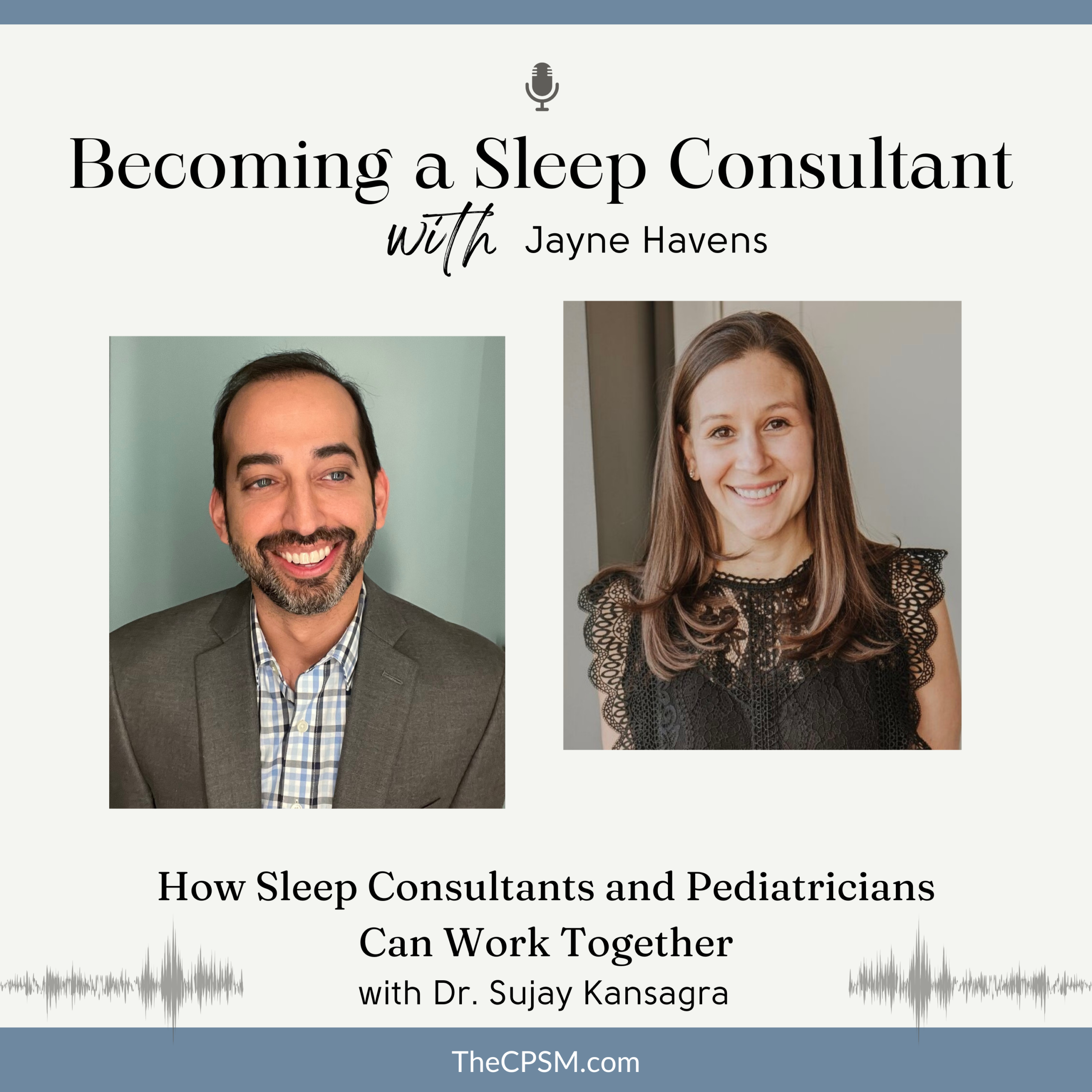
How Sleep Consultants and Pediatricians Can Work Together with Dr. Sujay Kansagra
In this episode of the Becoming a Sleep Consultant podcast, I’m joined by Dr. Sujay Kansagra for a conversation on how sleep consultants and medical professionals can work together to better support families.
Dr. Kansagra is a professor at Duke, and the Director of Duke University’s Pediatric Neurology Sleep Medicine Program.
In our conversation we discuss the role that medical professionals and sleep consultants play in addressing pediatric sleep challenges, where collaboration can improve outcomes, and how sleep consultants can build trusted relationships with pediatricians and other providers.
We also cover the ongoing controversy surrounding sleep training, the prevalence of misinformation in this space, and how to approach these conversations with parents in a clear, confident, and responsible way.
This episode focuses on how sleep consultants can strengthen their approach, support families more effectively, and build trust within the broader medical community.
Links:
Website: Lullabee
Instagram: @thatsleepdoc
TikTok: @thatsleepdoc
If you would like to learn more about becoming a Sleep Consultant, please join our Facebook Group: Becoming A Sleep Consultant
CPSM Website: Center for Pediatric Sleep Management
Book a free discovery call to learn how you can become a Certified Sleep Consultant here.
Transcript:
Intro: Welcome to Becoming a Sleep Consultant! I’m your host Jayne Havens, a certified sleep consultant and founder of both Snooze Fest by Jayne Havens and Center for Pediatric Sleep Management.
On this podcast, I’ll be discussing the business side of sleep consulting. You’ll have an insider’s view on launching, growing, and even scaling a sleep consulting business. This is not a podcast about sleep training. This is a podcast about business building and entrepreneurship.
In this episode of the Becoming a Sleep Consultant Podcast, I’m joined by Dr. Sujay Kansagra for a conversation on how sleep consultants and medical professionals can work together to better support families.
Dr. Kansagra is a professor at Duke, and the Director of Duke University’s Pediatric Neurology Sleep Medicine Program. In our conversation, we discuss the role that medical professionals and sleep consultants play in addressing pediatric sleep challenges, where collaboration can improve outcomes, and how sleep consultants can build trusted relationships with pediatricians and other providers. We also cover the ongoing controversy surrounding sleep training, the prevalence of misinformation in this space, and how to approach these conversations with parents in a clear, confident, and responsible way.
This episode focuses on how sleep consultants can strengthen their approach, support families more effectively, and build trust within the broader medical community.
Jayne Havens: Dr. Kansagra, thank you so much for being willing to have this conversation with me today. I’m very excited to be connected with you. Welcome.
Dr. Sunjay Kansagra: It’s wonderful to be here. Thanks for the invite.
Jayne Havens: So before we get started, would you share a little bit about yourself?
Dr. Sunjay Kansagra: Sure. So I am a child neurologist by training. I did a subspecialty in sleep disorders. And so day in, day out, in my clinic, I’m seeing kids that have sleep-related challenges. And yeah, I’ve been on the social media world for a few years now, trying to spread the education message wherever I can. And so you may have seen me there.
Jayne Havens: So I invited you to have this conversation with me today because I really wanted to talk about how sleep consultants and medical professionals might be able to work together to better support families. I think that when collaboration is there, families get better outcomes, and it really opens the door for stronger, more trusted relationships between consultants and providers.
Do you have any thoughts on this? How can sleep consultants and medical professionals work hand in hand or alongside one another to make sure that families are getting the advice and the support that they need to reach their goals?
Dr. Sunjay Kansagra: Yeah, I certainly think that in the sleep consultant’s role, if they’re identifying things that do seem like red flags regarding medical-related issues that could be contributing to sleep dysfunction, I think it’s something that it’s important to encourage families to kind of bring up. It’s interesting in that, from a behavioral sleep intervention standpoint, we really don’t get much training during most of our careers, medical school, residency. In some situations, there’s some, but it’s quite varied. And so, you know, what we take for granted regarding the range of behavioral approaches, pediatricians may not be as familiar with the entirety of the range and even the evidence behind some of that. I think sharing best practices, sharing evidence-based information, and then identifying where red flags occur and encouraging that conversation with medical providers is important.
Jayne Havens: Yeah, one thing that I’ve noticed as a mom of two—I’ve been going to well visits for years—the one question that gets asked at every single appointment is, “How is sleep? How is your child sleeping?” From the newborn phase all the way up to—I have a 13-year-old and a nine-year-old—and I still get asked this question at every single visit. And lucky for me, my kids sleep great. But maybe not lucky. I’ve worked hard at it. But a lot of parents go to these appointments and they get asked the question about sleep. The parents might say, “Oh, it’s horrible. We’re up every 45 minutes,” or “We don’t know what to do.”
And the pediatrician has, what, 15 minutes, 20 minutes with you. They’re not necessarily in a position to walk you through all of the different options for how to work on it. They may not even know all of the different options, as you’ve mentioned. And what I hear from parents is they might hand you a flyer: “Here’s how to implement the Ferber method,” or, you know, “It’s safe to cry it out. Your baby is six months,” right? They might say something like that.
Parents are feeling really overwhelmed by this. Okay, so it’s safe to do this, but now what? This feels really heavy and loaded and emotionally charged, and I’m just being told to cry it out and go on my way. So I think that that’s tough for parents. And I’m wondering if you agree that this is really where sleep consultants can come in and be really helpful.
Dr. Sunjay Kansagra: I kind of joke that my common, healthy child that’s having sleep issues as an infant, it takes me an hour. It’s an hour-long appointment to go through all the various strategies, go through what a parent’s perceptions are regarding sleep, where they’re coming from when it comes to temperament of a child, background history, medications, et cetera, et cetera. So it’s a long visit. And these poor pediatricians, in 20 minutes, they have to cover everything—from sleep to nutrition to potty training to gun safety, sleep safety. The list goes on and on.
And so, you know, if the expectation is, “I’m coming into this visit and I’m going to have a comprehensive understanding of all these different things,” it’s unfortunately not going to happen. And that’s where I usually encourage folks, if there is an urgent issue like sleep-related challenges, if they could consider actually making either a follow-up appointment or reaching out to a sleep professional to help them with that scenario.
Jayne Havens: What would it take for you as a medical professional to refer out to a sleep consultant? Now, I know your circumstance is a little different because this is literally what you’re doing. But I guess I’m asking you, from any pediatrician’s perspective, what might it take for a medical professional to say, “You know what? I think you would benefit from having coaching and emotional support as you navigate this process.”
Dr. Sunjay Kansagra: Yeah, it’s a really tricky scenario in the medical world because whenever we are referring out for whatever, there is already a system in place to say, “Okay, I need a dermatologist. Let me put in a dermatology referral in my epic EHR, electronic health record system,” and then it gets routed to the appropriate professional all through the back end.
We don’t really have a way of referring out to services that aren’t already tied into our medical system. That’s just the limitation of what we have. And so, you know, if I need, like, a sports trainer for a child, I’m like, “Oh, you could use some executive coaching skills because you’re taking on some leadership.” We just don’t have that. We don’t have that ability. And then in medicine, we do tend to work within the silo that we’ve been given or put in. And so it’s very hard to then say, “Okay, I’m going to send you to such-and-such person to help with your sleep issues.”
And then I think you understand this, I think, better than anybody because, again, you’re trying to formalize what is the education process regarding sleep consultants. But a pediatrician, they wouldn’t know the background training of a sleep consultant unless they were closely affiliated with that person. So it’s not that, okay, I’ll just send you to a sleep consultant. Because there’s a variety of what you’re going to get in that space, just like there’s a variety of what you’re going to get in medicine when it comes to seeing a pediatrician, et cetera. And so there has to be some sort of either a vetting process or a way for the medical folks to get to know who they can trust and who they can send the patients to.
Jayne Havens: In my personal experience, all of my referrals that come from pediatricians or medical professionals all come to me because I’ve worked with a family who then recommends me to the pediatrician.
Dr. Sunjay Kansagra: I love that.
Jayne Havens: Actually, I haven’t spent any time marketing myself to pediatricians, not because I don’t believe in it. I think it’s actually a really great way to market yourself as a sleep consultant. I just haven’t really needed to do that. But I do have several pediatricians that refer to me. Some of them aren’t local to me, which I always think is so funny.
You know, like, I’m in Baltimore, Maryland, and I get a call from a pediatrician in Great Neck saying like, “Hey, I know you work with infants, but can you help this family? They have a three-year-old.” And little does this pediatrician know that I actually work almost exclusively with three- and four-year-olds. So, you know, they’re thinking that I sleep train babies, which I do, but that’s just because the person who told them about me happened to hire me when their baby was six months. So that’s really what it looks like for me.
But, you know, as somebody who trains other sleep consultants to do this work, I do talk to them about forming relationships with people who are already supporting families in various different capacities. Not all are medical professionals. Some of them are preschool directors or daycare owners, postpartum doulas. But I do think that for many pediatricians who don’t have the time capacity or even necessarily the knowledge to support families in this way, it’s helpful to figure out ways to bridge that gap so that pediatricians can share that sleep training is evidence-based, safe, and effective, and then you’re somebody that can walk you through it.
Dr. Sunjay Kansagra: I think that’d be the ideal relationship, which is, again, having somebody that you trust either because patients have given direct feedback or because you’ve taken the time to kind of vet out the kind of practice they may have to make sure it jives with what you believe in as a medical provider. But yeah, I mean, if you’re in a visit, you want to offer them something more than just a handout because we know this is a longitudinal effort.
There’s been no scenario in which I’ve given behavioral insomnia recommendations in my clinic and then I never get questions again. It’s like, okay, we’re done. There are numerous things that happen between the planning and then execution phase that do need, I think, that more longitudinal kind of assistance. And so, yeah, I think there are certainly areas for the ability to partner and collaborate.
Jayne Havens: What would you say are some of the biggest sort of red flags that sleep consultants should be noticing or identifying that would suggest, okay, this is time to really kick it back to the medical professionals?
Dr. Sunjay Kansagra: I think in the behavioral insomnia realm, we’re very good about identifying patterns. And so we know what typically looks like a sleep-onset association issue for a child, and we understand that the pattern of this is how many times they’ll probably be waking up, which is in the realm of what I typically see. We know that if the shoe fits, it’s probably what it is, right? The child is getting back to sleep quickly with the same association put back in place. And so if there are no red flags regarding overall growth, the child isn’t premature, and development seems overall on track, those are usually all good signs.
I would say that if there’s anything that, to you, gets your spidey sense up to say, like, there’s something that’s just a little bit unusual here—you know, the child may be having some more difficulty even during the day. Maybe there’s some GI-related stuff. Maybe there’s some development-related stuff. All that stuff should be red flags to say, well, could we get a pediatrician’s input on why sleep is so disrupted?
Jayne Havens: One question that I get asked by parents regularly is they’ll say, “How do we know that something bigger isn’t going on?” I get asked that all the time. My response to them is, “Well, there might be, and I’m also noticing that you’re rocking your baby to sleep. Let’s just start with making that one simple change. My guess is just because your baby likes to be rocked and they like to fall asleep with a pacifier in their mouth, but they also don’t know how to replace it. Let’s work on these behavioral challenges first. And if it doesn’t resolve the way that we would expect it to resolve, then we’re going to dig a little deeper and figure out why your child is still struggling.”
Do you think that that’s fair? Do you think that behavioral interventions is like a fair place to start, and then if things don’t resolve the way that we would expect them to resolve, then okay, this is an outlier. Now we need to start digging deeper.
Dr. Sunjay Kansagra: No, I think that approach is quite fair. And I tell families, yes, there could be, as you mentioned, it could be multiple things. But we know based on your pattern that there is a behavioral component, right?
So there could be multiple things, but at least some percentage of this is from a behavioral standpoint. So let’s go ahead and implement those skills that your child can use to help them with that behavioral stuff. And I found that even if there are other medical things contributing, usually, those will come to light. Because the pattern is different than what we’d expect. And so, yeah, I like that approach. Let’s see if we can get the behavioral stuff taken care of and then see how the rest plays out.
Jayne Havens: So the whole reason that we connected originally is because you had noticed a comment that I left on one of your Instagram reels where I was responding to someone who had shared some misinformation on your post. Why do you think that there is so much misinformation that circulates so widely on this topic?
Dr. Sunjay Kansagra: Yeah, I think parenting in and of itself is an emotionally charged time. Everybody has strong opinions based on so many factors. One, how they were raised or how they perceived how they were raised, how they’ve raised their own children, the results that they see with their own children. So if you happen to have a great sleeper, you think you are the most amazing sleep coach in the world, right? You’re like, “Oh, my child was sleeping 12 hours by the time they were 12 weeks,” even though they didn’t necessarily do anything to harbor that. It just happened to be the nature of their child.
And then when the second child is born and they get drop-kicked in the face with sleep challenges, they’re like, “Oh, maybe it was something else,” right? So everybody is biased by their own experiences, what they’ve learned, what they’ve heard. And I will tell you that people are convinced, just due to the amount of misinformation out there, that they are correct and that sleep training is potentially harmful. They are convinced. And no amount of data, unfortunately, ends up changing their minds. It’s just the nature of the world we live in. We are biased by the information that we get and the information that we want to hear.
Jayne Havens: Yeah, so my personal experience was exactly as you described. My son, who’s now 13, when he was born, he was such an easy baby. He was totally chill. He drank his formula no problem. He slept as he was supposed to. He pooped as he was supposed to. And I just thought I was the mother of the universe.
Dr. Sunjay Kansagra: Then you probably were, to be fair. You still probably were.
Jayne Havens: I was like, “What is everybody having such a hard time about? Y’all need to get it together. This isn’t that hard.” And that was my story for about the first four months. And then right at 16 weeks, his sleep unraveled. He really sort, he went from sleeping through the night to waking up every single hour on the dot—midnight, 1, 2, 3—and he just wanted his pacifier replaced. That’s it. I was just doing it, and I thought to myself, what is going on here? I was a first-time mom. I had no idea why that was happening.
That’s really where my journey all started. This was before—I mean, it wasn’t before social media, but it was before Facebook groups. It was before online courses about sleep. And really, I went to Barnes & Noble and I sat on the floor. I went through the backs of the books and was like, “All right, what do I need to figure out?” I basically implemented some sleep training with him. It was totally life-changing. And I realized in that moment, okay, this is figure-out-able, and I wanted to just sort of share it with the world.
You talk about getting drop-kicked in the face. My second child had a milk soy protein intolerance, and she cried nonstop. And it’s amazing how all of your own personal experiences can really sort of impact how you view everything else. Because I take those two data points. I was on the phone with a client today and she was talking about how her baby might have reflux. I’m hearing her talk about it, and I’m thinking, that doesn’t sound like reflux. That sounds like milk soy protein intolerance. And so it’s interesting how your own very few data points really will, to some degree, impact the way that you think about things. And sometimes that works to our advantage and sometimes it doesn’t.
Dr. Sunjay Kansagra: You can only imagine that if your firstborn had just continued to be a wonderful sleeper, you’d be like, “Why is sleep training even a thing?” And you would be having hopefully joyful, well-rested days with your child where everybody’s happy and content. And you’d be like, “Why is that mother suffering from postpartum anxiety or postpartum depression, and why is she so tired?” without understanding that everybody’s experience is 100% different.
And every child you have, as you’ve so nicely demonstrated, is also different. Every child is like a new child. It feels like your first child because your experience is going to be different. Fortunately, we’re in a position where we get to see the breadth of what’s actually out there. But there are many that are not. They’re stuck in their little bin of information thinking and their sample end of two and saying, “Well, this is just how the world is.” And unfortunately, that’s just not the case.
Jayne Havens: Why would you say that sleep training is so controversial? The evidence is clear that it’s safe, effective. Why is there such argument about this?
Dr. Sunjay Kansagra: I think there are a lot of camps here. I think people are very good at extrapolating data that doesn’t apply in a certain situation and then trying to apply it to that situation. So we talk about learned helplessness, for example, which is not what sleep training is. We talk about trauma and orphanages, which is not what sleep training is.
People like to take data, things like cortisol and studies, and misconstrue and say, “Oh, cortisol increases.” Unfortunately for them, there is no data that shows cortisol increases. In fact, studies show the opposite. It actually decreases. But again, people are going to want to believe what they want to believe.
And so even if — I try to get too deep in my comments for this reason. Because no matter how much effort I put into showing data and showing studies, you can see people’s minds just trying to get back to the, “I know I was right in the first place.” This actually plays out in real time. On the post that you commented on, there was somebody that mentioned, “Hey, can you please share data? All I’ve heard about is small studies with small groups that are highly skewed.” And somebody followed on that comment and said, “Yeah, that’s what I’ve heard too.”
And then I share a bunch of data that has large studies, randomized controlled trials, and you can see the wheels turning. So the second commenter was like, “Wow, is this true?” and asks the first commenter, “Is this true? There’s actually data?” And the first commenter goes, “No, I’ve read all those, and I don’t think those are really good studies.”
These are randomized controlled trials, sometimes with hundreds and thousands of participants. And you can see the second commenter is like, “Okay, thank you for telling me that.” Telling you what? What you already previously believed that you want to continue to believe despite me sharing evidence that says what you believed is incorrect. We just want to believe what we want to believe no matter what. And as long as somebody tells us that we’re right, we just go with it. That’s unfortunate.
Jayne Havens: I think that’s right. I also think that there’s just a lot of weight and emotion put on our children’s happiness, like their permanent pleasure, right? Like we as parents, I think, have gotten to the point where we are just, on some level, very uncomfortable with our children’s temporary discomfort. And as somebody who’s been supporting parents—I’ve been supporting parents through sleep training for 13 years now—what I can say is that, 13 years ago, it looked different than how it looks today.
I think parents are so much more uncomfortable with our children’s temporary discomfort than they were 13 years ago. And I think that’s leading the charge on some level. It’s that we as parents, there’s this messaging—I don’t know where it’s coming from, if it’s mom-shaming in real life or mom-shaming online. But it’s, if our kids are crying, we are bad moms. Do you see that coming up in your conversations or in your work?
Dr. Sunjay Kansagra: Well, I think there are parenting trends in general that I see come up mostly on social media as opposed to my work. By the time they’re in my clinic, they’re usually really willing to make some sort of a change and open to advice on what to do for that. But in the social media world, I think parenting, unfortunately, this is the hardest time to be a parent because everybody has opinions, and they will swear by them even if they may not necessarily be true.
But yeah, I do think there is this sense of, we have to be perfect parents, and our children have to always be happy. Unfortunately, on the tail end of that, it leads to children that may not have been allowed to form a little bit of grit against areas of discomfort. I’m not saying we’re trying to instill grit in infants, but for our toddlers, as they’re getting older, teaching them that it’s okay to persevere on tasks that initially seem frustrating. Parents should not be coming in to save them every time there’s a little bit of discomfort because that actually takes away their own confidence. So, you know, I think these are tried-and-true principles, but ones that don’t really come across well on social media.
I also think that everybody has their own agenda. Most people that I have found that have been strongly opposed to sleep training and have led the charge in this message usually have an underlying agenda that may be obvious or not so obvious. There is some level of, I think, a bias against just of women unfortunately having to suffer the consequences of a child’s discomfort at nighttime.
It’s a very unfair world when it comes to the balance in caregiver duties, both during the day and nighttime. I think some of that bias sometimes comes through in some of these social media talking heads that say, you know, a woman should wake up every hour and breastfeed her child at night every time the child cries. Nope, she shouldn’t. She shouldn’t do that.
There are people that have entire books and courses around, “Oh, I will support you because sleep training is harmful. Let me give you an alternate strategy,” because you already believe this, and it’s easy for me now to take you into my realm and offer you something that I’m incentivized to offer you. And again, I say all of this as somebody that has zero incentive to actually support sleep training financially, right? I mean, maybe we’ll talk about Lullabee a little bit. But I’m just sharing what the data shows. I’m just a conduit of data as opposed to a conduit of what’s incentivized for me personally.
Jayne Havens: One thing that my students inside of Center for Pediatric Sleep Management are always asking me is how they can better combat the negativity around sleep training. And what I always say to them is, I’m not in the business of fighting people who think something else. I’m just not even interested in those conversations. I am focused on connecting with people who want help and who are comfortable with the idea of making some behavioral modifications. That’s it.
All the people who think that sleep training is torture and trauma, I don’t even have conversations with those people. I’m not going to change their mind. I don’t care if they’re tired. That’s their business. And a lot of the time, especially on the internet, I think that they’re particularly mean online because they’re cranky and sleep-deprived. And I just let them be. I really try to focus on having conversations with people who really want to make a change, and I really do tune out the rest of the noise as much as possible.
Dr. Sunjay Kansagra: You know, I love that. When it comes to sleep consultants, individual business practices, their own perhaps social media presence, I agree. Sometimes it’s important. You don’t want to invest 90% of your time in addressing something that people aren’t going to change their mind anyway.
At the same time, I am so incredibly thankful for folks like you and other sleep coaches and consultants and professionals that come into the conversation and actually act as the voice of reason and are like, “By the way…” I think we are our own kind of army of evidence-based warriors here where we’re like, well, we got to balance this message. Otherwise, a tidal wave of misinformation just sweeps and makes things difficult for all families. So I’m incredibly thankful that sometimes people do choose to fight a little bit of the battle. But at the same time, it should not distract you from what the main goal is, which is helping those that are receptive to your help get the help that they need.
My only goal when it comes to the misinformation is that parent that wants to do something but has been scared out of doing something because they’ve been presented with misinformation, but are certainly open to hearing what the evidence actually shows on this topic. And the evidence is very clear.
And so my advice would be to those folks that are being met with this challenge, I always say I’m open to new data. If you have a study that you can share, that’s a study that looked at sleep training as an intervention and harm as an outcome, send it to me, and I will read that study. And then I will balance that study with the hundreds of studies that have already been done that show that sleep training is helpful or, long term, is like a wash when it comes to overall sleep but shows no negative consequences whatsoever for children, for families. So I say, just send me the study. Just show me the study. I’m not asking for more than that. Just show me the study.
Jayne Havens: It’s interesting that you say that you’re grateful for sleep consultants like me who come in and engage in these conversations. I actually never do that. It’s not that I’m against it. I just don’t have the energy for it. And I don’t know what compelled me to say something on that reel of yours because I literally never engage with these people. But I think whatever that person said, I was like, “You literally make no sense. I need to respond.”
Dr. Sunjay Kansagra: Well, I thank you for doing it.
Jayne Havens: And I’m so grateful that I did because I’m all about making meaningful connections in the space. I really do try to not engage with the keyboard warriors. I’m generally not trying to change anybody’s opinion. But I do think that the internet is a really wonderful and special place that allows us, as professionals—you know, you and I probably never would have ever crossed paths personally if I hadn’t made that comment.
Dr. Sunjay Kansagra: That’s right. That’s right, yes.
Jayne Havens: So, you know, maybe I need to do that more often.
Dr. Sunjay Kansagra: Maybe, yeah. No, I have certainly forged some friendships over fighting for the science of sleep and the science of medicine in general.
Jayne Havens: It’s all good, right?
Dr. Sunjay Kansagra: Yeah, that’s right.
Jayne Havens: I do want to give you an opportunity to share about your latest project, which I think the internet has helped you to really be able to get this off the ground, right? Thank God for Instagram and TikTok or whatever, right?
Dr. Sunjay Kansagra: Yes, it’s been amazing. Yeah.
Jayne Havens: So tell us a little bit about what you’re working on.
Dr. Sunjay Kansagra: Yeah. So back in the day, I wrote like a high-yield, step-by-step guide for behavioral interventions, including sleep training for infants. It was about a decade ago. I was like, well, it’s fairly, in many ways, formulaic. Like, what our final goal is pretty common. I’m like, you know, maybe a device could help us with this and help us keep children in the crib, in a safe sleep space. And I just thought, someone’s going to invent it. It’s such an easy concept. It’s like an automated sleep-training crib mattress, right? That’s what Lullabee is.
And I was like, let me wait. Let me wait. And I kept waiting. And then I just saw enough kind of bad things happening to children when they were not in the safe sleep space that finally I said, “I got to do something. I’m going to make this myself—with zero business experience, entrepreneurship experience or engineering experience. And so we started. Eight years later, we have Lullabee, a smart crib mattress that teaches children to sleep better over time and gives them something that can help soothe them in that safe sleep environment, which is the crib.
Jayne Havens: Can you tell us how it works?
Dr. Sunjay Kansagra: Yeah. So it essentially looks like an ordinary crib mattress. It has technology embedded deep inside. When the child wakes up and cries, then Lullabee turns on and provides gentle vibration and sound at different intensities to help soothe them back to sleep. And once they fall asleep, it holds it for about two minutes and then slowly ramps back down to zero output. So for the vast majority of the night, nothing is coming out of Lullabee. It’s only there to support as a child needs. You can select different vibration patterns, different audio patterns, different combinations to find what your child likes best.
But the unique thing is that, over time, it’s tracking the child’s historical sleep patterns. And it knows the child is actually sleeping well with the help of Lullabee as a “sleep crutch.” And then it starts to wean them off of it. So we talk about behavioral methods like camping out. Gosh, if I could just rock my child 10% less every week, this would be a nice, slow way of sleep training. Well, human beings can’t do that, but Lullabee can do that.
And so it’s meant to gradually support them when they need it and gradually wean them off when they’re ready to become independent sleepers. And then, because sleep is this, it’s an up-and-down constant loop—it’s not a straight line—children are going to regress. It’s just the natural part of sleep. It’s there to pick back up through those regressions to help the child get right back on track over time. So temporary technology help for long-lasting behavioral change. That’s the goal.
Jayne Havens: That’s really exciting. I want to ask you, because you’re a medical professional but now you’re venturing into this entrepreneurial space, what’s been the most exciting part about it, and what’s been the hardest?
Dr. Sunjay Kansagra: Well, I will tell you that the feedback that I’ve gotten from families, it’s just so kind of fulfilling to know that we put— this has been my biggest project. Apart from parenthood, this has been the biggest project of my life. And we knew that we had something. After we did our initial clinical trial on this prototype that we developed, I was like, we got to get this out in the world.
Now that it’s out in the world, hearing back from families— you know, we just had our first customer that bought a second one, and she’s like, “I have to have this because I’m spending the summer at my parents’, and I got to have a Lullabee there too because it’s working so well for us here. We need to have a Lullabee in both places.” And just to hear that level of feedback from parents and that their baby is getting relief, they’re getting relief, is super fulfilling.
The hardest part has been managing that while still being a full-time clinician at Duke. I haven’t taken any time away from my Duke activities, and so that balance is hard. But because I sleep well at nighttime, I feel like I have plenty of energy and plenty of time, both during the day and with my kids and my wife, to still do all the other things that I need to do during the day.
Jayne Havens: That’s all really, really exciting and fantastic. Before we wrap up, please share where people can follow along on social media. I think that your videos are so great. They’re educational. They’re informative, and they also have a lot of humor, which I just really enjoy.
Dr. Sunjay Kansagra: Oh, thank you. I try to keep that attention because it’s so hard these days. But anywhere social media is consumed, I’m @thatsleepdoc. That’s my handle, @thatsleepdoc.
Jayne Havens: Thank you so much. It was great chatting with you, and I hope we can remain in touch.
Dr. Sunjay Kansagra: Absolutely. Thank you.
Outro: Thank you so much for listening to this episode of the Becoming a Sleep Consultant Podcast. If you enjoyed today’s episode, it would mean so much to me if you would rate, review, and subscribe. When you rate, review, and subscribe, this helps the podcast reach a greater audience. I am so grateful for your support.
If you would like to learn more about how you can become a certified sleep consultant, head over to my Facebook Group, Becoming a Sleep Consultant or to my website thecpsm.com. Thanks so much, and I hope you will tune in for the next episode.

Considering A Career in Sleep Consulting?
Download our free e-book filled with information on what sleep consultants do and how running a sleep consulting business might fit into your life.
FrEE DOWNLOAD
Thank you for your message.
We will contact you shortly!