
Jayne Havens is a certified sleep consultant and the founder of Snooze Fest by Jayne Havens and Center for Pediatric Sleep Management. As a leader in the industry, Jayne advocates for healthy sleep hygiene for children of all ages. Jayne launched her comprehensive sleep consultant certification course so she could train and mentor others to work in this emerging industry.

Meet Jayne Havens
Interested in Becoming a
Sleep Consultant?
Join Our Free Facebook Group
How Teaching Prepared Me for Sleep Consulting with Danielle Greene
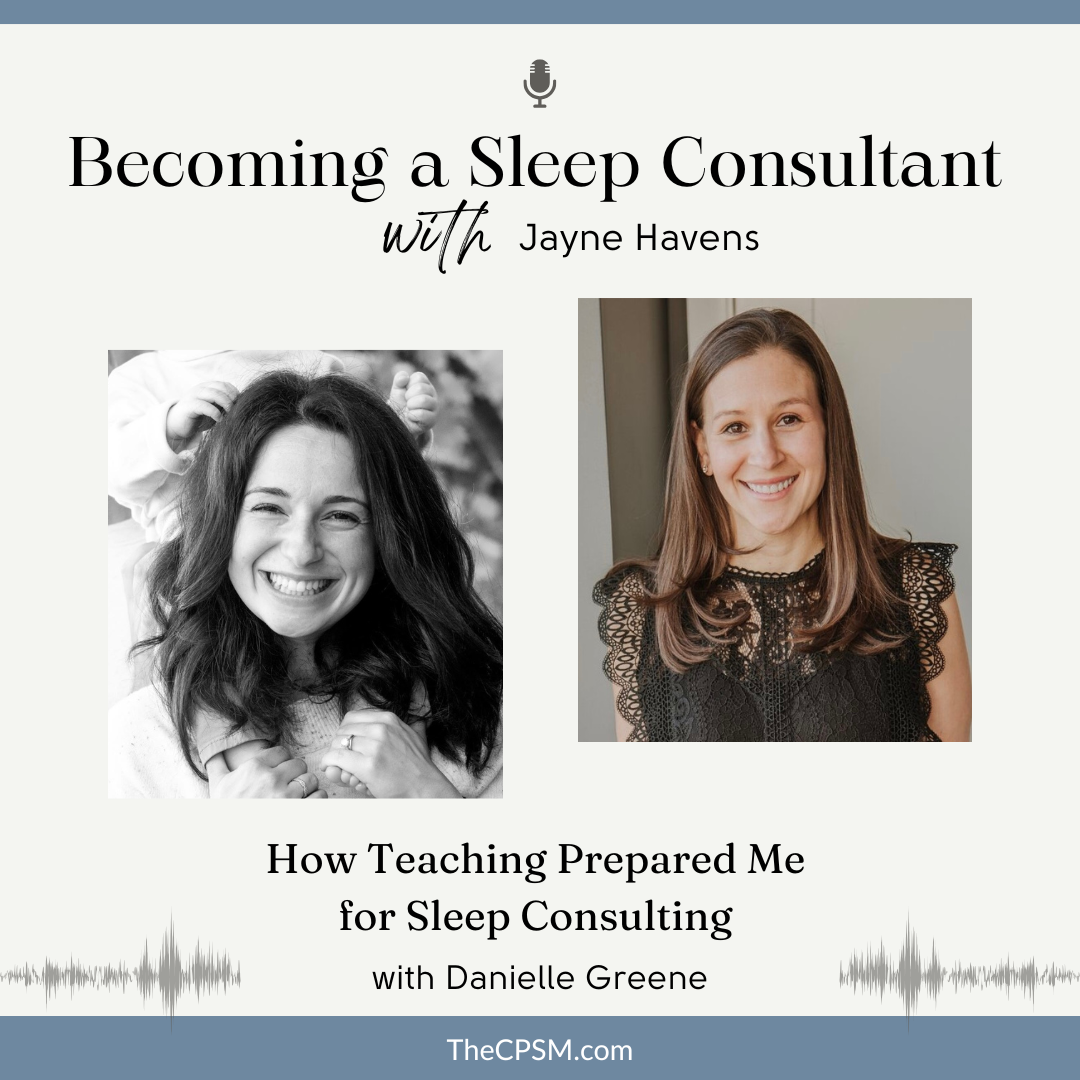
How Teaching Prepared Me for Sleep Consulting with Danielle Greene
This week on the Becoming a Sleep Consultant podcast, I’m joined by Danielle Greene, a former first-grade teacher turned pediatric sleep consultant.
Danielle shares how her years in the classroom continue to influence the way she supports families today. We discuss communication with parents, how she teaches her clients about co-regulation, and the many skills that transferred from teaching into her work as a sleep consultant.
If you’re considering a career in sleep consulting, this episode is a great reminder that some of your greatest strengths may come from the experience you already have.
Links:
Website: DG Sleep Consulting
Instagram: @dgsleepconsulting
If you would like to learn more about becoming a Sleep Consultant, please join our Facebook Group: Becoming A Sleep Consultant
CPSM Website: Center for Pediatric Sleep Management
Book a free discovery call to learn how you can become a Certified Sleep Consultant here.
Transcript:
Intro: Welcome to Becoming a Sleep Consultant! I’m your host Jayne Havens, a certified sleep consultant and founder of both Snooze Fest by Jayne Havens and Center for Pediatric Sleep Management.
On this podcast, I’ll be discussing the business side of sleep consulting. You’ll have an insider’s view on launching, growing, and even scaling a sleep consulting business. This is not a podcast about sleep training. This is a podcast about business building and entrepreneurship.
Danielle is a mom of two, certified sleep consultant, and former first-grade teacher with a background in social-emotional learning, serving exhausted parents both virtually and in person.
After struggling through her own newborn sleep struggles and then hiring a sleep consultant—that’s me—Danielle turned that experience into a business built around real, hands-on support, including in-home overnight sleep training, where she shows up in person to guide families through the hardest nights in real time. With hundreds of families served and results typically seen within the first one to three nights, Danielle is on a mission to help parents enjoy parenthood and get back to living a life they love.
Jayne Havens: Danielle, welcome back to the Becoming a Sleep Consultant Podcast. I’m so excited to chat with you today.
Danielle Greene: Thank you for having me again. I’m so happy to be here.
Jayne Havens: So tell us a little bit about your career before sleep consulting. What drew you into education in the first place? And I guess I’d also like to know why you ultimately decided to leave.
Danielle Greene: Sure. So I studied elementary education in college. And before that, I feel like if a teacher is listening to this, I’m sure you can relate, where it’s like you love babysitting, you love all the babies, you’re the best big cousin, you just gravitate towards the kids always, and it was kind of like a no-brainer. There’s like, “Oh yeah, of course Danielle’s going to be a teacher.”
But at the same time, my dad worked—and works still—in fashion, in the shoe industry, and that was something that I really, really loved. I felt torn. I was like, fashion school, fashion education, fashion classroom. I really didn’t know. And obviously, in the end, I decided to make my way to the classroom.
It wasn’t something that I was like, “Oh, I’m going to be a teacher, and I’m going to retire a teacher in the same classroom for 35 years.” That was never my goal. And I think, at the end of the day, the reason I became a teacher was because I was inspired by my elementary school teachers. I was very, very close with them. They were at my bat mitzvah. They were at our wedding. I love them so, so, so much. And as an adult, I realized it’s great to be inspired by people, but it doesn’t mean you have to do exactly what they do, right? I don’t regret having that realization too late because it led me to what I’m doing now.
But you know, when I studied education, I really loved the kids. I wasn’t interested in writing lesson plans. I wasn’t interested in any of, like, the stuff that isn’t super romanticized or glamorous. I really just wanted to be on the floor laughing with kids and doing fun art projects. I was good at teaching.
Surprisingly, I discovered that not only was I good at teaching kids, I was really good at parent communication. And I don’t say that as a flex, right? I say that because parent communication, I think, for most teachers, is one of the most stressful parts about the job. They dread it—the report cards, the phone calls, the emails. “Oh my gosh, your kid did something bad and I have to make the…” I loved it all. I loved being able to tell a parent, like, “You know what? Your kid made this choice. And here’s what we’re going to do to work together to not do it again and to make it better.”
By the time I had my second child, I realized, like, I’m so burnt out. I get home at the end of the school day, and I have nothing left to give my own kids because I’ve been giving 100% to these other people’s kids. But I actually feel like I have so much time to talk to parents. There’s something about it that I just, I never get tired of it. And once I had that realization, that kind of helped me realize maybe I don’t have to leave education entirely. Maybe I just have to change what the definition of education to me means for my own career.
Jayne Havens: So share with everybody how you got into sleep consulting. Share a little bit about your own experience sleep training your son and then a little bit about your decision to actually start doing the work.
Danielle Greene: Sure. So I became a mom during COVID in 2020. We were living in Manhattan at the time. My husband was back at work in person, and I was not. And I, as someone who has always wanted to be a mom, I think I was surprised by how bored and miserable I was—not necessarily by motherhood, but by the fact that I was quarantined in my tiny New York City apartment alone with this baby that would not sleep for more than 36 minutes at a time during the day. I was losing my mind.
I had a friend who had hired you, and she told me about you. And I was just like, “Okay, like, why not?” And I regret— I don’t regret not doing it sooner. I regret having the discovery call with you and then taking as much time as we took to decide to hire you. Because it was literally night and day in a matter of a night, right? Once I saw that this could work, I was like, “Oh my gosh.” All of a sudden, I love motherhood.
If I feel safe enough to leave my apartment because of this pandemic, we can go to Central Park because I’m not afraid of a nap on the go, or I’m not rushing. Like, I know that if he falls asleep in the stroller, I can adjust, right? I have the tools now. And then that made the rest of being quarantined a lot easier. And then I kind of forgot about it, right? You move on. The world moved on. Everything opened up, and life was good.
And then I got pregnant again, and I was like, I really don’t want to go back to what I was doing. Not because I want to be the stay-at-home mom that just is home, right? I wanted to be home with my kids but also doing something that was mine. I was like, I don’t know what that is. I’ve always been someone that said: “I’m going to work for myself. I just don’t know what it’s going to be.”
And because I had met you in 2020, in 2023, all I had to do was remember, “Oh my gosh, my daughter is an amazing sleeper because I was given these tools two and a half years ago.” Now I can maybe take those tools, help other people create their own toolbox, and actually make money from it. And that was it. I turned to my husband on the couch one night before I went back to work, and I was like, “I’m going to finish out the school year, but I don’t want to do it anymore. I’m done.” It’s going to be a huge risk. I have no idea if it’s going to work, but I am not going back.
No matter how much money I make or don’t make from sleep consulting, I’m done. Luckily, it worked out in my favor. But yeah, that’s how I got here.
Jayne Havens: Looking back on it now, what parts of teaching specifically would you say prepared you most for sleep consulting? Are there any things that you took from either the classroom or your conversations with parents that maybe you weren’t quite expecting to carry along into your consulting business?
Danielle Greene: Yeah, I think that when it comes to sleep consulting, you’re dealing with two populations. You’re dealing with the child—whether that’s an infant, toddler, or an older child—and you’re dealing with their parents. At the end of the day, you are not just getting their kids to sleep, no matter how old the child is, but you’re really teaching them how to parent, especially for new parents. And I think that when a parent has a child and they’re in school, they’re really focused on, “Are they nice? Are they having friends? Are they getting straight A’s?” Like, okay. Let’s take a step back. We’re looking at the big picture here, right?
I was never the teacher that just looked at what we were doing day to day. You have to be looking at the big picture, whether it is a unit of study or just the big picture of how we’re creating citizens of the world and how we’re actually going to do that in a way that is appropriate. That’s how I look at sleep consulting as well. It’s not just about sleep. It impacts everything.
And so I think that having a background in child development really helps. That is really what allows me to come at this with truly realistic expectations. Not just what sleep training method is appropriate based on your age, but really what’s happening in your baby’s brain that is making it so that this is a method that’s appropriate. Having that data and understanding really, really allows me to take a whole-child, whole-family approach as well.
And then parent communication, like I said, that is a part of teaching that parents dread. And for whatever reason, I loved it. I don’t know if it’s because when I was a kid, I loved hanging out with my mom and her friends and I’ve always been a grown-up person. I don’t know. But I think being able to have those conversations and really notice patterns, and just parenting in general— I feel something that I’ve noticed over the past five-plus years is parents are really looking to be their child’s best friend.
In my opinion, that’s really problematic. I think that they are afraid to put up a boundary, to create structure, to discipline their child—when really the root of the word discipline is just to teach, right? I think that they need more of those tools than they do the sleep tools. I’ve heard you say you ask about the bedtime routine. But you also ask about, what does it look like in the morning and what does it look like when they get home from school? Right? It’s not just about sleep. It’s literally about everything. And so being able to communicate with parents in a way that actually is going to be conducive to their life is really, really critical for this work.
So I would say the child development piece, the parent communication piece, and then also talking to kids. It’s funny. There are some people who will say, “Oh, I’m a teacher because I’m great with kids, but I cannot talk to an adult. I have so much social anxiety about them or about that.” For me, I wouldn’t say it’s the opposite. I’m happy to talk to anybody. But for kids especially, you have to be able to read the room.
I think that being a classroom teacher, that is what you’re doing every single second of the day. You have 20 kids in a room. You’re reading that kid. You’re reading that kid. When I’m talking to my sleep consulting clients, I am sending them videos all the time. It’s not just a “send this back to me if you have a great night.” I’m really creating and cultivating relationships with them because I don’t want them to feel like I’m just another parent that’s nagging them. I want them to feel like they have this cool sleep coach, sleep teacher, whatever they want to call me, in their corner. And in order to do that, you have to have certain skills.
Jayne Havens: So talk to me about that. Are you sending videos to the kids? Are you recording video of yourself to coach the parents? What does that look like?
Danielle Greene: It’s a good question. So a few different types of videos. When it comes to kids, I only will send videos to them if they’re like minimum—like two, two and a half years of age. Earlier than that, there’s really no point. But I send them videos just first to introduce myself. Once I get the go-ahead and the okay from their parents, I introduce myself. I tell them a little bit about my kids, my husband, my job, my favorite things to do, my favorite foods, ice cream, all the things.
Because I feel like once you start talking about all the kid things—which really are not kid things, like we should all be talking about ice cream—they’re like, “Oh my gosh, this woman likes ice cream,” right? And so all of a sudden, that’s 10 points for me.
Then they send me videos of their favorite toys, and then I send them videos of my favorite toys. And it’s just— I don’t like FaceTiming because that feels— I don’t mind. It’s not a boundary thing. It’s more just like if they have this 32-second snippet into my life, they can keep watching, keep watching, keep watching. And that to me, feels so much more impactful. And then we get into the sleep stuff.
So once I send those videos, those warm-up videos, and we break the ice a little bit, then I slow down the videos and I send one before bed and one in the morning, if they send me one. Depending on the family, some kids like to meet my kids, if my kids are okay meeting clients. I find that my kids really, really are huge motivators, whether they realize it or not. I think I’ve heard you say that about your own kids as well.
Jayne Havens: Yeah. Do you pay your kids? You should be paying your kids.
Danielle Greene: I know.
Jayne Havens: If you’re not paying your kids, you need to pay your kids.
Danielle Greene: I know. I was just having this conversation with someone else and with myself, and I really do need to start. So that’s that. But in terms of sending videos to parents, I don’t usually. I send them a tremendous number of voice notes, and I find that to be unbelievably effective. But if there’s a specific strategy where I’m using an actual tool, I will send a video of myself modeling that. Or if I have a video of my kids and they’re okay with me sending it, I’ll send that over to them as well.
Jayne Havens: You mentioned when you were a teacher that you felt really comfortable having those tough conversations, where you call a parent and have to share, “Your kid did this in the classroom today. Here’s what we’re going to do to work on it.”
Do you have specific language or communication strategies to have those tough conversations with parents? Anything that you say that sort of lightens the blow or makes parents feel a little bit more comfortable with whatever less-comfortable message that you’re sharing?
Danielle Greene: Yeah, I think there are a couple of things. I remember when I was teaching, we were always told that if there’s something that happens during the day that requires immediate communication, that’s not an email. That’s a phone call, right? If it’s an email, that means it’s not urgent. It doesn’t mean it’s an emergency and someone’s in danger. But if it needs real addressing, it’s not an email because you know how that can read.
I think I take that same messaging into this work. Because most sleep consultants, I think, are working virtually and offering text message support. And it’s really easy to forget that, especially when you have several clients that you’re working with at a time, that maybe texting is actually not the best method for right now. And I think for a text-based business, I don’t know if enough sleep consultants are thinking that way. And so that’s the first thing.
If there is something where you feel like you need to either put up a boundary between you and your client, or if you feel like you have to address a boundary—or a lack thereof—between parent and child, to me that’s not a text message. That is a voice note. Or, “Hey, I’d love to troubleshoot this with you. Do you have five minutes today to hop on a call?” That’s the first thing. And that already, I think, makes it— it might feel harder for you, but I actually think it ends up better because the parents then hear your tone of voice, right? It’s so much easier.
And then the next thing is, whenever I start, I always start with, just like I talk to my kids, like, “If there’s something we need to talk about, I want you to know before I say anything, I’m on your team. We are all Team Greene,” if it’s my family. This is not you versus your kid. This is not me versus you. We are all working together. And it’s okay that things are going in this direction. That’s fine. But I think just the way you start off, obviously, is going to be huge.
And so, like I said, voice note or phone call first and foremost. And then also just saying, “Hey, I’m here with you. I’m not saying this because I’m mad at you. I’m not saying this because I think you’re doing anything wrong.” It’s really about being on a team. I think that also then helps the parents understand, I could actually be talking to my child this way. They feel it. I think my kid feels like I’m out to get them at bedtime, but really, I’m on their team, right? And I think that reframe is really important.
Jayne Havens: I think that you’re right on both accounts.
One thing I’ve noticed about myself is that when I get really busy with clients, sometimes I move too fast and I fire off a text message that I’m like, “Oh, that should have been a voice note,” or “That should have been a phone call.” And so I’ve been really mindful in the past year or so to really slow down.
Because I want to provide real-time support. I want to answer as quickly as possible. I want to be known as the sleep consultant that gets right back to you. But if you don’t have the amount of time that it takes to deliver the message in a way that’s going to be well received, it’s not a great idea to just fire off that message so fast, right? And so we need to slow down.
I love your language around us all being on the same team. What I say—a close friend and colleague taught me this—is that I just use a lot of “we” statements. So I love that you’re saying we’re on the same team. That’s even more specific. But when I talk about something that’s going on in their home, I’ll say, “What we want to be doing,” instead of, “What you need to be doing,” right? And that, to me, I think it suggests that we’re all on the same team and I’m in it with them.
I love that. Maybe I’m going to borrow that and really be even more specific and let them know that not only are we working together, but we’re on the same side. We’re on the same team. We all have the same goals. We all have the shared interest of improving the dynamic in your household.
Danielle Greene: Right. I always think about things like parent-teacher conferences or just any conversation with a parent. They’re not all going to be fun and happy. There are going to be hard ones. But regardless of what the content of the call is, of the meeting, whatever it is, I just never, ever wanted it to feel like there is some sort of confrontation or just anything where a parent feels like I’m out to get them. Because that’s never, ever the goal, right?
If someone’s hiring you to support their family, whether it’s with behavior or sleep or a math tutor, they are hiring you because you are coming across as someone that could really help them, right? They’re choosing you. They could have chosen anyone else. And so I really try to keep that in mind.
And then to your point about being someone that is responsive and who gets back to their clients, truthfully, voice notes take a lot less time. Because when you’re texting, it’s, “Does that sound right? Did that come out okay?” Just all the things, like, why are we even thinking about that, right? It’s so much more helpful to me, at least, to send a voice note. And there are some times I’ll send a voice note and I’ll be like, “Hey, I’m sending this as a voice note because I think I’m going to get my message across more quickly. But if you want this in writing, let me know and I will do that for you at some point today.”
Jayne Havens: Yeah, love that. I know that you spent some time in schools working specifically as the social-emotional learning specialist. What are some SEL learning principles that you’ve carried through into your work as a sleep consultant?
Danielle Greene: Yeah, I think there are some really specific strategies, and then there are some just overall umbrella principles that I try to carry into my work with me. And so things that are specific would be the breathing ball that I know you and I had spoken about a year or two ago already. That would be an example of a really specific strategy. A body scan, right? Really noticing what each part of your body feels like when you’re in bed and you’re trying to calm your body or regulate your nervous system. Things like that are very specific.
But I also try to take a lot of my classroom management skills and combine those with the SEL stuff, the social-emotional learning piece. Because kids need motivation. They need scaffolding, right? I am always telling, even with my husband, we have conversations like, “Okay, was that expectation we had for our child realistic?
Did that make sense given his makeup, his age, her makeup, her age, whatever it was?” A lot of times, they can’t do the thing that you’re asking them to do, right? Like going from bath to pajamas and saying, “Do that right now.” They’re passing bedrooms and they are seeing their toy that they left there. They need a little bit more support. And so whether that is with a checklist and you’re giving them the marker and they check it off, that’s one thing we talk a lot about.
I know you and I have spoken about getting uncomfortable with the uncomfortable. I also think about making the unglamorous glamorous. And I really am a firm believer that not everything should be romanticized. Not everything needs to be glamorous. There are parts of life that just stink, and you have to do it anyway. I am not a believer in taking everything and making it all happy and sunshine and unicorns. I don’t want my kids to think that’s the way life works.
But at the end of the day, bedtime actually can be a pretty glamorous thing. If you think about 30 years from now, what do you want your kids to tell your grandkids about what bedtime looked like with you when your kid was younger? I want them to think of it as something that was glamorous and amazing and special, and your secret handshake, and this and that. So why don’t we make it glamorous?
So I start from getting out of the bath. We really, really make everything fun starting, I’d say, from bath time to saying goodnight. Even, okay, I say to my son, “We’re going to do our last hug now. I’m setting a timer. Let’s see if we can beat the timer.” I’m doing a 32-second timer on his visual timer. Let’s see if we can beat the timer, right? That’s making it so— I actually want, in that case, for us to beat the timer and do the hug longer than the timer is going. Whereas with pajamas: “Okay, I’m setting a timer for three minutes. Let’s see if we can beat the timer and do it in less than three minutes.” Right?
So just getting creative in ways where you’re tapping into your child’s actual makeup and their needs, rather than thinking of this as a cookie-cutter thing where all kids are the same. Because they’re not. They’re just not. I feel like one of my biggest pet peeves is when someone says, “Oh, my baby is so textbook.” I’m like, that’s literally not possible. I don’t know one baby who is the same.
Jayne Havens: Right. What does that even mean?
Danielle Greene: I don’t. What does that even mean? Right? I read every single book before I hired you, and they all said something different. So there is no textbook baby because every author has their own opinion.
Jayne Havens: Right. Right. And then I’m wondering. So it sounds like you’re bringing a lot of these fun, playful strategies into your plans and you’re sharing them with parents. Do parents ever ask you, like, “How long do we have to do this for?” That’s a question that I get asked all the time.
Danielle Greene: All the time.
Jayne Havens: It’s always so interesting to me when parents ask that. Because it’s like, why would you want to stop? This is really great. This is really fun. And then offering them that reframe of, like, “Oh yeah, I’m being a Scrooge. You’re right. This is really great. I’m going to keep doing this.” I find that to be really great when they have that realization of, “Oh, just kidding. I can just enjoy this and be happy that it’s going great.” I don’t have to pull back on the fun.
Danielle Greene: Right. And part of why it’s going great is because now not only does your child know what to expect, they feel safe with your new boundaries and limits, but they have something to look forward to and to enjoy. Isn’t that the whole point? Don’t we want our kids to enjoy things and to look forward to things and feel empowered to be able to do them in the way that actually allows them to be successful?
What you were doing before maybe wasn’t allowing them to be successful, and that’s why they’re not looking forward to it. And now they’re like, “Wait a second. I can actually do this in a way that’s fun? Of course, I’m going to do it.” Right? And so, yeah, I get that question all the time.
The other thing is, these strategies, they can be applied to any part of the day, right? When we talk about family meetings and the role-playing, I’m like, we went on a Disney cruise in January. I had never been on one, so I did the best I could with the prep. Disney is Disney, so they also were very helpful. They gave me all the tools I needed. But I was like, of course we were having a family meeting before.
We don’t necessarily have family meetings about bedtime, but we had a family meeting about this is what the cruise is going to look like. We showed videos on YouTube of our actual ship so they knew what to expect. Then we practiced holding hands and walking onto the ship and walking through— they don’t know what they don’t know.
And so, do you have to do this forever? Maybe not when it comes to sleep. But you’re going to eventually find yourself in situations where your kids have never done something before, and they’re going to need to know in advance, given the information you have. So take these strategies and just apply them elsewhere. It doesn’t mean that sleep is always going to need them, but other things will.
Jayne Havens Love all of that so, so much.
Let’s talk about co-regulation for a minute. I know that this is something that’s a big deal for you. First of all, share with everybody what that even means. Because I think sometimes people think that to co-regulate with your child means to stop them from crying. That’s not what it means. So I’d love for you to explain what it is and how you are helping parents to co-regulate with their children.
Danielle Greene: Yeah. You know, if I could get personal for a second, just thinking back to just my own experiences with just mental health and being diagnosed with things. I was actually on a walk with a friend this morning, and I was describing the first panic attack I ever remember having. I was in 11th grade. Obviously when you’re having a panic attack, there’s nothing about you that’s regulated, right?
I just remember being asked by so many adults at the time—I was having multiple panic attacks a week—”In the moment, what can we do? What can we do? What do you need?” I’m like, I don’t know. I don’t know, because I feel like I’m dying. I need you to regulate yourself and then help me,” right? I couldn’t say that in the moment, though, because I was dysregulated, right?
So whenever I am working with families, it’s not even just about expectation management and telling them, “This is what you could expect.” I also ask the question of like, “I want you to imagine. If this is going to happen, what feelings do you feel coming up in your body right now?” Because it’s really important that you’re able to anticipate some of your stuff so that I can help give you the tools to regulate yourself in the moment.
But I can’t give you those tools—you won’t be able to use those tools for the first time if you’re only starting to just use them when you’re dysregulated with your child. We need to practice the tools, whether it is deep breathing, right? Deep breathing doesn’t work in the moment if you don’t know how to do it. Right? That’s my biggest thing. When people told me in high school, “Take a deep breath,”
I’m like, “I literally can’t. Look at me.” Right? But I was also never taught when I was regulated. And so really giving those parents the tools to regulate themselves before the thing happens so that when something does happen, their starting point, their base, is so much calmer, right? So that’s the first thing.
And just to speak to what you’re saying about how people think it’s stopping your kid from crying, we weren’t designed to be happy all the time. I think it’s really important that our kids experience a vast number of emotions and experiences. And even more so, it’s more important that we give our kids the tools to work through difficult emotions, right? Everyone is like about validate, validate, validate. Yes, of course we should be validating. But now what? Right? You need to then give them the tools to work through it.
Of course I’d love to be happy all the time. It’s not going to happen, right? And so accepting that our kids are not always going to be happy—and that’s okay—is part of the job, I think. And then giving them those tools. When our clients understand that, then they themselves can feel so much more accepting about how they might feel and understand, “Oh, this is actually why I’m feeling this. It’s because I couldn’t accept the fact that I wasn’t making them happy.” I’m like, maybe it’s not that you’re not making them happy. They’re just having a moment. That’s cool, right? It’s all good.
And so once they shift their mindset around that, they are starting off so much more regulated. If you have a dysregulated parent, your baby is going to be dysregulated. Your toddler is going to be dysregulated. Your 13-year-old is going to be dysregulated. I’m sure you see it in your own home, Jayne, right? If you’re having a bad day and you are upset, you’re going to take it out on your kid. And then all of a sudden, they’re losing their mind, right? It happens. But there are ways to not necessarily avoid it completely, but to avoid having it happen all the time.
Jayne Havens: Yeah. One of our fellow CPSM community members shared an analogy with me—I think on this podcast actually—where she spoke about if you’re an anxious flyer and you’re on an airplane and there’s a ton of turbulence, and if the pilot comes on and is like, “Holy crap, this is really bumpy. I’m nervous. I don’t know what’s going to happen. Hold on tight. Grab your oxygen mask,” you’re going to freak out, right? You’re going to feel terrible.
On the flip side of things, if you’re an anxious flyer and there’s some turbulence, and the pilot comes on the intercom and says, “Hey, everybody, I know it’s a bumpy ride. I just want to let you know we’re just flying through some clouds. This is totally safe. The plane is going to be fine. I’m going to have you touch down in Denver in 20 minutes. All is good,” then you’re going to calm down. You’re going to feel better, right?
Danielle Greene: Yeah.
Jayne Havens: She says that she shares this with her clients. I’ve actually started sharing it with mine as well. I tell them that I’m going to be their pilot. I’m going to show up calm and confident and really sure that what we’re doing is going to be safe and effective and really transformative for their entire family. I want them to feed off of my energy and show up as that sturdy pilot for their child the same way, right?
I’m helping the parents to co-regulate, and then I need the parents to help their child. And when we show up feeling like everything is okay—”I see that you’re having a hard time. I understand why this feels nerve-wracking, scary, intimidating, overwhelming, all the things, hard. And I know that it’s all going to be okay”—that really, I think, lends to everybody having a better experience.
Danielle Greene: Yeah, I love that analogy. You know, I try to think of my job as a parent, and I guess as a sleep consultant as well, but just thinking of myself as the anchor, right? My husband and I are the anchors of our home. We are always going to be here. We will always be as steady as we can be. I want my kids to know that they can always come back to us. And in order to be the anchor that I want or need to be, my temperament has to be a certain temperament, you know? I think that’s really important.
Jayne Havens: What do you love most about your job now?
Danielle Greene: I think there are a few different things. I think as a parent, I love the actual flexibility it allows me to have and to be a really cool mom that has her own business and can also go out for ice cream whenever I want with my kids. That, to me, there’s nothing better in the world. I think it’s amazing.
In terms of the actual work, the empowerment—it is just night and day. I sent out an email actually the other day, and I posted about it on Instagram, where someone told me, “You were cheaper than a divorce lawyer.” I was like, I wasn’t kidding. I wasn’t trying to sell you. I wasn’t trying to be salesy. I was like, if you really were on the brink of divorce because of sleep, like you told me, I know I’m a lot cheaper. I don’t know how much they go for, but I know it’s not $750.
And so just seeing the transformation— I have to remind myself to really look at the before and afters. I think for clients, they do that when they realize, “Whoa, I’m so rested.” But when you’re working with so many families at a time, you forget to look at the before. You’re just like, “All right, on to the next,” right? And really sitting down to be like, “Wow, this family—this is where they were at two weeks ago, or three nights ago even. Look at them. They’re having a date night. Anyone can put this baby or toddler to bed.” And a toddler is recognizing, “Hey, I’m tired. I think I’m ready for bed.” That, to me, is the biggest win in the world.
I actually meant to text you the other day because I was thinking about a client win for us that we experienced almost six years after working with you. My son had a really late night. We had plans. We knew it was going to be a late night. He was fine going to bed at 9:30. He slept until whatever time, and he was fine. But he was tired.
And then the next night, he decides, he’s like, “I’m really tired. I know it’s only 6:30. Can I go to bed right now?” I was like, “You know your body better than anyone else. Do you want to read? You tell me. I’m all yours.” “No, I’m going to do some independent reading, and then I’ll just go to bed. I’ll turn on my sound machine by myself.” I was like, “Okay.”
And then the next morning he wakes up and he goes, “I slept so well.” I’m like, that is the client win that I want everyone to feel—where you’re working with a family when their four and a half months old, and then almost six years later, they are able to recognize the feelings in their body of what it feels like to be tired and also what it feels like to wake up after an amazing night of sleep. That, to me, is the best thing. It was the greatest feeling.
Jayne Havens: I don’t think I’ve ever gotten a testimonial six years later. I’m going to have to clip that little bit and save it. That’s incredible. And I see that. I see that with my own kids, too. I mean, my kids, they beg to go to bed when they’re tired. Going to bed isn’t something that they— it’s not seen as, “Oh, I have to go to bed?” It’s, “I get to go to bed. I’m tired. I’m going to go close my eyes.”
We all want that for our children. It breaks my heart that so many families don’t have it and that they think it’s so impossible. It really isn’t. You know, and I know. We work with families. I think you also do a two-week consultation. Most of my clients are in a really good spot within four to five nights. They’re in a really, really good spot, and they struggle for years sometimes with sleep. That seems so silly to me.
Danielle Greene: It is. And I think understanding the difference between what’s common versus what’s normal is really important. I think from the time a woman gets pregnant, people are like, “Oh, alright, enjoy the sleep while you can.” You’re like, “Why would you say that?” When I first got pregnant, I was like, “Oh boy, what am I in for? Why do people say that?” And now I’m like, “Why do people say that?” Because that’s just not how it has to be, right? It’s common to be sleep-deprived, but it’s definitely not normal. And I think that we’re all just on this mission to normalize good sleep and what should be normal.
Jayne Havens: One of the things that I love most about your story is that until you really decided you were going to do this, you really could not visualize yourself as an entrepreneur. I don’t think you just— you couldn’t. We had conversations about it. You’re like, “I don’t know. I don’t do social media. I don’t know how to do this, and I don’t know how to do that.”
And now I feel like, what, two and a half years later, you are so confident in your ability. I think you always had confidence that you were going to be able to help families. That, I think, was never anything that you ever had a doubt in your mind about. You knew that you were going to be good at getting families results. But I think you really held on to this— I don’t know. I don’t even want to call it fear, but just this feeling of, “What if I’m not successful?”
I guess, my question is, what did it take for you to get to the other side of that? Was it just you landing your first couple of clients? Was it the momentum and the traction? Or once you decided, “I’m doing this,” did the fear just sort of go away?
Danielle Greene: I think I needed to hear from people that weren’t my family or close friends that I was good at it—not because I needed it. It had nothing to do with my ego or anything like that. But it was like, of course my family is going to tell me that I’m a difference-maker. Of course, right? But I needed people to tell me, “You saved our marriage.” I needed people to tell me, “I didn’t know motherhood was supposed to feel this way.” I needed just to know, okay, I’m really onto something here. So that’s the first thing.
And then just really, you know, I have this business coach. I’m in a small-group cohort of other female entrepreneurs. We were on a call yesterday. People were talking about, or my business coach was saying, “You have to cut out what disrupts your peace.” I think that’s something that I have thought about multiple times, but not in those words. I actually wrote it down immediately. I was like, “This is amazing. This could apply to literally every area of my life—how have I applied it to my business, and how do I plan to apply it to my business?”
I think in my business, there are two camps, right? There’s the camp where I’m really trying to get clients to help as many people as I can, and then there’s also where I’m trying to get clients to make as much money as I can. I feel like a lot of women would answer this question the same way. It’s like, “Why do you have this business?” To help people. Of course we all want to help people, right? But if my business is already helping people—if it weren’t helping people, I’d be out of business.
So just getting out of that mindset and being like, “Okay, I am doing the work. I am helping people. I know I’m making a difference. I have the testimonials. It’s obvious.” I wasn’t business-oriented enough at first, and that was really where I was stuck. Now that I am clearly confident that I’m helping people, now I have this mindset of, “Okay, I’m doing that. That’s great. That’s not going to stop.
Now I’m also here to make money.” I think that I was afraid to have that mindset. I’m like, that is the mindset I should have. If my only goal were to help people, I’d be lying, right? I think I really needed to have that realization to feel more confident in all the areas that I wasn’t in.
Jayne Havens: Do you have any specific goals that you’re comfortable sharing, whether it be for this year or, I don’t know, if you have a five-year plan? Do you have any goals for where you want your business to be?
Danielle Greene: I do.
Jayne Havens: It’s okay if you’re not comfortable.
Danielle Greene: No, no, no. I’m just thinking. So I’ve been working really, really hard to nurture my community that I’ve been building, specifically with my email list. It was an area that felt very overwhelming and intimidating to me. I think I was just making it more complicated in my head than it needed to be. I’ve been on a roll with it. I’ve been really enjoying it, and I’ve gotten great feedback. So my goal is to continue to nurture in that way through the end of the year. I’m trying to send out three emails a week, which has been really fun. Doing that to nurture and then also as a way to generate sales, of course.
In terms of numbers, I want to really consistently have more five-figure months—closer to $20,000–$30,000 months, not $10,000 months. That’s what I’ve been working really hard behind the scenes to be doing, which is why I’m sure you’ve been seeing a push for my overnight in-person offer. Not to be doing multiple a month. I really only do one a month, if I even do it. But I want someone to see a Meta ad that I have going up for like $25 a month where it’s like, “Oh my gosh, I’m three months pregnant now. I better book this person.”
That’s my goal: really booking three, four, or five of those a month, because then I could be making $30,000 or $40,000 a month without really having to do much, right? And then I could really focus on just fewer virtual families and really give them my all instead of trying to get as many as I can to hit those numbers.
Jayne Havens: Yeah, I’m just so stinking proud of you. I’m so proud.
Danielle Greene: Thank you. I used to think that was so selfish, by the way. I was like, “That’s a lot.” And now I’m like, “That’s not selfish. That sounds amazing.”
Jayne Havens: I worked with a business strategist years ago. At the time, I don’t remember what my financial numbers were, but she was very, very confident. My numbers were good. This was not in the beginning of my business. I was running a very successful business at this point. She was like, “I see no reason for why you can’t double or triple those figures.” I didn’t see it. I was like, “I don’t know what you’re talking about.” Not that I didn’t believe in myself—I just didn’t really see where there was room for that.
She was right. I’ve doubled and tripled it. We all can grow. Not everything is about the money, but there’s so much growth that comes along with financial growth. The way that you run your business obviously looks different if you’re earning $2,000 to $5,000 a month versus $10,000 a month versus $20,000 versus $40,000. It all looks different. There’s a lot of growth that happens in there—both personal growth and professional growth. And of course your bank account is growing too, which is great. But I love to see that you’re dreaming so big—not just that you’re dreaming about it, but that you’re putting plans into place to make it happen.
Danielle Greene: Yeah. I think, you know, I always tell parents. I’m like, sometimes they feel guilty for hiring me, whether it’s because they waited too long or they’re like, “I should have known this. I’m their mom.” And I’m like, “You don’t know what you don’t know.” It took me a long time to admit that to myself. For multiple reasons, I didn’t want to put money into outsourcing things or hiring people to teach me things because it adds up, obviously. But also, this is my business. I want to know how to do it, right?
I would spend and waste all this time trying to figure out how to integrate this system with that system. And then I wasn’t doing the actual things that would then allow me to grow because for weeks on end, I’m trying to do this one little thing, right? And then I invested this year a tremendous amount of money in my business and really getting the support that would allow me to grow.
I think for anyone listening to this, the best advice that my business coach has given me is to really think about your business as an investment and not an expense. It’s not your kid’s tuition. It’s not a grocery bill. If you put the work in, you will make the money back and more. I had to get out of the mindset that my business was an expense. And so even though I don’t see the numbers yet, I’m like, I feel the momentum, which is huge.
Jayne Havens: Where can people follow along if they want to learn more from you and just follow your journey?
Danielle Greene: Yeah, so on Instagram, you can follow me @DGSleepConsulting. I send out a weekly newsletter every Thursday called Better Bedtimes, which just shares three client wins, two quotes. And then I reflect on the quotes that I like. Then I offer a tip and a deep and meaningful question for parents to consider. So you’re more than welcome to join that list. And I send some other fun emails as well.
Jayne Havens: Danielle, this was fantastic. I’m so grateful for your willingness to come back onto the podcast from time to time and share your story and all of your growth. I just love hearing from you and learning from you. So thank you, thank you.
Danielle Greene: Of course. I’m happy to be here, and I’ll see you in Denver.
Jayne Havens: See you in Denver.
Outro: Thank you so much for listening to this episode of the Becoming a Sleep Consultant Podcast. If you enjoyed today’s episode, it would mean so much to me if you would rate, review, and subscribe. When you rate, review, and subscribe, this helps the podcast reach a greater audience. I am so grateful for your support.
If you would like to learn more about how you can become a certified sleep consultant, head over to my Facebook Group, Becoming a Sleep Consultant or to my website thecpsm.com. Thanks so much, and I hope you will tune in for the next episode.
Thank you for your message.
We will contact you shortly!