

Newborn Feeding Cues and Cluster Feeding: A Doula’s Guide

Newborn feeding rarely follows a specific schedule. One hour a baby seems content and the next they want to feed constantly. Most of the time, they signal hunger in small ways long before a single cry. For first-time parents, that unpredictability is one of their biggest worries.
As a doula, learning to read newborn feeding cues and cluster feeding patterns is one of the most reassuring skills you can bring into a home. Not only can you help families during these already foggy weeks, but you can also help educate them through the process. As someone who’s spent years training and working alongside doulas, I’ll tell you what I tell every one of them: your power is observation, reassurance, and practical support instead of a clinical assessment.
In this post, I’m walking you through what feeding cues look like, what cluster feeding is (and when it’s typically normal), and how you can help parents during this stage. I’ll also explain when it may be important to contact a lactation consultant and medical provider if something feels out of your scope. This one is for doulas who want to support families in the newborn period with confidence and care.

Newborn Feeding Cues and Cluster Feeding: A Doula’s Guide
Understanding both feeding cues and cluster feeding lets you support parents confidently without stepping outside your role. When a parent panics because the baby “won’t stop eating,” a doula who can calmly explain what’s happening changes everything.
Helping with feedings breaks down into four categories:
- Observation: Noticing what the baby and parent are doing
- Reassurance: Normalizing common patterns
- Practical Support: Providing things like comfort, positioning, snacks, and water
- Appropriate Referral: Knowing when a concern belongs with a different professional
When a doula can confidently and calmly handle all four things, families feel more capable throughout the process. And when you’re the one helping exhausted parents finally feel a little relief, that’s the whole point.

What Are Feeding Cues in Newborns?
Feeding cues are the signals a baby uses to communicate hunger and they usually become more obvious as a baby gets hungrier. move through a predictable progression from subtle to urgent.
A baby might move from stirring and waking to making mouth movements, licking their lips, putting their hands toward their mouth, rooting, opening their mouth, and actively searching before they finally start crying. Part of your value as a doula is helping parents catch the earlier signs rather than waiting until the baby starts crying.
Why does earlier matter? Because crying is a late sign of hunger. A crying baby may find it harder to attach because their tongue is raised. Beyond not latching as well, crying can be tiring, so they might not feed well either.
In short: a calm baby latches more easily than a frantic one. Here are the cues to help parents watch for:
- Early cues (rooting, hand to the baby’s mouth, lip smacking): Early feeding cues can be particularly subtle in newborn babies. A sleepy newborn may begin by stirring, stretching, making small mouth movements, or becoming slightly more alert.
- Active cues (squirming, fussing): If the early signs are missed, the baby may try to make their hunger a little more apparent. They may squirm, fidget, or move their head from side to side. This is the “I’m really hungry now” stage.
- Late cues (crying): Crying is a late hunger cue, and if the baby is crying, a parent might have to calm them down before they can get them to start eating.
One cue alone doesn’t always mean a baby is hungry. But when rooting happens along with sucking, alertness, or hand-to-mouth movements, chances are hunger is the culprit.
What Is Cluster Feeding?
Cluster feeding is where a baby feeds very frequently over a short time. In most cases, they’ll feed several times within just a few hours. While it typically happens in the evenings, it can really occur at any time of day.
From a doula’s perspective, this is one of the patterns parents ask about the most. It helps to distinguish cluster feeding from an isolated stretch of frequent feeds. A random busy afternoon of feeding here and there is just a variable feeding pattern. Cluster feeding is when a baby has several shorter feeds close together usually followed by a longer stretch of sleep.
In most cases, cluster feeding is completely normal. It’s often the baby’s way of building a supply and preparing for sleep. That said, “usually normal” is not “always normal.” If there isn’t an obvious reason for cluster feeding, it can sometimes point to something else going on, like delayed milk coming in, low milk supply, or trouble latching.
As a doula, it’s important that you reassure the parents but never assume that everything is always “completely normal.” This is exactly where (and why) a referral can matter!
When Do Newborns Cluster Feed?
Most of the time, you’ll hear parents describe cluster feeding in the early weeks and again around a growth spurt as the baby grows. It’s normal for a baby to be fussier in the evenings when they’re cluster feeding. Some babies may even want to nurse every 30 minutes to an hour toward the end of the day.
For parents, especially those who just had their first baby, cluster feeding can seem like a lot. That’s where it’s your job to tell them that even though it may seem overwhelming, it can be normal. In most cases, it tends to improve as the baby grows and feeding patterns mature.
Quick note for doulas: Bottle-fed babies and breastfed babies cluster feed. The pattern generally looks the same, the process is just a little different.
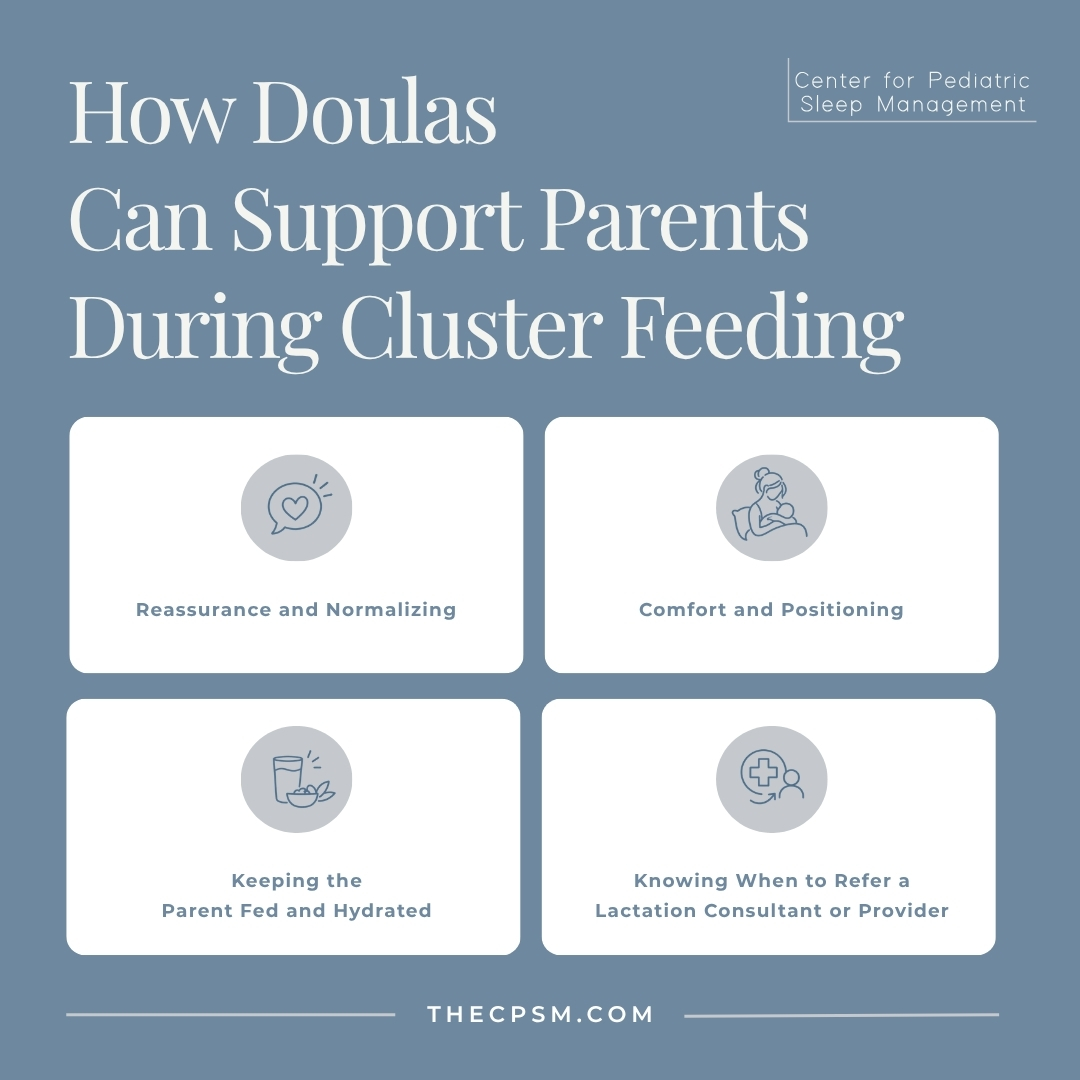
How Doulas Can Support Parents During Cluster Feeding
Doulas can be a huge relief to parents during cluster feedings. They help explain what’s happening, why it’s happening, what the strategies for addressing it are, and what parents can do to help throughout the process. Let’s break down the practical support you can offer:
Reassurance and Normalizing
The most valuable thing you can do is explain what’s happening and take the fear out of it. When a parent worries that frequent feeds mean they’re “starving” the baby, explain that this is normal. It doesn’t mean the baby isn’t getting enough milk, and it may just be the baby’s way of filling up before sleeping. Sometimes, simply being a calm, informed presence is one of the most helpful things you can do.
Comfort and Positioning
Helping a tired parent get comfortable can do wonders. Put the pillows in the right spots, place a glass of water within reach, give them a footstool if they need one. You can also help settle a baby who’s too worked up to latch. Try soothing them with rocking, letting them suck on a finger, turning on white noise, or holding them on the chest. They’re small soothing techniques that really matter when an exhausted parent just needs a second to breathe.
Keeping the Parent Fed and Hydrated
Cluster feeding is exhausting, and it’s no surprise that a parent can start to struggle. As the doula, one of your roles is to help make sure the parent takes care of themselves. They may be hungrier, thirstier, more tired, a little more on edge. Encourage other family members to help with bottle feeding, cooking dinner, changing diapers, or other small tasks that can add up at the end of a long day. Yes, you’re there to help with the baby. But you’re also there to support the parents.
Knowing When to Refer a Lactation Consultant or Provider
As a doula, one of your strengths is knowing when something isn’t in your scope. Concerns about milk supply, weight gain, or feeding effectiveness can all be worth bringing up to a lactation consultant or pediatrician. Being the one to recommend families to another trusted professional is exactly what builds trust.
Supporting families through the newborn stage naturally overlaps with questions about rest, sleep, and how to properly support a routine. If you’re curious how feeding and sleep connect as babies grow, read my article, “Infant Sleep Training Methods”, for a look at the approaches families ask about most.
Turn Your Passion for Newborns Into a Career With the CPSM
So many of the doulas I work with love the newborn stage and want to keep supporting families as babies get older, and that’s exactly where behavioral sleep comes in.
At the Center for Pediatric Sleep Management (CPSM), we focus on behavioral sleep for babies and toddlers, ages 0 to 4, through a client-led, parent-coaching model. I founded the CPSM in 2019, and I’ve been supporting families through sleep training since 2012, after I solved my own son’s sleep challenges. I’m a double-certified sleep consultant and a certified parent coach, and to date we’ve enrolled 1,100+ students into our program. Our self-paced sleep consultant certification course combines real sleep science with the business training you need to actually build a practice.
Doulas hold a special advantage here, because you already know how to support families through those early stages. Ready to explore it? Schedule a discovery call with me, Jayne Havens, and let’s talk. If you’re not ready to commit, download our free ebook, Launching Your Career as a Sleep Consultant, and start there.
Warmly,
Jayne Havens
Founder, the CPSM

Considering A Career in Sleep Consulting?
Download our free e-book filled with information on what sleep consultants do and how running a sleep consulting business might fit into your life.