
Jayne Havens is a certified sleep consultant and the founder of Snooze Fest by Jayne Havens and Center for Pediatric Sleep Management. As a leader in the industry, Jayne advocates for healthy sleep hygiene for children of all ages. Jayne launched her comprehensive sleep consultant certification course so she could train and mentor others to work in this emerging industry.

Meet Jayne Havens
Interested in Becoming a
Sleep Consultant?
Join Our Free Facebook Group
Stop Waiting to Feel Ready with Anna Marcolin
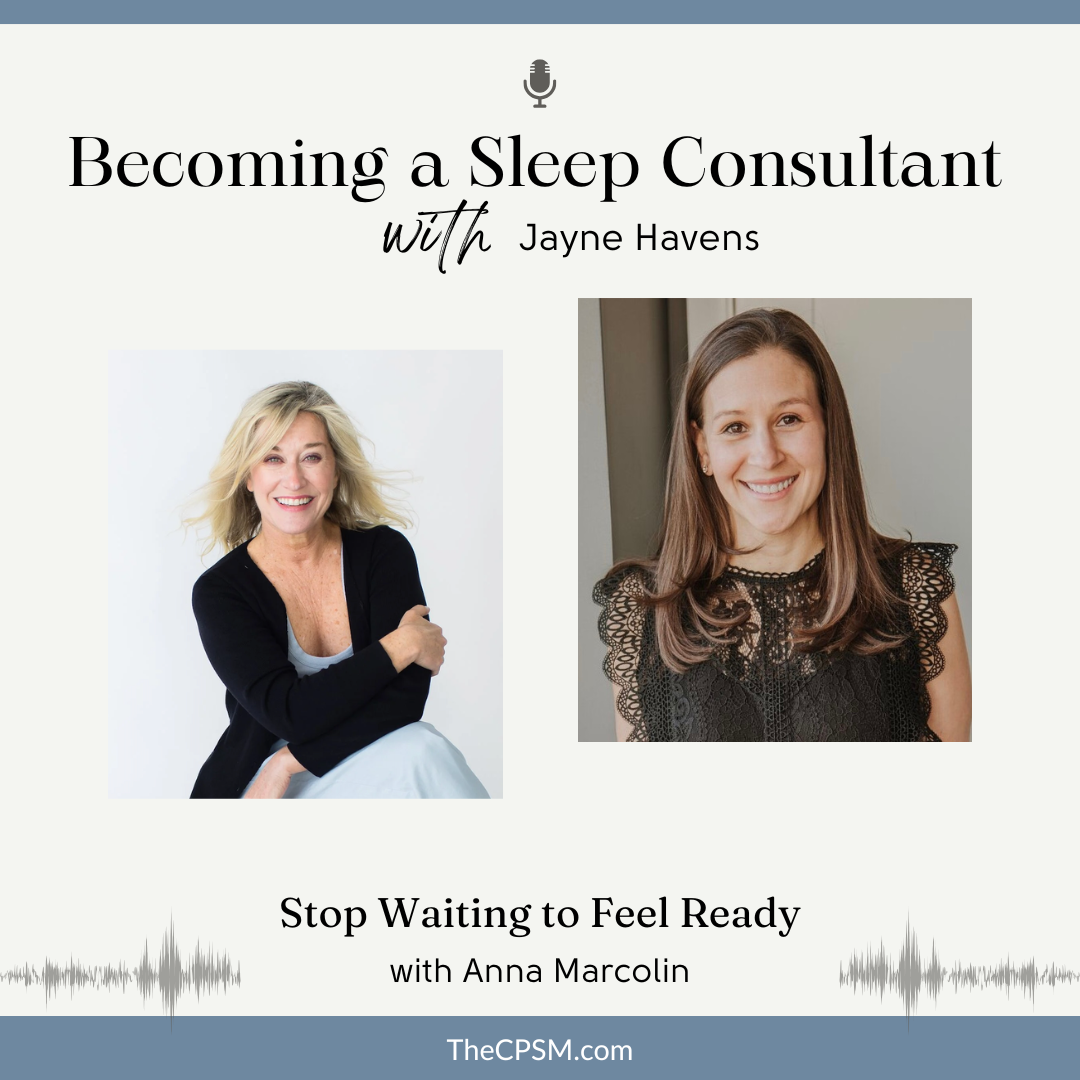
Stop Waiting to Feel Ready with Anna Marcolin
In this episode of the Becoming a Sleep Consultant podcast, I sat down with therapist and life coach, Anna Marcolin, for a conversation about what it actually looks like to grow as an entrepreneur. We talk about the mindset required for business ownership, the courage required to put yourself out there before you feel fully ready, and why taking action matters so much more than endlessly consuming information and waiting for confidence to arrive first.
This conversation is such a great reminder that confidence is built through action, repetition, failure, resilience, and continuing to show up even when it feels hard. There’s so much value packed into this conversation for anyone who’s building a business, navigating self-doubt, or trying to figure out how to keep moving forward without waiting to feel perfectly ready first.
Links:
Website: Anna Marcolin
Podcast: Badass Confidence Coach Podcast
Instagram: @askannamarcolin
TikTok: @askannamarcolin
If you would like to learn more about becoming a Sleep Consultant, please join our Facebook Group: Becoming A Sleep Consultant
CPSM Website: Center for Pediatric Sleep Management
Book a free discovery call to learn how you can become a Certified Sleep Consultant here.
Transcript:
Intro: Welcome to Becoming a Sleep Consultant! I’m your host Jayne Havens, a certified sleep consultant and founder of both Snooze Fest by Jayne Havens and Center for Pediatric Sleep Management.
On this podcast, I’ll be discussing the business side of sleep consulting. You’ll have an insider’s view on launching, growing, and even scaling a sleep consulting business. This is not a podcast about sleep training. This is a podcast about business building and entrepreneurship.
In this episode of the Becoming a Sleep Consultant Podcast, I sat down with therapist and life coach, Anna Marcolin, for a conversation about what it actually looks like to grow as an entrepreneur.
We talk about the mindset required for business ownership, the courage required to put yourself out there before you feel fully ready, and why taking action matters so much more than endlessly consuming information and waiting for confidence to arrive first.
This conversation is such a great reminder that confidence is built through action, repetition, failure, resilience, and continuing to show up even when it feels hard. There’s so much value packed into this conversation for anyone who’s building a business, navigating self-doubt, or trying to figure out how to keep moving forward without waiting to feel perfectly ready first.
Jayne Havens: Anna, welcome to the Becoming a Sleep Consultant Podcast. I’m so excited to chat with you today.
Anna Marcolin: Hi! Thanks for having me, Jayne. Happy to be here.
Jayne Havens: Before we get into the good stuff, can you share a little bit about your background and the work that you do today?
Anna Marcolin: Historically, I’ve been a psychotherapist and licensed clinical social worker for 30 years, actually, and I’ve been in private practice for 26 of those 30 years. About 10 years ago, I sort of shifted from just being a therapist into coaching. Because I was in a group practice, and I shared space with people who were life coaches, executive coaches, and realized in getting to know them that coaching was really more of—not more of my jam, but quite a bit of how I thought and how I was already working with my therapy clients. So about 10 years ago, I made this shift from my practice being just therapy to really half therapy and half life coaching. So that’s what I do.
I started a podcast in 2019. It’s been over six years now. It’s the Badass Confidence Coach Podcast, which is doing very well. Yeah, and I’m also a triathlete, so sport is a huge part of my life. We’ll get into it, but that’s a huge part of what informed me and taught me about becoming an entrepreneur because they’re aligned in many ways.
Jayne Havens: I know that you’re working with really sort of highly functioning women, highly productive, really successful. I’m wondering what patterns you see over and over again in these women who are incredibly capable. Where are they doing well, and where are they getting stuck?
Anna Marcolin: You’re absolutely right. High-functioning people who, on the outside, look like they’ve got it all together. And you know, they do have really it all together. That’s why I started my podcast six years ago. Because I’d sit across from these clients, these women, and I would think to myself, everyone asks me, like, “Oh, badass confidence coach. Is that because you’re a badass?” I’m like, “Well, yeah.” But really, it came out of my sitting across from women over all the two-plus decades and saying to myself, “You’re all stressed out. You don’t think you have it together. I see you’re overwhelmed, and you’re not managing great right now. But you’re a badass.” I mean, I would think it. I’m like, “These women are badasses,” but they feel so poorly on the inside.
So it’s a lot of overwhelm. It’s a lot of irritability. It’s a lot of air quote “being in a bad mood,” not feeling like we’re parenting our kids really as well as we ought to be, we should be. Those are the people that I work with to help them sort of regulate their nervous system and teach them the skills that they need to sort of balance their personal life with their professional life. Because they just feel like, “I have to do it all. I have to do it all.” Well, you can do it all, but you can’t do it all at once. That’s a big lesson for so many of us women.
Jayne Havens: So, from where I sit, I train people to become sleep consultants. Some of them have entrepreneurial backgrounds, some of them don’t. Some of them are teachers, nurses, stay-at-home moms, you know. And I think when they’re getting into this new field, sometimes they think the hard part is going to be just learning how to help families achieve better sleep. But then, later they realize that the harder part is managing their own mindset around things like visibility or rejection or comparing themselves to other people in the field and some level of uncertainty as they’re starting something new.
Why do you think entrepreneurship brings up so much emotional discomfort, and do you have any strategies for how to feel better while moving through this process?
Anna Marcolin: Well, I think many people who come into entrepreneurship were in more traditional or sort of conventional roles, like you mentioned, being a teacher. Maybe you worked, you’re a healthcare worker, maybe you were in sales and you had a boss. You knew the parameters of your job. You knew the boundaries of when it started, when it stopped, and what your job description was.
When you become an entrepreneur, that sort of all goes out the window. And if you were somebody who didn’t do great time management, let’s say when you were a teacher, you are going to really feel it as an entrepreneur. And I think that what happens is then we see that, “Oh, I’m not great at this, the entrepreneurial piece. This is really hard.” And then we start to compare ourselves to other women, other people who are in positions the same as us. But I have to tell my clients, listen, they’ve been at it for five years longer than you, and they also have been an entrepreneur since they were 22. You’re 35.
Do you know how many years it takes to get good at being an entrepreneur? And so what I find is that we start to sort of criticize ourselves. I say, stop ripping on yourself. Because we do the compare and despair, which in cognitive behavioral therapy world is a thought distortion. So my clients, and what I would remind them of or I teach them about for the first time and then I teach the skills is you’ve got to, number one, stop comparing yourself to everyone around you. You have no idea what their story is. You really don’t know how long they’ve been in the game.
I always tell my clients: put your blinders on like a racehorse. We do this with thoroughbreds so that they can’t be looking around. Some horses need this, some don’t. If you ever watched the Kentucky Derby—it was last weekend—some horses have them on, some don’t. Those horses need to stay focused, and they need to go straight ahead. And I tell all of my clients who are in the entrepreneurial space, look straight ahead.
Put your blinders on. Stop comparing yourself on Instagram. Stop comparing yourself in your women’s networking groups and whose fields are aligned with yours, and they’re doing this, they’re doing that. No, no, no. That is so not helpful for your thinking and for what you need to be doing to sort of move yourself forward. So that’s number one. Stop comparing yourself to everybody else’s story. Pay attention to your story.
Jayne Havens: So one thing that I see people doing is that they sort of like, they get really deep into learning mode. Like, they take my certification, and I think that I do a really great job of setting them up for success, both to be a really good sleep coach, but also to have the tools to be a successful entrepreneur. But they finish the course, and then they’re like, “I still feel like I need to learn more. What else should I do?”
Like, “Should I take this course? Should I take that course? Should I hire this coach?” And really, they get into this loop of like, “I got to learn more. I got to get better before I actually get out there and do the work.” What are your thoughts on that? Do you think that that’s just like a protection, like a strategy to protect yourself emotionally?
Anna Marcolin: Yes. Yeah, I’m glad you brought that up. It’s pretty common. I did it myself. When I was first starting out in coaching, I thought — I had a coach. I hired a business coach after I hired somebody to help me move into coaching, and then I had this business coach. I would say to her, “Oh, I need to take this course. I need to read more about this.” And then after a while, many, many, many months of getting to know me, she said, “Anna, you don’t need to know any more.”
I actually had coaches say to me, “You don’t need to take this coaching certification course. You’re a therapist. You’ve been doing this for so many years. They’re not the same, but a lot of what you…” And then I’m like, wait, I learned how to actively listen when I was a freshman in college in my social work major. Like, I learned these things my freshman, sophomore year of college. But I was like, nope, there’s got to be more information out there that’s going to help me.
And you know what it was, Jayne? I think this was for so many of us. We would rather just learn, learn, learn, get all the information rather than be taking action, using behaviors like being afraid and getting on the camera and doing a reel or a story for Instagram or TikTok or recording something for your website. We’re like, “Oh my God, oh my God.” Like, “I don’t look good. I’m going to screw up. I’m going to stutter.” You might. And that’s what I think we all need—and I needed—to get my head around. Yes, you might. And you may say, “I’m going to fail. I’m going to fail.”
Okay. So fail forward. We all have. I’ve done it. You probably have. I have failed so many times, I can’t even tell you. And I’m like, “Oh my God, that was cringey. That was cringey.” And I still say to my clients, “I still want you to drop that. I still want you to drop that episode. I still want you to put that on your Facebook group. I still want you to do it.” And the next time you’ll be a little better.
But you’ve got to do things when you’re still afraid and you think you’re going to fail, even though I can tell you all day long to get that thought out of your head. My clients say, “And I’m still going to fail.” Okay. Let’s fail forward. And I think people think, “If I just get all the knowledge…” No. At some point you have to stop with the knowledge, and you’ve got to start acting, you know? Because what we do is we are indecisive, but we’re actively inactive. Well, right?
Jayne Havens: Yeah, this isn’t video, but I’m over here being like, “Yes, yes.” Like being — say that again. Like being actively inactive, is that what you said?
Anna Marcolin: We’re actively inactive, yeah.
Jayne Havens: I love that. That is a thing. That is a thing, for sure.
Anna Marcolin: It is a thing. It is a thing. And I know because my coach sort of kind of read me the riot act many years ago. She’s like, “Stop it.” She’s like, “Anna, really? How much more do you need to know about cognitive therapy and whatever, the neuroscience of this or that?”
She’s like, “You’ve been doing this for so many decades.” And she’s like, “What is really going on right now?” I’m like, “Well…” She’s like, “You’re afraid. Just stop it. Just, who cares what you look like? Just get out there and do it.” I’m like, “Okay.” And I was so mad at her. I’m like, “Okay, you’re getting on my nerves right now.” But it was what I needed to hear, and she was right.
Jayne Havens: Yeah, I think that there’s some quote about it, but I don’t remember what it is. But there’s some saying that successful people fail more than unsuccessful people even try, right?
Anna Marcolin: Yes.
Jayne Havens: Like, if my business is successful, I have literally more failures in a day or a week than somebody who’s not taking action in their business even puts themselves out there. Like, I may fail five times in a week, and someone else literally hasn’t tried five things in a week, you know?
Anna Marcolin: And for all of your listeners to remember that, all the successes that you all are seeing, wherever it is you’re looking, those are everyone’s highlight reels. That’s really important for everyone to acknowledge. Those are highlight reels. I can’t tell you how many group coaching programs I put together, let’s say in the past five years alone, that have failed. I’m successful, and I fail all the time.
I was so funny. I was looking at my Facebook, scrolling through my Facebook business page. I put together a group coaching for moms of teens and tweens. I put together a group coaching on early version of Emotional Mastery. You all, I had no one sign up. Zero. I put all this time and effort into marketing it on social media. No one signed up. And it’s really important. So you still have to do it. You may say, “Well, no one’s going to sign up.” Yes, people might not sign up. Sometimes I’ve gotten two people. Well, so what? Okay, do it. Do it with the two people.
Maybe you’re not making a lot of money, but you’re putting in the reps. And the only way that I became— we maybe haven’t talked about this, but the only way that I became a successful triathlete was putting in the reps. Hours and hours and hours in the pool, hours on the bike at 6 o’clock in the morning freezing my butt off on a country road, you know, hours of running, of not feeling like it.
My legs felt like tree trunks. I did hours and hours and hours before I became someone who was on the podium in every race. But do you know that that took me years to get there? It’s the same with the entrepreneurial space. I’d say it’s even harder, but you’ve got to put in the reps.
Jayne Havens: Yeah. Recently, someone from my program sent me an email. She said that she was feeling burnt out because she had been doing some outreach, reaching out to pediatricians’ offices, chiropractors, lactation consultants. She wasn’t getting so many responses. She was feeling like she was doing a lot for nothing. And I looked back. Literally, she only passed the course a couple of months ago. She literally just kicked off her business. She used the word burnout, and she was saying that she was feeling really depleted.
And so when you share that story, it makes me think, you know, burnout is real, right? Like putting in a lot of work can definitely make you feel really exhausted, tired, spent, all the things. But I want to sort of look at that and then compare it to somebody else who has been in the business for 5, 10, 15 years, and they are doing the reps and the reps and the reps, like you said, like truly have become a triathlete in their business.
What would you say is the difference between the beginner burnout—that’s just, I think, I don’t know. I want you to answer. I don’t want to put words in your mouth. But in my mind, I’m thinking that’s just like feeling like your business is hard in the beginning, right? Is that true burnout? Is that just like, “I just started and it feels really hard, and I don’t want to do this anymore,” versus, “I’ve been doing this for years and years and years, and it’s just wearing on me emotionally.”
Anna Marcolin: I think burnout happens, like you said, it happens at both ends. It happens in the beginning when we’re going whole hog, like gangbusters, doing all the things. We just took a certification course. Now it’s like, “I’m motivated. Let’s go.” And then you find two to three months later, you’re like, “Oh,” like you had mentioned, “Oh, why is nobody getting back to me?”
Well, that’s the burnout in the beginning of going, going, going, going, and you have expectations. See, this is the thing. It’s that we have these non— I think we don’t acknowledge the expectations we have in our minds about how it’s supposed to go. I’m air quoting. “This is how it’s supposed to go. This is how it should go.” And so we have these expectations that we may not have even acknowledged to ourselves that we thought would happen for us. And three, four months later, it’s not happening. But you’re like, “I’m working my butt off. I’m working so hard.” So you’re starting to get burnt out because you may not have balance.
Now, I will say, in the entrepreneurial space, I don’t think balance is a thing. I actually don’t think balance is a thing for most of us in life. We talk about work-life balance. Especially when you’re an entrepreneur, you’re not going to have work-life balance.
When I was in a more traditional therapeutic role before I started coaching, I worked in healthcare and hospitals. I worked from 8:30 to 4. I had balance because at 4:00, I was like, I clocked out, saw my last patient, left, and went home. And my home life was my home life, and work life was my work life. When you become an entrepreneur, that’s not it. You’re often on emails at 9 P.M. You may be working on Saturday morning, Sunday afternoon, and you’re like, “I’m working so freaking hard.”
So if you’re doing that and you have these expectations of yourself and you can have all these returns, this is not a sprint. You have to remember, for those of you who started out in the beginning, this is not a sprint. This is a marathon. The people who have been doing it 5, 10, 15 years, they also can get burnt out too. I wouldn’t say that they don’t have it. They do have burnout. I see that quite a bit as well.
I think that the people who are burning out years later, they’re actually not taking any breaks. So you don’t have balance. You must take your breaks. You must turn your phone off. You must go away for a weekend and not bring your laptop. You have to do that. If you don’t do that, 5, 10 years later, you will burn out.
You can be successful, but what happens at that end is that, “I’ve reached this level. Now my expectation of myself is that I’m going to go to this next higher level.” So you’re working, working, working, working really hard. You’ve got to take your breaks. And even in the beginning, you have to take breaks. But I will not tell you, I cannot guarantee that any of us is going to have balance in our lives. Not as an entrepreneur. You’ve got to find what works for you.
It’s a nuanced question you’re asking me, so I can’t. It’s case by case for every person as to how they find you’ve got to have a reprieve. You’ve got to take your breaks. You’ve got to get out of your high cortisol, your sympathetic nervous system, and you’ve got to get into parasympathetic, whichever way works for you. So maybe that’s a weekend without your laptop. Maybe that’s every morning getting up and having 30 minutes of meditation, prayer, or just sitting and staring out the window drinking your coffee and going for a walk. You’ve got to put that into your schedule to take care of yourself to try to stave off burnout. Does that make sense?
Jayne Havens: Yeah. As I’m listening to you speak, I’m thinking about my own efforts at having balance. One thing that I’ve put into place over the past year or so is: I’ve started taking tennis lessons, and I do so in the middle of the day three days a week.
Anna Marcolin: Good for you.
Jayne Havens: So the interesting thing about this is like, you know, if I have a tennis lesson from 11 to 12:30, I have to block my calendar from 10:30 to 1. Because I can’t be on a Zoom and then get to my tennis lesson, right? So I literally need 30 minutes on the front end, 30 minutes on the back end. So an hour-and-a-half clinic actually takes two and a half hours out of my day.
And the reason I did that is because I was trying to achieve balance. I wanted to get back to a lifestyle where I wasn’t working from the time I dropped my kids off at school to the time that I picked them up. I wanted to have something a few days a week in my day that was for me.
The interesting thing about balance is that I put that into place so that I would have balance, but then there are consequences to that. Because if I’m missing two and a half hours of my workday in the middle of my day, that means that I feel like I still have more to do when my workday is done. And so that means my laptop is on my lap in the evenings after I put my kids to bed. Or sometimes I do take calls on the weekends. But that’s like the best that I can do for myself right now, and usually it feels like it’s working.
One other sort of interesting way that I’ve helped myself keep the balance is that if I’m really, really busy, I could just not go to tennis, and then I have two and a half hours open on my calendar because my calendar is locked off. And for me, that’s the most beautiful thing ever. Like, if I literally need more time, I have it. I just have to make the choice to use it wisely. And so I don’t know. It’s sort of what’s working for me now.
I don’t know that it’ll work forever, but I did put that into place in an effort to achieve balance. But then also, the balance, it looks different. It spills out into other areas, other hours of my day because of the choice that I’ve made.
Anna Marcolin: Yeah, because you’ll be working more at other hours of the day, other days and later hours. For your example, it’s a good one. I think that it’s funny you say that. Because just yesterday, my good friend called me. Last year, she wanted me to join this women’s golf league, and I can’t golf. I played golf like three times in my life. And she’s like, “Oh, come on. I don’t know how to play golf either. It’s just a fun group of women.”
And here I am. She’s like, “But Anna, it’s Tuesdays at four. You have to leave at four to meet me.” I’m like, I’m finding ways to say no because I’m usually working. But they’re not client hours. That’s more — I end up doing more administrative stuff at the end of the day on Tuesday, and I’m already going, “No, I can’t do it. How am I going to say no?” Because I’m so used to my routine, and that’s usually when I’m working. And I told myself, “No, Anna, you need to do more.” I mean, I do my own working out on my own. But this is with a friend. This is community.
Jayne Haves: It’s social.
Anna Marcolin: It’s social. So I told her I would do it, and I’m committing to it. So it’s so funny you said that because I’m doing this women’s golf league. I know it’ll be a ton of fun, so I tell myself, “So you’ll make up for whatever. Anna, it’s administrative work. You can just add it into your Wednesday morning. I mean, it’ll be okay.”
And I think that’s right. So we’re both striving to find some sort of balance in our lives. I mean, social life, connection, community is also very important. And if we deny that and we pull away from that, that will come back to bite us in the butt. We really do need to pay attention to our parasympathetic nervous system, which we call rest and digest. We all have to chill. We all have to find ways of really relaxing and saying, “I’m done for now. The day is done. Tuesday at 4 o’clock, I go to have fun time now, and I’ll get back to it.” It will still be there for all of us.
Jayne Havens: Yeah. I also think for me, it’s important to sort of practice what I preach, right? Like, if I am telling people that if you want to do this work, you can make it work in a way that works for you, right? The beautiful thing about entrepreneurship is that it doesn’t have to be nine to five. You can work for two hours in the morning and three hours in the afternoon and meet a friend for lunch or play mahjong or go for a walk or just read a book, whatever. You get to create your own life.
But you have to be really intentional, and it is really hard. I don’t pretend that it’s easy. I think that there’s this idea that entrepreneurship is just sort of like, “Oh, you decide you’re going to do something, and then you do it. It’s ready, and it’s good to go, and you’re good.” I think it’s a lot harder than that, and I think we all need to be honest with what it looks like, but also the benefits that come along with it.
Because yes, it’s really hard, but it’s also mentally and emotionally incredibly fulfilling. Like the pride that I feel in my own success, that I’ve built this business from nothing, that’s an incredible feeling. And I want people to not be afraid to go after that because we are capable of doing amazing things.
Anna Marcolin: And Jayne, I think it’s important that if you’re someone who struggles — Like, I have ADHD. I’ve had it my whole life.
Jayne Havens: So do I, apparently. I just learned that, like, last year.
Anna Marcolin: Well, I got diagnosed. I knew I had it. I mean, my good friend is a psychiatrist. He’s a specialist at ADHD, and he has it. I sent my kids to him. Not all of my kids, a couple of my kids. And I’m like, “Perry, I think I have ADHD.” He’s like, “Well, take the test.” I’m like, “I already did.” I was looking at my son answer his questions, and I was like answering yes, yes, yes. He goes, “Yeah.”
Anyways, he formally gave me the diagnosis last year. And I’m like, “Oh, it makes sense.” So when you have ADHD and you’re an entrepreneur, well, I think it’s important. I’ve really needed to dial in my focus. And if you use meds or you don’t use meds— I don’t use meds. I’ve found ways to focus. I have lots of different hacks for how I get focused.
One of them is that I’ve gotten coaching. Many of us do need coaching around our coaching business and being an entrepreneur. Well, I firmly believe we don’t do it alone. I have not gone to where I am today without coaching. There’s just no way without support, with people, a business coach, a life coach. At times I’ve been in and out of therapy for years. I don’t have a therapist right now, but if I’ve ever needed it because I have some personal things coming in, I go back to therapy.
I’ve had people coaching me and helping me with just the details of my website and my social media. I had a social media strategist who coached me on social media. There’s no way I could have done all the different arms and branches of my business without help. And I think that that’s really, really important to tell people that, please don’t try to do this alone.
And there are times I thought, “Oh my gosh, this person is so expensive.” You know what? I have had to pay for these people. I mean, thank God. But was it stressful? Yeah. Was I rolling in the dough at the time? No. Did I have to put it on my credit card? Yes. Did I have to stop eating out and ordering food and going to Starbucks? Yes. And it was worth it. Because I think it’s so important for all of us to know we’re all here together.
Pay for services. Pay for coaching if you need it. Because another skill—and you and your listeners may already know this—one of the first things that I teach my coaching clients, one of the first things that was taught to me about being an entrepreneur, is to get organized. So I still use my paper calendar. Everything is written down. Everything is color-coded. Podcast is purple. Clients are written down a certain color. Coaching clients are a certain color. Therapy clients another color. Admin work, team meetings now with my podcast coach, all these people, it’s all written down in different colors.
And you have to have white space. White space is, as you know, white space is that time when it’s like, “This is my workout time,” or “This is my time when I sit out in my backyard and I listen to the birds.” That’s a time you get to scroll on TikTok and laugh and watch all the fun. You have to have that in your life.
So I would say get very organized in whichever way works for you—if you want a paper calendar, if you want to put it in your Google, you put it on your phone. That’s going to be really important as an entrepreneur. Because all of a sudden, you’re like, “Oh my gosh. I’m working at 10 o’clock at night, but I feel like I’m a mess.” And then, “Oh, I’m working at 6 AM, and I kind of love it, but I kind of hate it.”
I think to myself, it’s an honor for me at 5 o’clock to be sitting on my couch on certain days. Like Mondays are my days I work late. I’m sitting on my couch, but I’m sitting on my couch. I’m actually not in an office sitting in a hardback chair. I’m working, and I’m working for me, and I’m doing it at home. But it does take discipline, and it does take some form of a regimen. So I would say that. And if that’s hard for you, like it has been for me over the years, get help with it.
Jayne Havens: Yeah, I’m so glad to hear you say that because the work that we do— look, you could sleep train your baby without a sleep consultant, right? Like that can be done without coaching. But here we are saying, look, there’s this huge benefit to having accountability, support, emotional support, right? Like, here we are saying this is so valuable, and this is what’s really going to help you to achieve your goals with your child’s sleep. And then we, as sleep consultants, we sometimes resist getting very similar support, right? Like, we would all benefit from accountability and coaching and support, just like our clients do.
And I think you’re exactly right. I’ve hired coaches, consultants, people to help me with search engine optimization. I have somebody helping me right now with Pinterest. I’ve hired business strategists. I don’t pretend that I know everything and that I could figure it out on my own. Like, I’ve never ever felt that way. I actually think that what I know is very, very limited in the grand scheme of things, right?
Like where I have my expertise, my expertise is strong, and I feel really confident in that knowledge and that expertise. But then there’s a whole world of information and all these skill sets that I have not yet mastered, and some of them I have no desire to ever master. Like, I don’t ever want to learn how to do my own SEO. Ever.
Anna Marcolin: Exactly.
Jayne Havens: You know, like, sometimes people say to me, “Oh, I can teach you that.” And I’m like, “No, no. I don’t want to learn that. I want to outsource that.” And then there are other things that I do want to learn. I want to get better at myself. And I recognize that, as you said, I’m not necessarily going to have the discipline, and I’m not going to take it as seriously if I don’t have somebody holding me accountable and cheering me on as I am learning this new skill or acquiring this new — even if it’s just a mindset.
Sometimes it takes somebody else coming in and working with you to strengthen that entrepreneurial muscle or to shift that mindset from desperation and scarcity. Sometimes it takes somebody else coming in and really helping you to shift from that scarcity mindset to abundance mindset. For some people, that’s really, really hard. I don’t pretend to have all of those skills on my own. I get help when I need it.
Anna Marcolin: Absolutely. You know, it reminds me of the years — so I spent probably the first 10 years of when I entered into triathlon, so I was first a marathon runner and ran marathons. Then I had too many injuries from just all the long-distance running, and I moved into triathlon. I loved the sport. I probably spent the first 7 to 10 years self-coaching. So in those days, we had Triathlete Magazine. You could go online, and you could, for free, get a six-month or even a six-week sprint triathlon, six weeks to your best sprint triathlon, like three months to your first Olympic-distance triathlon. I would do all of those. I did it for years. I self-coached.
They were fine, but I was always coming in — in my age group, so all we care about really—unless you’re a professional or an elite triathlete, you want to win the whole race—most of us care about doing well in our age group. And I would always come in like, depending on the race, the size, and depending on the women who were there, fourth. You know? I was never on the podium. I’d come in fourth. I’d come in fifth, sixth. I was always one person away from getting third place in my age group.
Jayne Havens: That was pretty impressive to me, by the way.
Anna Marcolin: Yeah, but I was annoyed because I’d put so much time and energy and effort into being a triathlete. At that time, it probably was maybe 10 hours a week, and I had five little kids. It was insane. I look back now and I think about how I did it with working and having a husband and kids. But I was like, “You know what, Anna? If you’re going to put all this time and effort into this, something is not working.” Because I was self-coaching.
I hired a coach. And it took me a bit. So this is important for everybody to think about in your own world of being an entrepreneur because it’s very much aligned. I hired somebody who — it was this massive group coaching. There were like hundreds of people. There were two guys who coached all of us, and it was really not much different from the self-coaching I was doing. I think you had to do a 5K run test. You had to put in your numbers into this little calculator. They said, “This is your program.” There was no way to talk to them. There was no way you could ask them questions. It was terrible. I did that for six months. I got out of it.
I hired another coach who didn’t have the experience, who was new to the triathlon coaching world. It was a terrible fit. I think he thought I was a big pain in the butt, and I thought, “You’re not qualified.”
So I fired him. I think he was going to fire me too because I was annoying because of all the questions.
I finally found this coach, did all this homework, interviewed three female coaches, finally went with the one, and she coached me for seven years. I paid a lot of money for her. In my first year, 2013, it was okay. I did better, but I was working with her. And so I was like coming in still third, fourth, fifth. The second year of working with her, I went to her swim clinics. I did everything she told me to do. So I was coachable. That’s important. I was coachable. I did what she told me to do because I’m thinking, “I’m paying her so much freaking money every month.”
Jayne, I was on the podium almost every race I did after that. Every race, I was either third, second, or first on the podium in my age group. It was badass. But it was because of her. It was because of her and that I was a good student and I was coachable. I did what she told me to do. I did it.
Finally, my goal was to qualify for the world championship, half Ironman was my distance. I qualified for world championship. Ironman, the half distance. And I did it because of her. If I didn’t have her, there is no way I would have gotten where I did in the world of triathlons. It’s because of her.
So that’s why I cannot underscore enough to all of your listeners the importance of being coached. It’s the exact same in the entrepreneurial space. I would not be where I am today without my life coaches and my business coaches helping me get to where I am, telling me, “Stop the way you’re thinking. Get up and go right now. You know how to do this, Anna. Stop wasting time. You have all the knowledge. You don’t need to read any more about neuroscience. Go. Go now. Go.”
Same way that my coach would be on the side of the road like, “Anna, knock it off. Go run.” It’s the same way in the coaching space for all of us. It’s the same attitude all of us need to have as entrepreneurs.
Jayne Havens: Yeah, and I think the coaching is, the benefits are multifaceted, right? There’s mindset work that needs to go into it, but then there’s also the discipline of doing the work, right?
Anna Marcolin: Yes.
Jayne Havens: In order to start winning those races, you needed to believe that you were capable. You needed to believe that it was a possibility for you, and then you also needed to put in the hard work physically to get that transformation.
And I think it’s the same thing in entrepreneurship. I think some people really are good at the mindset piece. They believe they’re capable. They have the confidence. They have the mindset, but maybe not the work ethic. And then some people really, really lack the confidence, and they have the work ethic. And you really need to have both.
Anna Marcolin: Absolutely. Yeah. I mean, there were days when — I cannot tell you. Today as an entrepreneur, and the days of being really — because I’m not competitive triathlete now. I’ve taken a break from it. Too many injuries. But there were days when I did not feel like doing it. I’d wake up at 5:30 in the dark and I would start — I put my bathing suit right by where my feet hit the ground, the side of my bed. I’m like, “There’s my bathing suit. There’s my gym bag.” And I’m like, that’s the only way I’m getting myself to the pool before work. It’s to put that bathing suit by my bed.
It’s the same thing in the entrepreneurial world. It’s like, the only way I’m going to get up is if I know there’s a yummy cup of coffee brewing for me, and I turn my mind off. So the way I coach my clients is you go into no mind. So there’s positive mind. There’s negative mind. There’s no mind. No mind is the middle. And no mind, you use a lot in sport, and I use it a lot in the entrepreneurial space.
So don’t have thoughts about the fact that you have to get up early maybe, and you have to start maybe doing some content creation for your business, or you need to start putting some posts up, or maybe you’re putting a coaching program together for your clients, your people that you have taught. So I want you to get up and have a plan. You go get that coffee, you get your sweatshirt on, and go sit your butt down and start writing. And that’s no mind.
So this is the one time, especially as a therapist, I don’t want you to feel. I don’t want you to be all positive, la la la, because it’s not positive. Let’s not be toxically positive here. And let’s not be negative. Let’s be in the neutral. It’s no mind. And that, my triathlon coach taught me. That is the only way that I got to the pool at 6 A.M. That’s the only way that I was doing a 45-minute run at 6 o’clock at night after I’d seen clients all day. It was, I’m like, “Anna, get it done.” And that’s what I did. So I hope that that’s helpful to your people because that’s been so helpful to me over the years.
Jayne Havens: Yeah, my mind is churning thinking about ways that I can get into that no-mind zone in certain areas of my day. So I actually really appreciate that.
Before we wrap up, why don’t you share a little bit about where people can learn more from you if they’d like to connect with you? Yeah, so share whatever you’d like to share.
Anna Marcolin: Yeah, so I’m on TikTok and Instagram @askannamarcolin. My website is annamarcolin.com. I’m all over social media, really. And then you can find me on Facebook, Anna Marcolin Coaching & Counseling. And you can always — my website, you can find me, Anna Marcolin, and you can email me at hello@annamarcolin.com. I’m pretty easy to find if you want to reach out and connect in some way. Thanks for helping me out.
Jayne Havens: Yeah, anytime. I’m so glad that we connected, and I really appreciate you taking the time to share your zone of genius with my audience, and we’ll have to do it again soon.
Anna Marcolin: Thanks for having me, Jayne. This was a great conversation.
Outro: Thank you so much for listening to this episode of the Becoming a Sleep Consultant Podcast. If you enjoyed today’s episode, it would mean so much to me if you would rate, review, and subscribe. When you rate, review, and subscribe, this helps the podcast reach a greater audience. I am so grateful for your support.
If you would like to learn more about how you can become a certified sleep consultant, head over to my Facebook Group, Becoming a Sleep Consultant or to my website thecpsm.com. Thanks so much, and I hope you will tune in for the next episode.
Add Your Heading Text Here
Thank you for your message.
We will contact you shortly!