

What Is a Pediatric Sleep Coach and How Do You Become One?


Bringing home a newborn is one of the most exciting moments of a family’s life. But one of the biggest adjustments that comes with this new chapter is adjustments to sleep. Most people know going in that restful nights will be hard to come by. But reality often hits harder than expected. In fact, research shows that some parents don’t return to their pre-pregnancy sleep patterns until their child turns six.
That level of sleep deprivation takes a real toll, affecting everything from mood and mental health to decision-making and overall well-being. As a result, many parents actively seek out pediatric sleep consultants to help guide them.
If you want a career where you can actually help people while building something of your own, pediatric sleep coaching is worth a serious look. The demand is there, the work is meaningful, and the opportunity to build a flexible business around it is real.
Before taking that first step, it helps to understand exactly what the role involves. In this post, I’m walking you through everything you need to know. I’ll share what to expect day to day, the skills required, and the pros and cons of the career. Plus, you’ll find a step-by-step plan for how to get started.

What Is a Pediatric Sleep Coach?
A pediatric sleep coach is a professional who helps families improve their child’s sleep through personalized sleep plans, evidence-based guidance, and ongoing support. Most pediatric sleep consultants work with children from birth, and sometimes up to age 6. They use age-appropriate methods to build healthy sleep habits and address sleep issues.
But it goes beyond handing over a sleep plan. Pediatric sleep coaches work closely with families over time. They educate parents on long-term strategies and adjust their approach as the child grows. It’s relationship-based work, and the results it produces are lasting.
The quality of that work depends heavily on the education you bring to it. The sleep consulting industry is unregulated, which means technically no certification is required. However, getting certified changes everything, both for your business and your client’s trust.
It gives you a grounded understanding of the specifics of sleep science for babies and children. And that knowledge is what allows you to make recommendations that actually get results. It’s also what gives families a reason to trust you from the very first call.
What Does a Pediatric Sleep Coach Do?
A pediatric sleep coach helps families work through sleep challenges at every stage, from newborns to older children. Here’s a look at what the work actually involves:
- Assessing Sleep Issues: Evaluating a child’s current sleeping patterns, bedtime routines, nap schedules, and any environmental factors that may be disrupting rest.
- Creating Customized Sleep Plans: Developing personalized strategies based on the child’s age, temperament, development stage, and the family’s parenting style and preferences.
- Educating Parents: Teaching parents about age-appropriate sleep needs, wake windows, sleep cycles, and the science behind healthy sleep.
- Recommending Sleep Training Methods: Guiding families through approaches based on what feels right for that specific family.
- Providing Ongoing Support: Offering follow-up calls, check-ins, and plan adjustments throughout the implementation period.
- Identifying Potential Medical Concerns: Recognizing signs of underlying conditions, like reflux, sleep apnea, or allergies, and referring families to their pediatrician when appropriate.
- Offering Emotional Support: Providing reassurance and encouragement to exhausted parents during what can be a genuinely stressful process.
For a deeper look at the day-to-day work, check out my guide, “What Does a Sleep Consultant Do?”
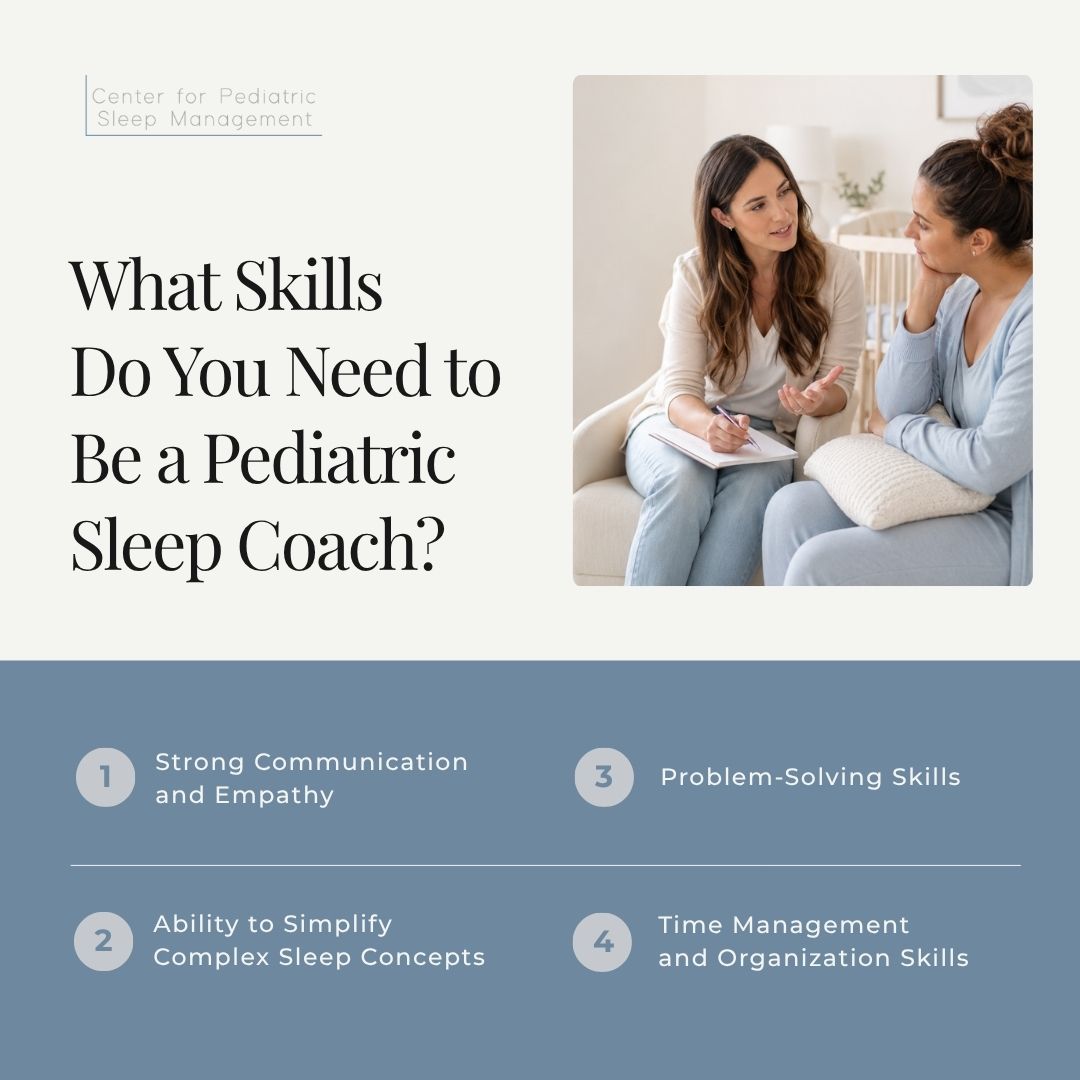
What Skills Do You Need to Be a Pediatric Sleep Coach?
Getting a sleep consultant certification is the foundation of this role. But there are additional skills that separate a good sleep consultant from a truly great one.
Strong Communication and Empathy
The families who come to you for help are exhausted, frustrated, and oftentimes at the end of their rope. Meeting them with genuine empathy isn’t just a nice quality to have. It’s an essential part of the job.
When parents feel truly heard and understood, they trust you more. They’re also more likely to follow through on the plan you’ve put together for them. Strong communication and the ability to acknowledge what a family is going through enable you to do your best work. Sleep science matters, but so does the human connection.
Ability to Simplify Complex Sleep Concepts
Most parents you work with won’t have a background in baby sleep science. Part of your job is to take complex concepts and translate them into language that actually makes sense to a sleep-deprived parent.
The ability to explain the “why” behind your recommendations in a clear, easy-to-understand way builds trust and long-lasting success.
Problem-Solving Skills
Sleep training is rarely a linear process. Strong problem-solving skills are what allow you to navigate that reality with confidence. Sleep issues come up, and regressions happen. A plan that was working beautifully one week may need adjusting the next.
Your job as a sleep trainer isn’t to have a perfect sleep plan from the start. It’s about staying calm, assessing what’s happening, and figuring out the best path forward for that specific family. Parents are counting on you to be the steady, knowledgeable presence that helps them through the hard stretches. That requires both flexibility and the ability to think clearly under pressure.
Time Management and Organization Skills
As your client base grows, so does the demand on your time and organizational skills. Juggling multiple clients while also managing the day-to-day or running a business requires real systems and structure. The good news is that these are learnable skills. Building the right systems early on makes everything easier as your business scales.
When you’re organized and on top of your workload, every family gets the attention they deserve. Follow-ups happen on time. Plans are adjusted as needed. Babies start showing progress, and clients leave with the kind of experience that turns into glowing testimonials and referrals.
For a closer look at running a pediatric sleep coaching business, check out my guide, “Growing a Business as a Sleep Consultant.”
Is Becoming a Pediatric Sleep Coach Worth It?
Before committing to any new career, it’s worth taking an honest look at both the benefits and the challenges that come with it.
Pros
Becoming a pediatric sleep coach is one of the most fulfilling ways to earn an income on your own terms. Here are some of my favorite things about this career:
- Meaningful, rewarding work: You’re genuinely changing lives, not completing tasks. The role you play in each family’s lives is one that will stick with them for years to come.
- Flexible, self-set schedule: You decide when you work and how many clients you take on. If you have the time and energy to do so, you can scale your business as much as you’re comfortable with.
- Low startup costs: Compared to most businesses, the barrier to entry is refreshingly low.
- Fully remote: Work from home, a coffee shop, or anywhere with a reliable internet connection. Getting to choose your space gives you the freedom to create a work environment that actually supports your productivity.
- Strong income potential: Your earning potential grows with your experience and client base.
- Growing market demand: Families need sleep coaches, and that need is only increasing. When you have the qualifications to show for your commitment to the role, your plate can begin to overflow with opportunities.
Cons
Like any career, this one comes with its own set of challenges. Here’s what to be aware of going in so you can prepare accordingly:
- Inconsistent income: Especially in the early months, income can be unpredictable. Planning your finances around a slower start makes a real difference.
- Emotionally draining: Working closely with exhausted, stressed families takes a toll on you. Setting boundaries and prioritizing your own well-being is essential.
- Irregular hours: Client needs don’t always follow a nine-to-five schedule, and flexibility is part of the job.
- Unregulated industry: Without industry-wide standards, building your own credibility through certification and strong results matters more than ever.
- Heavy marketing burden: Finding clients requires consistent effort, especially when you’re starting out. Marketing is an ongoing part of running the business.
- Burnout risk: When you care deeply about your clients’ outcomes, it’s easy to overextend. Knowing your limits and protecting your energy is part of doing this work sustainably.
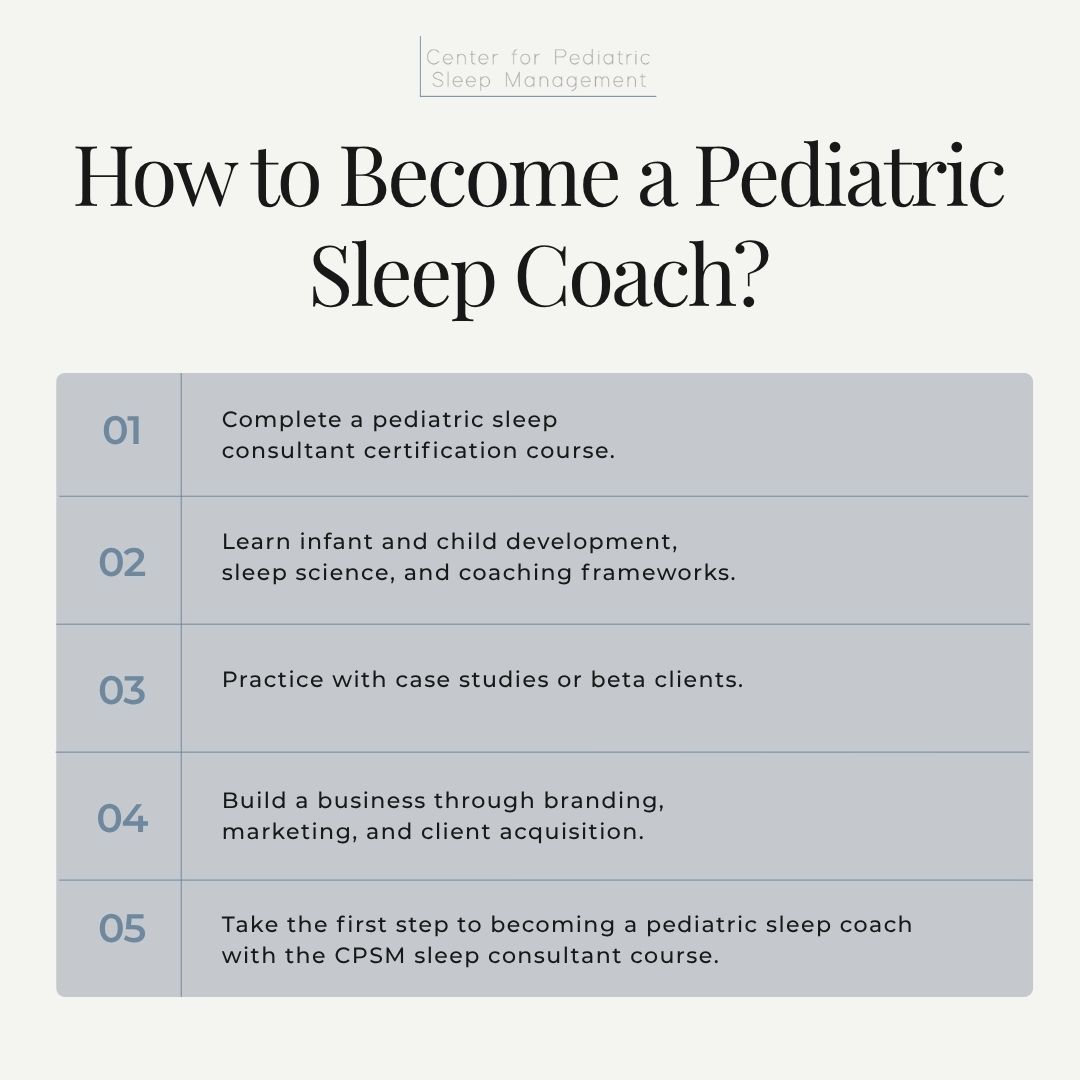
How to Become a Pediatric Sleep Coach
Complete a pediatric sleep consultant certification course.
Even though the sleep consulting industry is unregulated, getting certified is one of the best investments you can make in your career. A quality certification course gives you the foundation you need to actually help families. And ultimately, that knowledge is what allows you to educate parents, build tailored sleep plans, and show up as a credible professional from day one.
But becoming a great pediatric sleep coach is about more than understanding infant sleep. It’s also about building a sustainable, growing business. That’s where the Center for Pediatric Sleep Management stands out from other programs.
The CPSM sleep consultant course is entirely self-paced. It covers sleep science fundamentals, communication skills, and how to launch and scale your business from the ground up. It’s a comprehensive program designed to prepare you for both sides of this career: the work itself and the business behind it.
Want to find out if CPSM is the right fit for you? Book a discovery call with me, Jayne Havens, founder of CPSM, and let’s talk through it together.
Learn infant and child development, sleep science, and coaching frameworks.
Your certification course is where you build the knowledge that everything else in your business rests on. Sleep science, child development, and infant sleep habits are the core of what you’ll study. Understanding these concepts deeply is what allows you to help families with confidence and build sleep plans that actually work.
One of the things I hear most from CPSM graduates is how much they appreciate being able to go at their own pace. Because the course is self-paced, you can take your time to really absorb the material. Plus, with lifetime access, you can revisit anything you need, whenever you need it. That kind of ongoing resource is something you’ll find yourself returning to more than you might expect.
Practice with case studies or beta clients.
Once you have your certification, it’s time to take what you’ve learned and put it into practice with real families. Many new pediatric sleep coaches choose to work alongside a mentor during those first few client experiences. There’s a meaningful difference between understanding the concepts and actually applying them in real situations. Having someone in your corner during that transition makes it feel a lot less daunting.
CPSM students and graduates have access to our exclusive online community, where that kind of support is always available. Whether you have a question about a client or need guidance on the business side, the community is happy to help.
Build a business through branding, marketing, and client acquisition.
With your foundation in place, the next focus is getting your business in front of the right people. Building a sustainable pediatric sleep coaching practice means creating a recognizable brand and developing a steady pipeline of new clients. It’s a lot to think about at first, but it becomes more manageable as you learn the ropes.
That’s exactly why I built a dedicated business-building section right into the CPSM course. You won’t have to figure out the marketing and client acquisition piece on your own after graduation. It’s all part of the program.
For a deeper look at the practical side of finding clients, check out my guide on “Ways to Find Clients.” Or, if you’re planning to build this business while still working another job? My podcast episode “Growing a Sleep Consulting Business While Working Part-Time” is worth a listen.
Take the first step to becoming a pediatric sleep coach with the CPSM sleep consultant course.
Becoming a pediatric sleep coach means more than helping families get a good night’s sleep. It means developing real communication skills, staying organized with clients, and building a business you’re proud of. The families you serve will be counting on you during one of the hardest seasons of their lives. That’s a responsibility worth taking seriously.
For the right person, there is no more fulfilling career. If everything you’ve read here has you feeling like this could be your path, the next step is enrolling in the CPSM sleep consultant certification course. With flexible payment plans available, getting started is more accessible than you might think.
Not quite ready to commit yet? Download my free ebook, Launching Your Career as a Sleep Consultant. It gives you a clearer picture of what this career looks like before you take the next step.