

Sleep Training Classes: How to Choose the Best One

Bringing home a newborn is one of the biggest transitions a family will ever go through. Months of round-the-clock feedings, diaper changes, and broken sleep take a real toll. So, it’s no surprise that so many new parents are turning to infant sleep consultants for support. There is actual science behind infant sleep that most parents never learn. That gap is exactly where a sleep consultant steps in.
For anyone interested in becoming a sleep consultant, taking a class and earning a certification is the natural starting point. These courses cover various sleep-training methods, the science behind infant sleep, and how sleep changes as a baby develops. Knowing where and how to get started is often the hardest part.
In this post, I’m covering everything you need to know about sleep training classes. That includes what they are, the methods they teach, and how to choose the right course for your goals. By the end, you’ll have a clear picture of what this training actually involves. Plus, you’ll have an actionable first step toward building a career as a sleep consultant.
What Are Sleep Training Classes?
Sleep training classes teach the methods, science, and practical skills behind helping babies build healthy sleep habits. Most of these courses are specifically for people pursuing careers as certified sleep consultants. However, they can vary quite a bit in philosophy and scope.
Some focus heavily on gentler approaches, while others lean toward more structured methods. Knowing what a course actually covers before enrolling matters, especially if you want to be able to support families with a wide range of preferences.
The real goal of any sleep training class is to prepare you to build a customized sleep plan. That’s the foundation of what makes working with a trained sleep consultant so much more valuable than following a generic guide. A sleep consultant looks at the full picture and tailors a sleep plan accordingly.
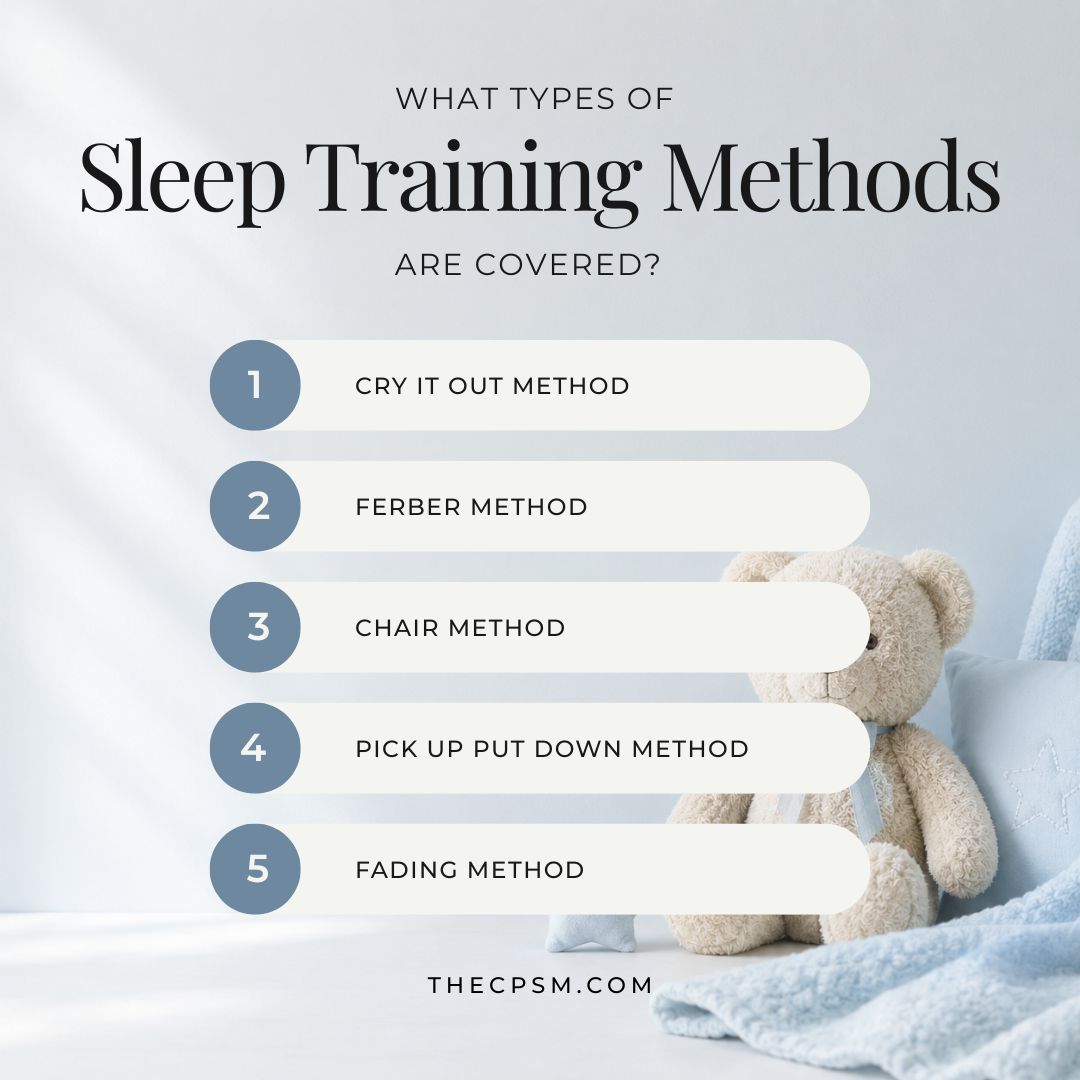
What Types of Sleep Training Methods Are Covered?
Cry It Out Method
The Cry It Out method (CIO) is also known as full extinction. Parents place the baby in the crib awake at bedtime and allow them to fall asleep independently without further intervention, even if they cry. Dr. Emmett Holt first introduced the method in 1894, and others in the field refined the approach. Ultimately, the approach is built on the idea that removing parental intervention helps babies learn to fall asleep on their own.
This method tends to work well for families who have tried gentler approaches without seeing results. It’s also ideal for parents who need to see a meaningful change quickly due to exhaustion or demanding schedules. When you apply this method consistently, most families see significant improvement within about a week.
Not sure how you feel about this method? Listen to my thoughts on it in my podcast episode, “A Cry It Out Story with Jayne Havens.”
Ferber Method
Dr. Richard Ferber developed the Ferber Method in the 1980s as a graduated extinction approach. After the bedtime routine, parents place the baby in the crib awake and leave the room. If the baby cries, parents return at progressively longer intervals, starting at around three minutes. Then they gradually extend that time to five minutes, then ten, offering brief verbal reassurance without picking the baby up.
The Ferber Method tends to be a good fit for families who want a structured approach but find the CIO method emotionally difficult. It also works well for parents who appreciate having a clear protocol to follow. When implemented consistently, families often see improvement within about a week.
Chair Method
Sleep consultant Kim West popularized the Chair Method, a gradual approach in which parents stay in the room while the baby falls asleep. The parent sits in a chair next to the crib, offering minimal verbal or physical reassurance. Then, they gradually move the chair further away every few nights until they’re no longer in the room.
This method tends to work well for families transitioning out of co-sleeping. It’s also a good fit for older infants and toddlers experiencing separation anxiety. Progress is slower than with extinction-based methods, typically taking one to two weeks of consistent effort before seeing improvement.
Pick Up Put Down Method
The Pick Up Put Down Method, developed by Tracy Hogg, is a gentle, hands-on approach to sleep training. After the bedtime routine, parents place the baby in the crib drowsy but awake. If the baby cries, parents pick them up and soothe them until they’re calm but not fully asleep. Then, they place the baby back in the crib. The cycle repeats as many times as needed until the baby falls asleep on their own.
Younger infants between four and seven months old tend to do well with this method. It’s also an ideal technique for parents who want a no-cry approach and prefer to provide close physical reassurance. Families can expect results to appear within two to three weeks with consistent effort.
Fading Method
The Fading Method gradually reduces sleep assistance over time rather than eliminating it all at once. One version shifts bedtime later to match when the baby naturally falls asleep, then moves it earlier in small increments over time. Another version gradually reduces the duration of soothing behaviors, such as rocking or feeding, until the baby sleeps independently.
Sensitive babies, families recovering from a sleep regression, and parents who have tried extinction-based methods without success find this method effective. It also suits those who prefer to see gradual, measurable progress without relying on crying as the primary mechanism. When implemented well and consistently, families see results within three to four weeks.
Are Sleep Training Classes Worth It?
Sleep training classes are a worthwhile investment for anyone who wants to work with infants and toddlers as a sleep consultant. The knowledge you gain becomes the foundation for everything you’ll eventually offer to the families you serve.
There’s also the credibility factor. Completing a recognized sleep training course and earning a certification tells clients that you’ve put in the work. It signals that real education grounds your recommendations. That trust is invaluable when it comes to building relationships with parents and growing your business.
For a full breakdown of how to get started in this career, review my guide “How to Become an Infant Sleep Consultant.”
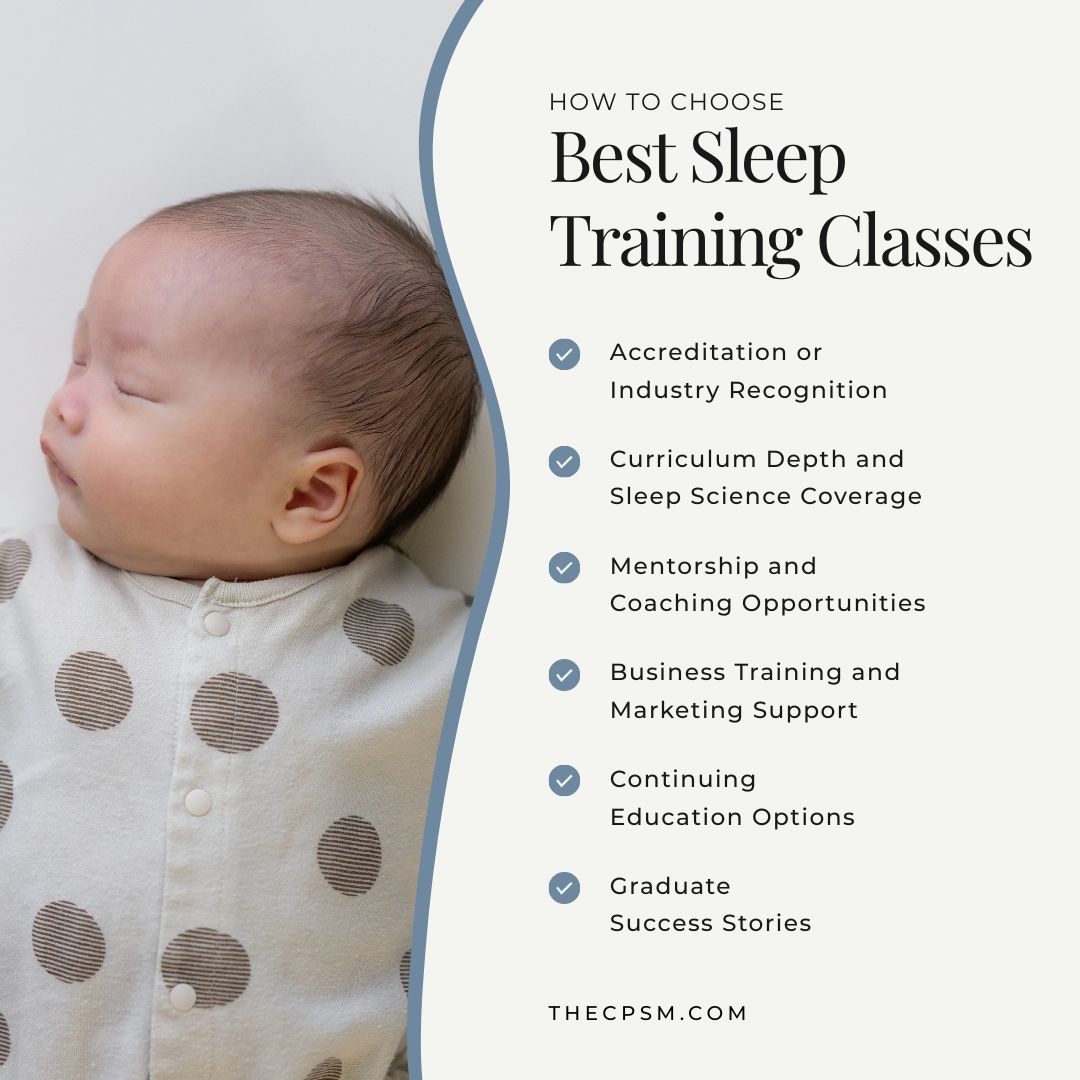
How to Choose the Best Sleep Training Classes
Accreditation or Industry Recognition
When evaluating sleep training courses, two things matter most: industry recognition and feedback from past students. It’s important to understand going in that sleep consulting is an unregulated industry. Therefore, most courses, including mine, are not formally accredited. That’s not unusual, but it does mean the research process is on you. (It also means that any programs claiming to be accredited are using marketing tactics and deserve more careful consideration.)
Beyond this, look closely at what graduates have gone on to achieve. And, if possible, have a real conversation with the course director. That kind of direct conversation tells you far more about the program’s reputation, values, and quality than a sales page ever could.
If you’re curious about the CPSM sleep consultant certification course, I’d love to chat. Book a free discovery call with me, Jayne Havens. We can talk through what the course covers and whether it’s the right fit for you.
Curriculum Depth and Sleep Science Coverage
It’s worth remembering that not every sleep training class covers the same ground. Some focus narrowly on gentler approaches, while others take a more comprehensive view of sleep training techniques.
At CPSM, we believe a well-rounded education is what truly sets you up for success. When you understand the full spectrum of methods, you’re equipped to make the right call for each family. That’s true regardless of their parenting style or the baby’s temperament.
As you’re comparing courses, pay close attention to how deep the curriculum actually goes into baby sleep science. That depth is what separates a course that checks a box from one that genuinely prepares you for real-world work with families.
Mentorship and Coaching Opportunities
Questions are going to come up as you work through your sleep training class, and that’s completely normal. Having a mentor or coach available to answer those questions and guide you through this new career path makes a real difference. It means you start your business feeling more confident and prepared to help families who are counting on you.
This is exactly why I created the CPSM Facebook community, where current and past students connect for mentorship and support. It’s an active group of people who are either going through this same process or have already been through it.
Business Training and Marketing Support
For most people, taking a sleep training course is the first step toward building a business, not just learning a skill. That’s why a truly great course goes beyond sleep science and includes dedicated sections on business building and marketing.
The CPSM course includes dedicated modules to help you launch your business from the ground up. We cover how to structure your services, communicate with clients, and get your marketing off the ground.
For a taste of the kind of business support we provide, listen to my podcast episode “The Power of Consistency in Business.”
Continuing Education Options
Sleep science is always evolving, and staying current with new research and techniques is part of being a responsible sleep consultant. That’s why ongoing access to your certification material matters just as much as the initial training itself.
It’s also exactly why the CPSM students get lifetime access to the course. Students can come back and revisit a module to brush up before a tricky client situation. Or, they can take advantage of new content we’ve added down the road. It will all be there whenever you need it!
Graduate Success Stories
One of the best ways to gauge a sleep training class is to look at what its graduates are doing. When you see people out there building real businesses, working with families, and thriving in their careers, it tells you everything you need to know.
I love highlighting these stories in my CPSM Graduate Spotlight series on my podcast. Past students share their journeys, talk about how the course helped shape their businesses, and offer useful advice for future students. Want to hear what that journey can look like? Check out the episodes with past students Brittany Hefetz, Jaimie Toliver, and Cristina Pilcher.
Start your sleep consultant career with the Center for Pediatric Sleep Management certification course.
A sleep training class covers the range of proven methods used to help babies learn to fall asleep independently. These methods range from extinction-based approaches to gentler, more gradual techniques. Understanding how each method works, what it’s best for, and how to apply it is the foundation of everything you’ll do as a sleep consultant.
If you’re ready to take that first step toward becoming a certified sleep consultant, the CPSM certification course is the place to start. The curriculum covers sleep science fundamentals, sleep training techniques, sleep plans, and everything you need to launch and grow your business. You’ll walk away with the knowledge and confidence to get started right away.
Enroll in the CPSM course today and take the next step toward a career that’s both meaningful and entirely your own. Not quite ready to commit yet? Download my free ebook, Launching Your Career as a Sleep Consultant,for a closer look at what the path involves.