
Jayne Havens is a certified sleep consultant and the founder of Snooze Fest by Jayne Havens and Center for Pediatric Sleep Management. As a leader in the industry, Jayne advocates for healthy sleep hygiene for children of all ages. Jayne launched her comprehensive sleep consultant certification course so she could train and mentor others to work in this emerging industry.

Meet Jayne Havens
Interested in Becoming a
Sleep Consultant?
Join Our Free Facebook Group
Building a Successful Business with ADHD and Dyslexia with Vanessa Simpson
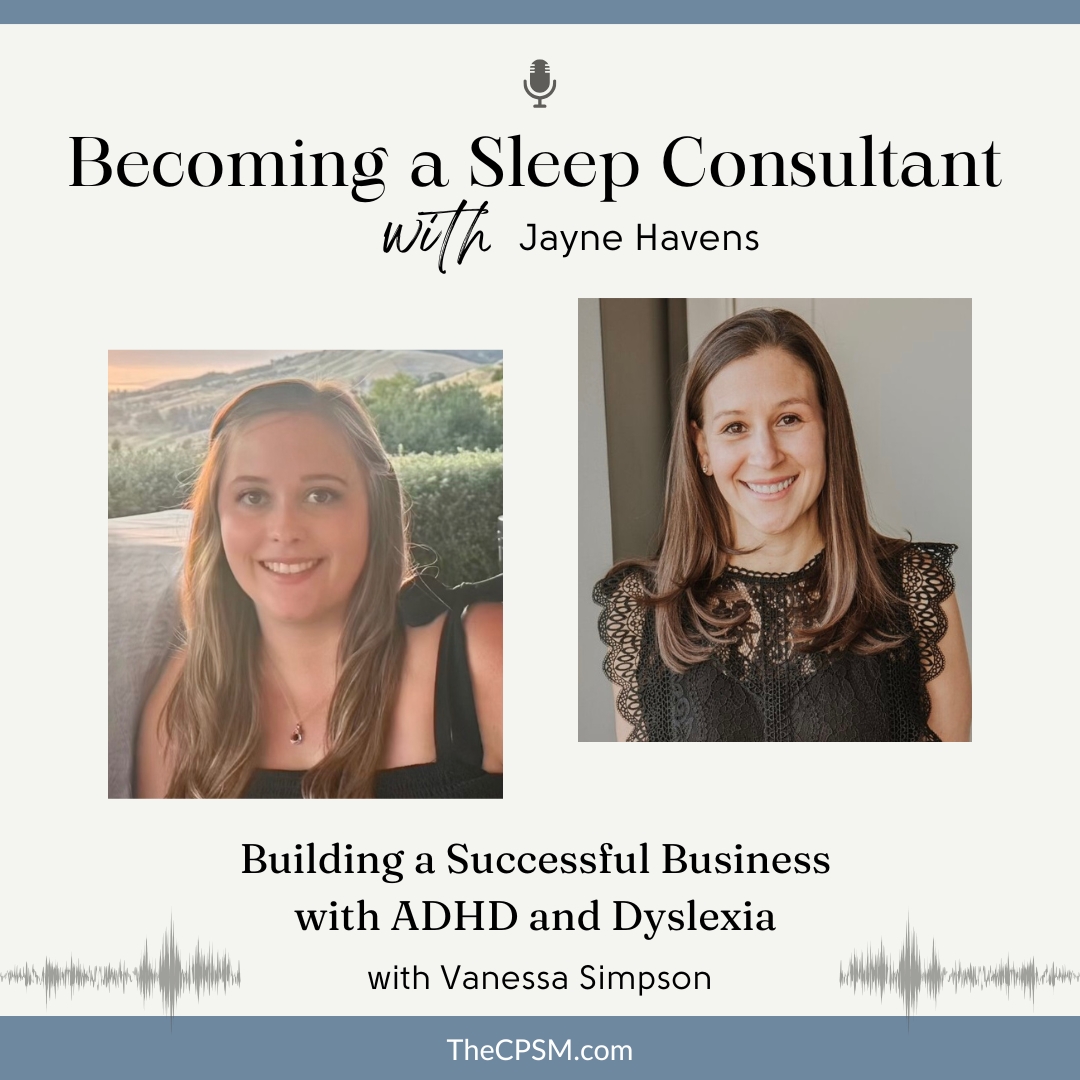
Building a Successful Business with ADHD and Dyslexia with Vanessa Simpson
This week on the Becoming a Sleep Consultant podcast, I’m joined by Vanessa Simpson, founder of Bay & Beyond Sleepy Time Solutions.
Vanessa openly shares what it’s been like to build a successful business while navigating both ADHD and dyslexia, and the practical systems and mindset shifts that have helped her turn perceived obstacles into strengths.
In this conversation, we talk about the routines, tools, and strategies she relies on to stay organized, why entrepreneurship can actually be a great fit for neurodivergent thinkers, and how she learned to stop focusing on what doesn’t work and start building around what does. We also discuss the importance of trial and error, creating a business that fits your life instead of someone else’s expectations, and why there is no single “right” way to attract clients or grow a successful sleep consulting practice.
If you’ve ever wondered whether you have what it takes to build a business, I think you’ll really appreciate Vanessa’s perspective. This is a conversation about embracing your strengths, finding systems that work for you, and realizing that there is no one-size-fits-all approach to entrepreneurship.
Links:
Website: Bay & Beyond Sleepy Time Solutions
Instagram: @bbsleepytimesolutions
Facebook: Bay & Beyond Sleepy Time Solutions
If you would like to learn more about becoming a Sleep Consultant, please join our Facebook Group: Becoming A Sleep Consultant
CPSM Website: Center for Pediatric Sleep Management
Book a free discovery call to learn how you can become a Certified Sleep Consultant here.
Transcript:
Intro: Welcome to Becoming a Sleep Consultant! I’m your host Jayne Havens, a certified sleep consultant and founder of both Snooze Fest by Jayne Havens and Center for Pediatric Sleep Management.
On this podcast, I’ll be discussing the business side of sleep consulting. You’ll have an insider’s view on launching, growing, and even scaling a sleep consulting business. This is not a podcast about sleep training. This is a podcast about business building and entrepreneurship.
Jayne Havens: Vanessa, welcome to the Becoming a Sleep Consultant podcast. I’m so excited that you’re here today.
Vanessa Simpson: Thanks, Jayne. Thanks for having me. I’m excited to be here.
Jayne Havens: Can you start by sharing a little bit about who you are, the work you do today, and what your business currently looks like?
Vanessa Simpson: Yes, so I’m the founder of Bay & Beyond Sleepy Time Solutions. I’ve been in business for about two years now. I’m obviously a sleep consultant and a postpartum doula, so I like to say I have the best of both worlds. I get to help families with sleep, and I get to snuggle babies, which I love.
I’ve been working with families for about 17 years now. Obviously, I’m passionate about helping families. I’m passionate about child development and emotional regulation. I use a whole-family approach, and I offer families non-judgmental support, research-backed guidance. And I often like to tell them that I don’t want to just help them with sleep or postpartum. I want to help them along their parenting journey. And so I offer that in different ways: a DIY, in-person, obviously virtual.
And right now, I’m happy to say that I am the visiting expert for the New Mom School here in the Bay Area, which I’m excited about. I get to go to a room full of parents and talk to them and help them with sleep. I’m also a part of the Bay Area Night Doula team. So I’m super proud and happy to be a part of those teams here in the Bay Area as well.
Jayne Havens: You’ve been doing really, really amazing work, and I love hearing you speak so confidently about all of it. You’ve been pretty open with me, and I think our community, that you navigate both ADHD and dyslexia. I’m wondering if you’re willing to share a bit about how this has impacted your work, both as a doula and a sleep consultant.
Vanessa Simpson: Yeah, so like everything, right, there’s pros and cons to it. So for instance, some of the things that I have challenges with is time management, word retrieval, being able to get my thoughts and opinions out—out to the public, organization, task follow-through.
But then there’s also strengths, right? So, I’m very creative. I’m very innovative. I have a very entrepreneurial mindset, so I’m always thinking. I’m constantly wanting to learn more, and I’m very adaptable and resilient, which I think has really been helpful with being a business owner.
Jayne Havens: Do you think that there’s anything about either ADHD or dyslexia that people misunderstand in the context of running a business?
Vanessa Simpson: Yeah, definitely. I feel like people just automatically assume that if you are neurodivergent, that you’re not capable, or you’re less than, or you don’t have the capacity to do things like run a business. But that’s definitely not true.
It’s very interesting, actually, that most entrepreneurs, I think they say like one in four, or more than the general population, actually go into entrepreneurship. So I think it is actually a really good lane for people who are neurodivergent to go to because there’s so many benefits and so much flexibility. And it actually works well for people like me.
Jayne Havens: I know that you’ve put some systems and strategies into place in your business to help you really thrive in your work, even with all of the things that you’re up against. Can you share a little bit about that?
Vanessa Simpson: Yeah, so I’d say my biggest thing that I’ve done for myself and for my clients as well, actually, is I’ve created a Google Drive research library. So basically a resource library.
Sorry. So basically, what this means is every time I get asked a question, even once or more than once, I realize that it’s a good way for me to put it into writing. I can do my own research and have it there in writing—not only for me to look back on if that question comes up again, but then I’ll put it in my Google Drive. So when it comes up, I can just tell my families, and I can send them the direct link and say, “I already did a handout for it. Here’s the link,” and go ahead and send it to them that way.
So I’d say that’s probably my biggest tool. But there’s a lot of other things that I’ve realized over the couple years that I’ve been a business owner, such as I really need a routine and structure, basically. And then I also have created different types of organization tools for myself, such as daily planners, weekly planners, meal organizers. And then my favorite is actually my brain dump page.
And so basically, if anything pops in my head, instead of having it simmer in my head, I like to write it down. And then when I do have a moment, “What should I do now?” I kind of have something to look back on, and I pick what I want to work on at that point. Because there’s always something to work on. So having somewhere where I can kind of look and have a direction to point me into is really helpful.
I also just recently actually realized that instead of listening to podcasts or having TV on in the background, if I play something that doesn’t have any lyrics—like classical music, or music that’s from different countries that I don’t understand, or stuff like that, or lo-fi, I know a lot of people use lo-fi type music—that really helps me concentrate and stay on task, as well as setting up time blocks, putting my phone on focus mode. Because I get distracted so easily, so having that kind of turned off helps me focus and stay on track. I’m very into color-coding everything. The erasable color pens are like my favorite thing in the world.
What else can I say? AI for structure, and then also for my spelling. Because being dyslexic, my spelling and my sentence structure is just horrible. So having somewhere where I can just write all my thoughts and say, “Fix the spelling, fix the grammar, and then make this cohesive,” has been an absolute game changer. I don’t know where I would be as a small business owner with dyslexia if I didn’t have AI, to be honest. So, I’m super happy that that’s available for me.
And then basically just knowing my own strengths. So knowing that I’m more functional between 10 AM and 12 PM rather than 3 PM. So using that as a benefit to me, like I should work now because this is when I get the most done. So just basically knowing my strengths and my weaknesses and finding these little systems and tools and tricks. And choosing audio rather than reading. I can listen to podcasts and audiobooks and get all that for my intake and my learning rather than reading has been really beneficial to me as well.
Jayne Havens: I don’t know if this is a silly question, but I guess what I want to ask you is if you ever get overwhelmed by all of the tools that you have in place. Because I know that those tools are all intended to be helpful to you, and it sounds like they are. I mean, it sounds like you have really good systems in place. But sometimes when I’m given the advice to color-code things or to make lists, then I have to think, “Which color was that supposed to be?” and “Which list does this go on again?”
Do you really feel like you just have such a mastery of your tools that it truly works for you, or do you ever feel like some of the tools just give you overwhelm?
Vanessa Simpson: Yeah, that’s a good question. It could be overwhelming when you see a to-do list that has a million things on it. So one thing I noticed is that I circle the number one thing that I have to get done for that day. And then the other stuff, I kind of underline two to three things that I should get done, and then I kind of leave the rest as is. And I feel like that kind of helps me without getting overwhelmed. And for myself, it’s like strengths and weaknesses, right? So that’s one thing that works for me. But for you, it doesn’t work, right? So that’s kind of like the trial and error and finding what works and doesn’t work.
Jayne Havens: Did you feel like you ever struggled with confidence, either before you stepped into entrepreneurship or now? To me, when I hear you speak, it seems like you have such a handle on all of the things that maybe would make both your day-to-day life, but also more specifically your business, more challenging for you. But when you’re speaking about all of this, it’s like you’ve harnessed it. You’ve taken control of it, and you exude this confidence. I’m wondering if you have moments of feeling like, “This is too hard. I can’t do this,” or if you just really lean into that confident mindset.
Vanessa Simpson: That’s a good question. I think early on, obviously not knowing I was dyslexic and ADHD was hard.
But then I think because I’ve been working with kids for over 17 years, like I’ve said, right? And I was actually a nanny for 10 years. And during those 10 years, I always got so many compliments. I’ve always been told I’ve been the best nanny. I’ve always been very, very good at my job and very good at helping families. So every time I would jump onto an interview with a family, I would instantly get hired. And I think that’s helped me build my confidence. That’s helped me take that confidence into this profession and me being a business owner because I do know that I can help.
I know I’m capable of helping these families. I know I mix up my words and I stumble and do things like that. But over the general scope of things, I know that I can help these families. That’s kind of what I keep in the forefront of my mind.
But just like everybody, right, there’s going to be a family, a difficult client. There’s going to be a difficult case. And so when it comes to things like that, I’m very thankful that I have the CPSM Facebook group to reach out to so I can get help and get some extra input to help me navigate the challenging things. So I’m very confident in the fact that I can help families. And if I have a question, I know where I can reach out to. So that makes it really helpful.
Jayne Havens: I think you’re also just doing so much to set yourself up for success, right? Whether you have these limitations or not, whether you’re neurodivergent or not, I think so many people sometimes just sit and stew or worry about all of the things that are hard. And what I love about everything that you’ve just shared is that for every single thing that comes up in your business—and I guess you probably apply this to your life in general, if I had to guess. But for everything that comes up that feels so hard, you’re like, “Oh, I have a solution for that,” or, “Oh, I have a way that I’m going to tackle this,” and what an incredible way to be.
I hope that everybody listening will hear you and realize that all of these roadblocks and all of these challenges—whether it’s ADHD, dyslexia, or just lack of motivation, or general overwhelm, or just imposter syndrome—people have all sorts of feelings about themselves and their businesses. And you sort of have a choice. You can just feel those feelings and let them paralyze you and stop you in your tracks. Or you can think about, “How am I going to set myself up to accommodate the way that I’m feeling or my own circumstances and figure it out so that I can grow?” It’s really impressive to me.
Vanessa Simpson: Yeah. What I actually like— I don’t remember where I heard it, but it’s you approach things with curiosity. So when you approach things with curiosity rather than stress, then it makes you more curious. And then you’re more likely to want to learn and figure it out with curiosity rather than stress. Instead of saying, “I have to do this,” I get to do this, is another thing that I like to use a lot. Because, not just neurodivergent people, right? Just like you said, everybody struggles with these things.
Jayne Havens: Do you use social media in your business?
Vanessa Simpson: Yeah. Yeah, I do. I have Facebook and Instagram. I’m not very active. Wow! I’m kind of bad about it. I’ll post three times a week and then not post for maybe two weeks. So I kind of go back and forth a lot. I got it to like 32,000 views in one month. And then I kind of went on vacation, and then it slowly dropped. So I use it here and there.
I have noticed, because I do have the question, “How did you find me?” And so I do find a little bit of clients through social media, but not a ton. But I think it’s nice to keep up with because it keeps me, not active, but it keeps me— if people want to look more, a lot of people look to social media, right? So having a little bit of activeness helps me in that aspect.
I also really like the creative aspect of it. I don’t like putting myself, my face, on video. That’s one thing that I need to do better about. And I think when I do do that, I get a lot more views. But just making content on Canva is something that I like to do when I feel like I want to be creative, basically. It’s kind of fun.
Jayne Havens: How would you say that most of the families that you’re supporting are finding you? Is it word-of-mouth referral from previous families?
Vanessa Simpson: Yeah, so right now, it’s a little bit of everything, honestly. It’s a little bit of social media. It’s a little bit of word of mouth. I actually just recently had a client tell me that they found me on Gemini Chat, which was mind-blowing, and I’m super excited about. But like I said, I’m also a part of the New Mom School visiting expert team. So I tend to get about one or two clients every time I do a class with them, which has been really fun too.
Jayne Havens: So you said earlier that whenever you go on an interview, when you’re nannying or for postpartum doula work, that you always get the job. I could see why. And I’m wondering if you’ve pinpointed what it is about yourself that just seals the deal. Do you know what that X factor is?
Vanessa Simpson: I’m not sure. I would like to say it’s because I’m probably maybe warm and inviting. But I also tell families, like I said before, I don’t want to just help them with sleep and postpartum. I do want to help them along their parenting journey. Because I’m also college educated in child development and early childhood education, so my resource library covers a wide range of things. And in general, I just want to help families have a good bonding, long-term relationship with their kids. I think they can see that, and they know that I can help them—not just temporarily, but long term.
Jayne Havens: Yeah, I think it’s your warmth. You just exude this level of calm, which I think is interesting to come from somebody with ADHD. Because I was diagnosed with ADHD myself a year or so ago, and I don’t know that I bring calm the way that you do. But I can totally see that you bring this sort of level of stability, calmness, confidence. And I think it’s incredible that you’re able to do that even with these limitations that make, I think, in some ways, when you’re neurodivergent, it feels like it’s a limitation, but then also it can be your superpower, right?
Vanessa Simpson: Yeah.
Jayne Havens: And I think that you’re using these things about you to your advantage rather than having it be something that holds you back. And I do believe that on some level, that’s a choice. Because you could sit with, like, “Oh, this is hard. Oh, I have so much trouble with this. This makes everything really, really challenging.” Or you can say, “Okay. This is the hand that I was dealt. This is what it looks like for my brain to work on a day-to-day basis, and here’s how I’m going to maximize what I’ve got and use it to the best of my ability.” And I feel like you’re so good at that.
Vanessa Simpson: Yeah, it’s definitely a lot of trial and error, for sure.
Jayne Havens: So talk to me, actually, about that trial and error, if you’re comfortable. Are there any systems or tools that you put into place that you maybe thought, “Okay, this is not working for me. I’m going to move on”?
Vanessa Simpson: Yeah, so actually, like a month or two ago, I decided to try a virtual planner, daytime planner. So it was the Bright app, actually, on my phone. And I really liked it, but I wasn’t as consistent. So I found out that pen and paper is my go-to. So that’s one thing off the top of my head that I can recall that did not work for me. Because I definitely need that pen and paper when it comes to organization.
Jayne Havens: What would you say to somebody who is struggling with ADHD or dyslexia or some other challenge in their life, and they’re wondering, “Can I grow a business? Can I do this hard thing?” What would you say to somebody like that?
Vanessa Simpson: I would say, don’t count yourself out. And, like I said earlier, honestly, neurodivergent people are actually more prominent to go into entrepreneurship. So definitely do your research. Remember that everybody has different strengths and weaknesses and that ADHD and dyslexia, it has its challenges, but it also has a lot of strengths.
And then you also want to change your mindset from “This doesn’t work for me” to “What works for me?” There’s going to be hard times. There’s going to be good times. And as long as you keep going and you don’t give up, you will eventually get there. It just takes time, patience, and consistency.
Jayne Havens: How did you get so comfortable building a business that fits your life rather than someone else’s definition of success?
Vanessa Simpson: So, for me, I’ve never really fit inside the norms. So I never really said, “This is what I have to do, and this is what my business should look like.” I am a strong believer in learning and educating myself. So using your podcast, doing research. And then just like with parenting, right, you do your research, you learn. And then you take bits and pieces of everything that you’ve learned and you put it towards you and whatever works for yourself.
Jayne Havens: What does success look like for you in your business right now?
Vanessa Simpson: So right now, obviously, continuing to help families and just being happy, having fun. Also, I do feel like it’s an honor and a privilege to be chosen by these families. So every time I do get a new client, I really enjoy that these families are trusting me. Some of them allow me into their home. So it really is a privilege, and it’s an honor. It’s very rewarding, and I think it is the best job in the world.
Jayne Havens: What do you love the most about it? Is it getting the client results with your sleep clients? Is it snuggling the babies with your postpartum doula clients? What do you love the most about your work?
Vanessa Simpson: Oh, that’s a hard question. Because snuggling the babies is so sweet, and then helping their families come into parenthood, or helping them get used to a four-person home, is super rewarding. But also, once those kids get sleeping through the night, and you get those messages, “My baby slept through the night for the first time,” it’s super rewarding too. So to be honest, I don’t know. I think that’s a really hard question.
Jayne Havens: For me, I sort of have two favorite things about my business. One is getting clients results and hearing from them, as you said, in the morning when their three-and-a-half-year-old just slept through the night for the first time ever in their entire parenting journey, right? There’s literally nothing better than that.
But also, I have so much satisfaction and pride and joy that comes from being a successful entrepreneur. I just find that to be so thrilling and so rewarding. And I know that so many people listen to this podcast, and they just think, “I don’t know if I could do this. I don’t know if I can find clients. I don’t know what if I can’t help the families that pay me.” Everybody has all of these worries. I think that’s all totally normal. But I just wish that people would have enough confidence to take a chance on themselves because it is so rewarding to grow a business, especially one supporting families.
Vanessa Simpson: I totally agree. And I think, to piggyback off of that, I feel like lots of people think there’s one way to do it. Or they’ll hear somebody say, “I got so many clients by posting on Facebook,” but it doesn’t work for them. So I think people who are successful are able to pivot and try new things and try to work the system to see what works for them because they have different strengths. And even the different location where they live, people respond differently to that. So it’s about being consistent and not giving up and finding out what works.
Jayne Havens: Yeah, I think you’re total proof of that, that you have figured out ways to grow your business in a way that works for you that is totally unique to your personality and your business. I think that anybody is capable of that. They just have to be willing to try.
Vanessa Simpson: And put in the work.
Jayne Havens: And put in the work. That is exactly right.
Where can people learn more about you, learn more from you? Do you want to share your social media, website, anything like that?
Vanessa Simpson: Yeah, so people can reach out to me. Also, if anybody’s interested in my organization tools, like my weekly planner, my daily planner, my meal organizer, any of those types of things, I’m open to sharing. So they can reach out to me if they want that or if they have any questions. You can find me on my website, which is www.bbsleepytimesolutions.com, and I’m on Instagram @sessa_bbsleepytimesolutions. And then I have a Facebook. I’m not on there as much, but it’s just Bay & Beyond Sleepy Time Solutions.
Jayne Havens: Vanessa, this was fantastic. Thank you so much for being willing to share both all of your knowledge, your expertise, and also your actual tools. And congrats on all of your success in your business, and we’ll have to do this again soon.
Outro: Thank you so much for listening to this episode of the Becoming a Sleep Consultant Podcast. If you enjoyed today’s episode, it would mean so much to me if you would rate, review, and subscribe. When you rate, review, and subscribe, this helps the podcast reach a greater audience. I am so grateful for your support.
If you would like to learn more about how you can become a certified sleep consultant, head over to my Facebook Group, Becoming a Sleep Consultant or to my website thecpsm.com. Thanks so much, and I hope you will tune in for the next episode.
Thank you for your message.
We will contact you shortly!