

Infant Sleep Training Certification: What to Look For

The demand for infant sleep consultants continues to grow as more new parents seek structured, evidence-based support for their newborns. After weeks of sleepless nights, many families reach a point where guesswork isn’t working. It’s now that they recognize that professional guidance is worth investing in. That growing demand creates a real career opportunity. It’s perfect for anyone who wants to do meaningful work while building a business on their own terms.
If you’re considering becoming a certified sleep consultant, choosing the right certification course is an important decision. Not all infant sleep consultant certification courses are equal, and knowing what to look for before you invest your time and money matters.
In this post, I’m covering exactly what an infant sleep training certification is. I’ll also discuss why it matters for sleep consultants and what a quality course actually teaches. Plus, I’ll share what to look for when comparing programs so you can make a confident, informed decision. By the end, you’ll have a clear path forward and know exactly where to start your career.

What Is Infant Sleep Training Certification?
An infant sleep training certification is a professional training program that teaches you how to support families through the challenges of infant sleep development. The coursework covers age-appropriate sleep habits and the science behind how babies sleep. Beyond this, it explains various sleep-training methods to help infants develop healthy, independent sleep patterns.
The ultimate goal of a sleep consultant training course is to prepare students to work confidently as pediatric sleep consultants. Completing the course and obtaining a certification makes a real difference for the families they end up serving.
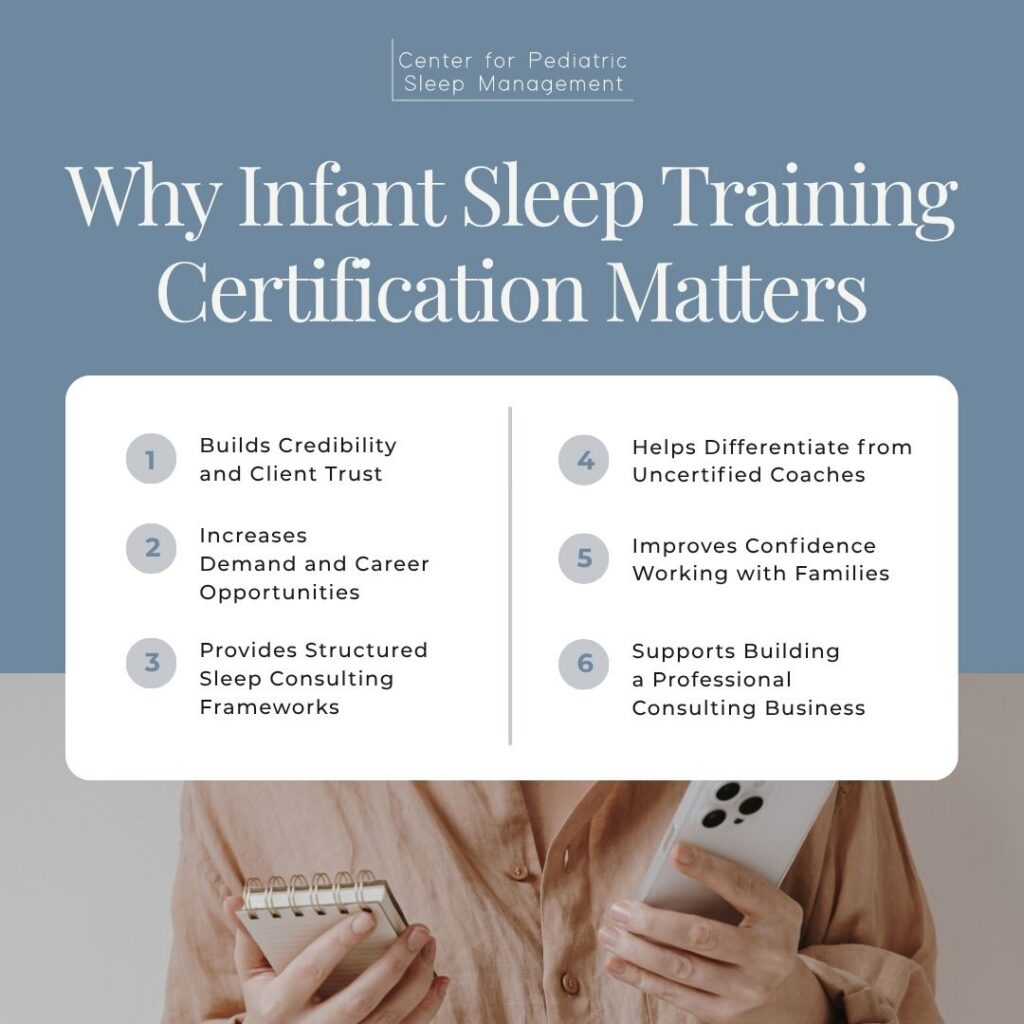
Why Infant Sleep Training Certification Matters
Builds Credibility and Client Trust
Earning an infant sleep training certification immediately strengthens your credibility and gives potential clients a concrete reason to trust you. Families are far more likely to work with a sleep coach who has completed a recognized certification program. Without formal training, building that trust is much harder.
That credential demonstrates that you’ve invested in your education and that you ground your knowledge in evidence-based practices. But more specifically, it shows you are ready to handle the sleep challenges each baby faces.
Increases Demand and Career Opportunities
A sleep consultant certification opens doors that are hard to access without one. More specifically, clients actively seek out certified consultants. That credential positions you to attract families ready to invest in professional support.
As your client base and experience grow, additional opportunities have a way of presenting themselves. These could be expanding your services, raising your rates, or building a reputation that brings consistent referrals. It often starts with one decision. And that decision is enrolling in the right infant sleep training certification course.
Provides Structured Sleep Consulting Frameworks
A structured infant sleep training course gives you more than information. It gives you a framework you can actually apply when you’re sitting across from a real family with a real sleep problem. Reading about sleep science on your own is a starting point.
However, it doesn’t prepare you to translate that knowledge into a personalized plan. And it definitely doesn’t help you communicate that plan clearly to exhausted parents and adjust when things don’t go as expected. A quality certification course builds all of those skills together. That is exactly what separates consultants who get results from those who struggle to deliver on their promises.
Helps Differentiate from Uncertified Coaches
Before diving into this career, it’s worth understanding that sleep consulting is an unregulated industry. There is no required certification, which means technically anyone can call themselves a sleep consultant without any formal training. And that can be a dangerous situation.
That’s exactly why getting certified matters so much. In a field with no gatekeeping, your certification is what sets you apart. It distinguishes you from those offering sleep advice without evidence. But the reality is that it signals to families that you’ve invested in real education. It’s proof that your recommendations are evidence-based, and you’re someone they can trust with their baby.
This distinction is not a small thing when parents are making decisions about who to let into their family’s life.
Improves Confidence Working with Families
There’s a confidence that comes with being certified that you simply can’t fake. When you genuinely understand the science behind your recommendations and know exactly why you’re advising specific practices, it shows. Parents pick up on that. They can tell the difference between someone who is reading from a script and someone who actually knows their stuff.
That confidence translates directly into trust. And when parents trust you, they follow through on the plan, which is ultimately what gets results for the families you serve.
Supports Building a Professional Consulting Business
At the Center for Pediatric Sleep Management, we don’t just teach you how to help families. We teach you how to build a real business around that work. That means understanding how to set your rates, structure your services, manage your schedule, and grow a sustainable practice on your terms. The flexibility of being a business owner means you can work part-time alongside other commitments or build something full-time.
Your infant sleep training certification is what gives that business its professional foundation. It’s the credential that allows you to step into this industry with confidence and present yourself as the qualified expert you actually are.
Are you curious about what building your own business entails? You can find more information in my post, “Sleep Consultant Services: How to Build and Price Yours.”
What You Learn in Infant Sleep Training Certification Programs
Sleep Assessment and Intake Process
One of the most practical skills you’ll develop is knowing how to properly assess a family’s situation before ever recommending a sleep plan. More importantly, the intake process teaches you to gather the full picture. This includes feeding schedules, the baby’s developmental stage, sleep environment, and what the parents are realistically able to commit to.
The sleep assessment process matters because no two families are the same. A strategy that works for a four-month-old in a quiet apartment looks very different from one for a toddler sharing a room. Getting that assessment right from the start is what helps sleep consultants get results and happy clients.
Age-Appropriate Sleep Expectations
Understanding age-appropriate sleep expectations sounds straightforward until you realize how much it shapes every recommendation you make. A newborn waking every two hours isn’t a problem to solve. A ten-month-old doing the same thing might be. Knowing the difference is foundational, and it’s exactly what a quality certification program teaches you.
Good infant sleep training programs cover how sleep needs and wake windows shift across the first few years of life. They also go into real depth on overnight consideration. Without that foundation, it’s easy to set families up for frustration. They end up chasing goals their baby simply isn’t ready for yet. That’s not helpful, and it’s not something a well-trained sleep consultant should ever put a family through.
Sleep Regression and Transition Support
Sleep regressions have a way of derailing even the most well-established routines, and most parents arrive at them completely blindsided. A good certification program teaches you how to recognize what’s actually happening at each stage. That includes the four-month regression, developmental leaps, and nap transitions that tend to throw everything off.
More importantly, it teaches you how to coach families through those periods. You’ll help them hold onto the progress they’ve worked so hard to build. That knowledge is what allows you to be the calm, reassuring voice a panicked parent needs at the end of a hard night.
If you’re interested in learning more about this topic, listen to my podcast episode with Dr. Sujay Kansagra. Together, we offer a more comprehensive approach to addressing sleep challenges and the role consultants can play in this process.
Night Waking and Settling Techniques
Night wakings are usually the number one reason parents reach out to sleep consultants in the first place. This makes knowing how to handle them well one of the most essential skills in the job. Infant sleep training programs walk you through the full range of settling techniques available, from more gradual approaches to faster ones. They also teach you how to match the right method to each family rather than applying the same plan every time.
You’ll learn to identify why a child is waking, whether it’s a sleep association, genuine hunger, or something developmental. From this, you can build a response strategy around that specific cause. Ultimately, that diagnostic thinking is what turns a generic sleep plan into one that actually gets results.
Parent Coaching and Communication Skills
Sleep consulting is really only half about sleep. The other half is people. Infant sleep training certification programs teach you how to show up for exhausted, emotionally stretched parents. You learn how to explain a plan and safe sleep clearly, set realistic expectations, and keep a family motivated when progress feels slow. But the real skill is learning how to keep these conversations from overwhelming the parents.
Many consultants enter this field with solid sleep knowledge, but struggle to translate it into something a sleep-deprived parent can act on at midnight. Strong communication skills are what bridge that gap. And honestly, they’re what turn a one-time client into someone who sends referrals your way for years.
Creating Customized Sleep Plans
Generic sleep plans are easy to find. What parents are actually paying a sleep consultant for is something built specifically around their child, their home, and their own boundaries. Each family has its own approach to the process, and they want their consultant to respect that.
When you take a sleep consultant course, you’ll learn how to use everything you’ve gathered during intake to create a custom plan. That means accounting for the baby’s temperament, the family’s feeding method, and the parents’ comfort level. In reality, a generic, downloadable guide could never account for these factors, which is why parents pay consultants.
Learning to build plans this way is what gives you real confidence as a consultant. You aren’t just following a script. Instead, you’re solving a specific, real-world problem for a specific family. Now that’s a skill worth developing properly.
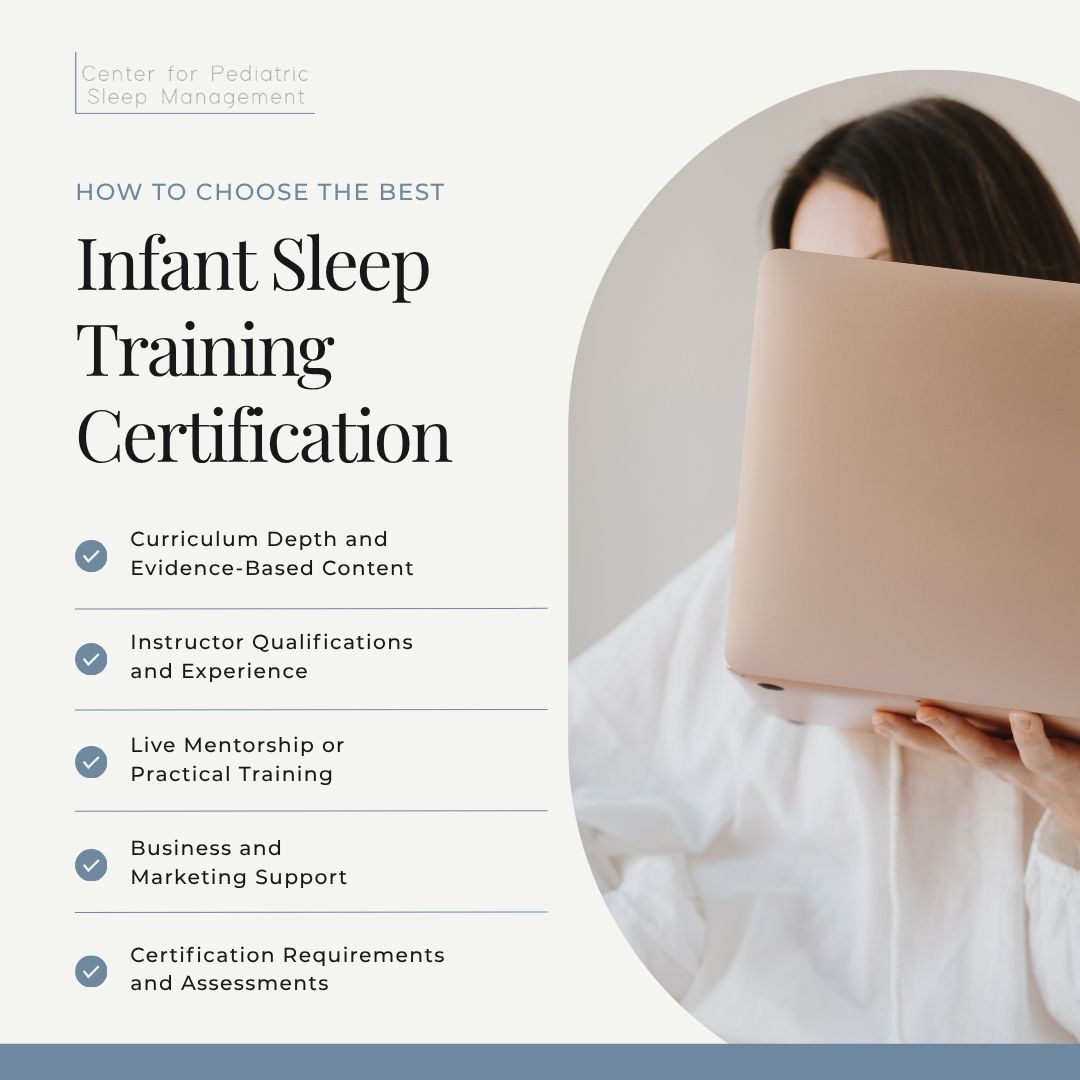
How to Choose the Best Infant Sleep Training Certification
Curriculum Depth and Evidence-Based Content
When evaluating certification programs, curriculum depth is everything. Look for courses grounded in actual sleep science, not trend-based advice or single methodology someone decided to brand and sell. The best programs cover how sleep develops biologically in infants. They also walk you through the full range of evidence-based training methods at every age and stage.
I’ve built the CPSM certification exactly this way. The curriculum covers sleep science, sleep training methods, and age-related sleep development. We present it in a way that actually prepares you for real client work, not just passing a quiz. A shallow curriculum might get you a certificate. However, it won’t give you the foundation to show up for families and get them results.
Instructor Qualifications and Experience
The person teaching the course is just as important as the course itself. Look for instructors who have actually worked with families, not just studied the topic on their own. There is a real difference between theoretical knowledge and the kind of insight that only comes from doing hands-on work.
I’m a good example of this. Before I built the CPSM, I navigated infant sleep with my own children. Then I turned that experience into a consulting practice. I spent years working directly with families before I ever set out to teach others.
The curriculum I built reflects what actually happens in real client work, not just what looks good on paper. That practitioner background is in every part of the program. Ultimately, it’s one of the things our graduates tell us makes the biggest difference. They feel genuinely prepared when they start working with their own clients.
Live Mentorship or Practical Training
Textbook knowledge only gets you so far. When you’re sitting across from a family whose baby hasn’t slept in weeks, you need more than a course module. That’s why live mentorship and community support are worth looking for in any certification program.
At CPSM, this is something we take seriously. For those interested in learning more about becoming a sleep consultant and what this role entails, our Facebook community is an excellent place to start.
That kind of ongoing access to someone with actual experience in the field is rare. But it also means you’re never completely on your own when something unexpected comes up with a client. Oh, and I can’t forget to mention that I host continuing education sessions live, so you keep learning.
Business and Marketing Support
A lot of sleep consultants graduate from certification programs with solid knowledge and zero idea how to actually find a client. The business side of things is an afterthought in many courses. Ultimately, that means graduates are left to figure out pricing, marketing, and positioning on their own.
The CPSM takes a completely different approach. I built a dedicated, step-by-step module around launching and growing your sleep consultant business from the ground up. So, by the time you earn your certification, you’re prepared to run a real business. If you’re serious about making this a career rather than just earning a certificate, that practical foundation is non-negotiable.
For a taste of what I mean, check out my post “Ways to Find Clients as a Pediatric Sleep Consultant.”
Certification Requirements and Assessments
Not all certifications carry the same weight. How a program assesses you says a lot about how seriously it takes the credential.
At CPSM, I built the evaluation into the learning process from the start. As you move through the course, you’ll answer multiple-choice quizzes and short-answer questions. This method keeps you actively engaged with the material rather than passively consuming it.
The final assessment takes things a step further. You’ll create and present written sleep plans based on real case studies. That’s about as close to actual client work as a training program can get. Once you complete the final assignment, you will earn your certification.
Earn your infant sleep training certification from the Center for Pediatric Sleep Management today.
At some point in the process of deciding to become an infant sleep consultant, the question of certification will come up. For anyone who wants real credibility and a solid foundation, the answer is simple: certification matters.
A quality certification course teaches you the foundation of sleep consulting, including sleep training methods and how to build a custom sleep plan. And when you choose the right program, it also gives you a clear starting point for launching your business.
That’s exactly how I’ve built the CPSM sleep consultant certification course. By the time you earn your certification, you’ll be ready to support families during one of the most vulnerable periods. Graduates also have access to continuing education and ongoing mentorship through our exclusive Facebook community. So, the support doesn’t stop when the coursework does, and that makes a meaningful difference.
Ready to take the next step? Enroll in the CPSM sleep consultant certification course today.
Not quite ready to commit yet? Schedule a discovery call with me, Jayne Havens. Let’s talk through what becoming a certified sleep consultant could look like for you.