Interested in becoming a sleep consultant?

Jayne Havens is a certified sleep consultant and the founder of Snooze Fest by Jayne Havens and Center for Pediatric Sleep Management. As a leader in the industry, Jayne advocates for healthy sleep hygiene for children of all ages.
Jayne launched her comprehensive sleep consultant certification course so she could train and mentor others to work in this emerging industry.

Meet Jayne Havens
Ready to Start?
Become a Certified Pediatric Sleep Consultant
Turn your passion for helping families into a flexible career you can build from home.
Free Guide
A closer look into what sleep consultants do, and how this career could fit into your life.
More Than a Night Nanny With Lauren Harvey
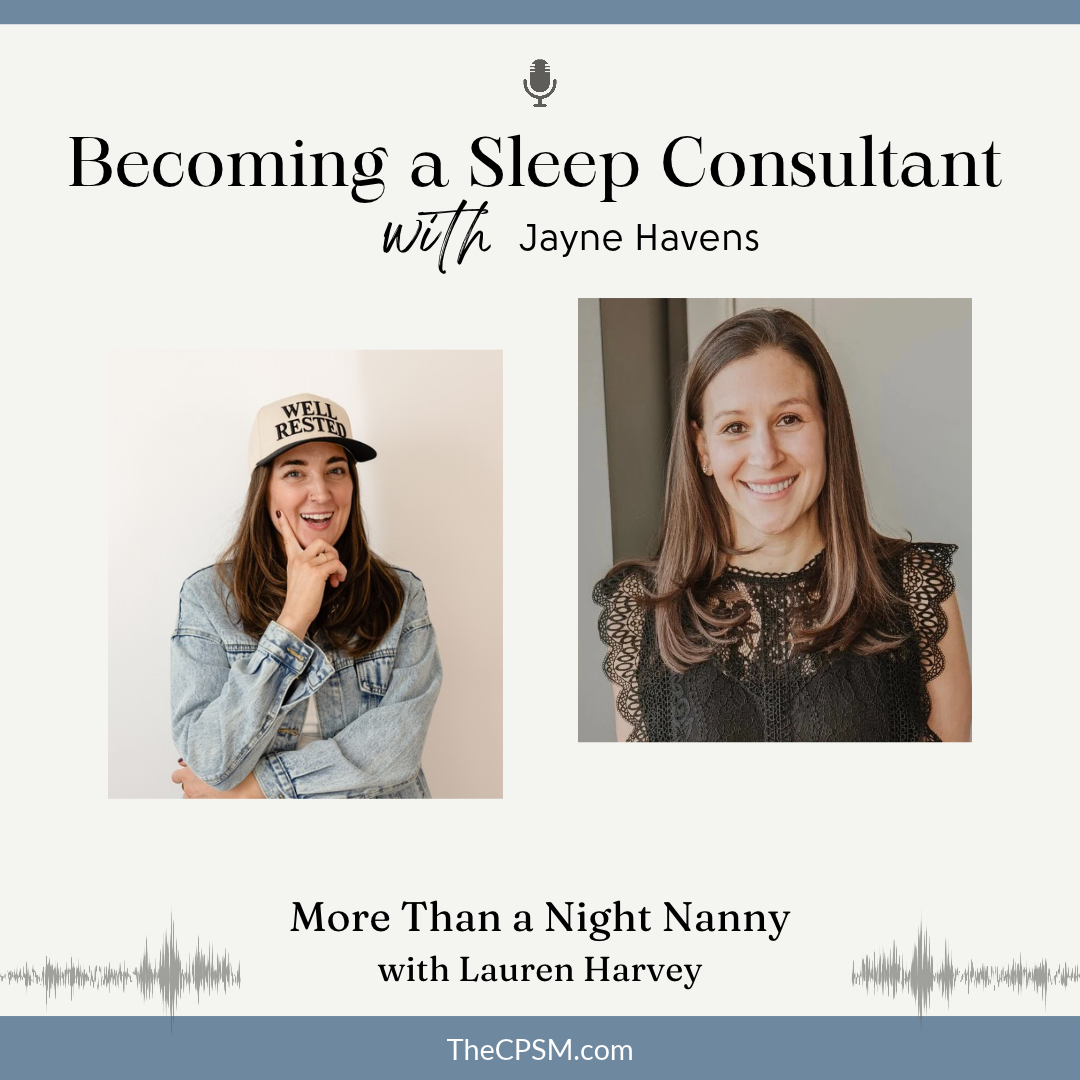
More Than a Night Nanny
with Lauren Harvey
What happens when you take a career you’re already passionate about and invest in the education that allows you to become even better at what you do?
For Lauren Harvey, becoming a certified pediatric sleep consultant completely transformed her career as a Newborn Care Specialist. She went from simply providing overnight support to becoming a trusted expert who helps families establish healthy sleep habits from the very beginning.
Lauren’s story is a perfect example of how sleep consultant certification doesn’t necessarily have to mean starting a new business or leaving behind work you already love. Sometimes, it’s about deepening your expertise, building confidence, increasing your value, and creating a career that’s both financially rewarding and sustainable for the long term.
In this episode of Becoming a Sleep Consultant, Lauren shares how this specialized education has helped her stand out in her field, and why she’s now more confident, more in demand, and more fulfilled in her work than ever before.
Links:
Website: The Sleep Edit
Instagram: @thesleepeditco
If you’d like to learn more about becoming a Sleep Consultant, please join our Facebook Group: Becoming A Sleep Consultant
CPSM Website: Center for Pediatric Sleep Management
Book a free discovery call to learn how you can become a Certified Sleep Consultant here.
Transcript:
Intro: Welcome to Becoming a Sleep Consultant! I’m your host Jayne Havens, a certified sleep consultant and founder of both Snooze Fest by Jayne Havens and Center for Pediatric Sleep Management.
On this podcast, I’ll be discussing the business side of sleep consulting. You’ll have an insider’s view on launching, growing, and even scaling a sleep consulting business. This is not a podcast about sleep training. This is a podcast about business building and entrepreneurship.
Jayne Havens: Lauren, welcome to the Becoming a Sleep Consultant podcast. I’m so excited you’re here with me today.
Lauren Harvey: Happy to be here. Thanks for having me.
Jayne Havens: So, as we get started, why don’t you tell us a little bit about yourself and specifically your career as a newborn care specialist? How did you get into this work, and what does your business look like?
Lauren Harvey: I was a career nanny for the majority of my 20s, working daytime, raising kids, doing the whole nine yards. I decided I wanted to leave that family when they no longer needed me, but I didn’t want to just jump right back into another family and raise another set of kids again.
I learned about doing overnight work as a newborn care specialist, as a night nanny, and I dove into that field. I learned that I didn’t have to become super attached to families. It was much shorter contracts. It wasn’t as emotional because I was in a really emotional state leaving that previous family. I really love working with newborns. I helped raise those kids and worked with a few newborns after them briefly, and so I really wanted to niche down and learned about becoming a night nanny. So that’s where I got my feet wet.
I took a newborn care training course and started working nights as very entry-level, like entry-level night nanny. I wouldn’t even consider myself a newborn care specialist because I was still so new that I didn’t really know what I was doing. But these families hired me anyway. I did that for about three years, exclusively working nights. I did some nanny work on the side as I was gaining clients, but the majority was overnight work. This was 2020, 2021, when the pandemic was at its height, and I was going to be moving to a new state and city.
I wanted to find another service that would complement what I was already doing and that I didn’t have to be in someone’s home. Because everyone at the time was nervous about having extra hands in the home, especially with a newborn at the height of COVID. And so I wanted another service that I could work virtually, that I could still have an income, but I didn’t have to be in someone’s home. And so, sleep consulting was kind of the next best option. I really wanted to start an actual business.
Before then, I was just an independent contractor. I was working with agencies. I didn’t have an LLC. I didn’t have a website. I didn’t have contracts. I really didn’t have any of that. And so I was going to be moving to a new state. I wanted to have an actual business, and I wanted to provide these quality services that would complement each other.
And so, after being a night nanny for about three years in my previous city, then I took the Center for Pediatric Sleep Management course. I took it pretty fast because I was so excited. At that time, I was working with a set of twins who were sleeping through the night by that point, and so I had the time at night to really power through. I was so passionate about sleep, and so it was a course that was easy for me to get through because I was so excited to keep learning. It was not a chore at all.
Now I’m a certified sleep consultant and a newborn care specialist in the Atlanta area.
Jayne Havens: What did it look like for you to bring sleep consulting into your practice as an NCS? Did that change the game for you?
Lauren Harvey: Yeah, absolutely.
When I took the course and started actually applying the knowledge that I learned in the course, I realized that I didn’t know anything before. I took this newborn care course, and then I had my experience. But that didn’t compare at all to the actual sleep training course. I try to think back on what I was doing previously, and I remember there being a clear before and after. Whenever there’s a huge event in someone’s life, you’re like, you know, that’s your before-and-after moment. The course was that for me because I realized I knew nothing.
As a brand-new, entry-level newborn care specialist, I really was just another nanny but working nights. I wasn’t the specialist coming in and guiding the parents. I was another kind of almost employee, which is what I wanted to get out of when I ended being a nanny. I wanted to actually be a specialist. And so I realized once I took the course and learned everything there is to know about sleep with babies, I really didn’t know wake windows and sleep pressure and feeding things.
There were just so many things that were not in my other course and not in my experience as a daytime nanny that I could apply at all to this. I like to say I was a Band-Aid, almost. I wasn’t fixing the root cause. I was just coming in and helping. The parents were telling me what to do, and I was facilitating that. I wasn’t making changes. I wasn’t guiding them through. I wasn’t their source of information. I wasn’t their professional. I was just a helper—a mother’s helper at night.
And so now I’m an actual specialist. I’m someone who comes in; they’re hiring me because they need help, and they want to be told what to do. And so it’s been complete night and day, no pun intended, from what I used to do and the lack of knowledge and then now, I mean, it’s everything. And I know the sleep consultant course as a whole, because sleep training can span from infancy until, I think you’re working with a nine-year-old right now. There’s such a large age group. My niche is specifically infants and newborns. From this course that spans so many years, I learned so much just from the newborn section alone.
Jayne Havens: I think sometimes people hear the term sleep consultant and they immediately think about sleep training. Obviously, that’s not really what you’re doing when you’re working overnight as a newborn care specialist with a four-week-old baby, right?
What are some of the ways that you’re supporting sleep in those very early weeks and months that have nothing to do with formal sleep training?
Lauren Harvey: So I would characterize sleep training as formal sleep training. I mean, it starts around four to five months. It’s kind of the golden time frame. And so I’m working with babies from night one of the hospital. And so that’s obviously not considered sleep training. But there is still so much we can do so that we can prevent needing sleep training at the four- to five-month mark. I like to say that sleep training is breaking habits. And when I’m there, I’m preventing those habits from starting so that we don’t have to break anything later on.
It’s almost like the boiling-the-frog analogy. We’re getting the baby used to these little things early on in a very slow process so that by that time, when babies can naturally sleep through the night, if they’re given all the tools from the beginning, they don’t need formal sleep training.
And so it’s a much slower and gentler process than when you’re hiring a sleep consultant and a parent is nervous because they know there’s going to be a lot of tears and it might be hard. There’s going to be a lot of uncomfortable feelings. This is a gradual process. We’re working with the baby’s natural rhythms and we’re setting them up for success so that I can get a baby sleeping through the night by 12 weeks. It’s always my end goal, and then you don’t need sleep training later on.
Now, I’ve had families come back to me maybe a year later because there’s been regression, and now their toddler is starting something and the parents are doing something different, and now there’s a new habit that’s formed. But I rarely have families come back to me a month after me being with them needing help sleep training, because we’re past that point. They don’t need sleep training.
Jayne Havens: What would you say are the couple of most important things that you’re putting into place with these newborns from the beginning so that they don’t need sleep training later?
Lauren Harvey: Children and babies learn by pattern recognition, and so I like to have routines in place. I want families to have an end time to the day and a start to the day. I like to have a solid bedtime routine. I want them to end the day at the same time every single day, have a solid bedtime routine, and then from there we start the night. I can see if there’s any changes that we need to make. But if the times are all over the place and nothing is consistent, we really can’t make progress. I like consistency. Babies need consistency, and so we are creating these patterns.
I really try to prevent day-night confusion, and so I only use red light at night. I’m crazy about the lights. Parents will tell you. They see the lights that I’m using, and then they buy them because they know how serious I am. There can be no light in the nursery, even from electronics. And if we are using light, it’s only red light. And so these are things I’m putting into place that they see, and then they can kind of mock me when I’m not there. But my biggest thing is we’re preventing day-night confusion. I want there to be a complete separation between day and night.
We can have a really solid daytime routine of eating every three hours. Naps sometimes are a little messy in the beginning, and that’s fine. But I want there to be a predictable routine to the day that babies can depend on. And then at night, when I take over, we have a clear separation of what’s happening at night. Baby is swaddled in a nursery, maybe white noise, it’s pitch black, or there’s just red light. There’s very low stimulation. There’s no talking and singing and toys and any of these things that are going to stimulate a baby. That’s my ideal environment for a baby when I’m there overnight.
Jayne Havens: What are parents doing during the day? Are you really giving parents a lot of instruction and advice for how to manage the day so that they can set you up for success for all the work that you’re putting in at night?
Lauren Harvey: Yeah. So, obviously, I’m only there at night, and then I sleep during the day, and so I’m not available via text throughout the day. Most parents don’t text me if I’m their newborn care specialist overnight. But when I come in, I want to know how the day was because the day will affect the night, and the night will affect the day. I’m looking at a whole 24-hour picture. And so I want to know how the feeds were, how the naps were, if they were out and about.
It is a complete partnership. I tell parents this: this is a group project that we’re working on. I can only be there 8 to 10 hours a night on the nights they have me. They’re the ones that are in charge of the daytime. And so I do give the parents a schedule that I would recommend for their baby. I say it’s not a black-and-white schedule you have to follow exactly, but it’s a guide on how I want the pattern of the day to go so that the baby is set up for the nighttime.
And so that could look a little different depending on each family and what they have going on. But yes, I do make recommendations for the daytime. Especially with feeds, I’m making recommendations for bottles, different nipples on the bottles, different pacis, anything that we can do to make the daytime easy for the parents as well. Because I obviously can help them with the day if they’re giving me that information. And if there is any difficulty during the day, I do want to know about it so I can adjust with them.
Jayne Havens: When you are hired as a newborn care specialist now, maybe it looks a little different than back in 2021, are families aware of your expertise in sleep? Is that part of how you are pitching yourself to these families? Are you using your education, your knowledge, your credentials to separate yourself apart from other night nannies or newborn care specialists that they might also be interviewing?
Lauren Harvey: Yeah, absolutely.
My specialty is sleep. I’m a newborn care specialist who has a niche in sleep. I’m not just going to be there anymore to hold the baby all night and then allow for these habits to form that are no longer sustainable. I try to work myself out of a job, and I try to do that as soon as possible. These parents usually need to get back to work. They’re doctors, lawyers, individuals that have pretty stressful work. Most are going back to work in 12 to 16 weeks. And once they are at work, they need to sleep.
Most families hire me knowing that I can get their baby to sleep. A lot are recommendations from other families, like, “Lauren got my baby to sleep in 12 weeks, and now baby’s sleeping through the night. Can we hire you as well?”
And so that’s my preferred family, is the one who wants me to get their child to sleep in 12 to 16 weeks. Those are the ones who are going to follow exactly what we advise them, the recommendations. We’re in this together. They specifically look for someone like me, or at least appreciate what I can offer them, as opposed to maybe a postpartum doula or someone who isn’t specialized in sleep and will allow the parent to sleep while they’re there but may not set them up for sleep once they’re gone. So there is a difference.
Jayne Havens: I think that this sort of works both ways, right? You’re setting your clients up for a lifetime of healthy sleep habits for their child and for their household, but you’re also positioning yourself to get more sleep on the job, right?
You’re putting in the work for the first probably six weeks, is really a lot, right? A lot of hands-on support to get them comfortable lying flat on their back in the bassinet and being comfortable in that swaddled position, sleeping safely. And then once the dust settles and feeding is established and some day-night confusion is eradicated, then you really start to see the fruits of your labor, right? And then they start sleeping longer stretches, and it makes it more sustainable for you, I would imagine.
Lauren Harvey: Yeah, my job starts out really difficult in the beginning when I get a brand-new baby, and then by the end of our time together, it’s very easy. It might look like me just hanging out at night and having a sleepover at their house without doing any work.
It’s still beneficial to the parents because they have a guaranteed night off, and I basically have a night off too. I’m just hanging out at someone else’s house. I don’t sleep at night because I have a backwards circadian rhythm now, but I do get to hang out and do whatever I want. So it’s mutually beneficial for everybody. The parents and the babies are getting that good sleep at night, regardless of how the night is, and then I get a really easy night. I have a really easy job by the end.
Some parents do want past 16 weeks. I recently had to tell someone, “You don’t need me. You’re not going to need me then. I know you want to keep extending, but the baby is going to be sleeping through the night. And so If you’re okay paying me to just come over, that’s fine. I’m not going to say no to that. But if you are on a budget, you really don’t need me.” And so they decided, “You know what? You’re right,” and they cut back the hours, and the baby’s sleeping through the night. I was right.
Some parents do want that guaranteed night of sleep. They can completely turn off. They’re off the clock, and I’ll be there just in case. But most likely, the baby is sleeping through the night by that point, by 12-plus weeks. Families ask a lot what the preferred amount of time to get a baby sleeping through the night. I generally say 12 to 16 weeks because by then we’ve transitioned out of the swaddle. We have weaned feeds completely, and the next speed bump is rolling over.
And so if they want me there for that, then that will be between four and five months. But it’s possible it could be after, and so I could just be waiting around for the baby to eventually roll. Most of the time, though, by 16 weeks, the baby still hasn’t rolled yet. But I give parents a worksheet and a PDF on what to do once that comes, and if that does happen after I’m gone, I’m happy to offer text support for free. I will help these parents overnight.
Jayne Havens: I just see this as being something that positions you to have your work be so much more tolerable and sustainable long term, right?
If you’re just there to keep the baby quiet all night long, then if that’s the mentality as a newborn care specialist or a postpartum doula—your job is to keep the baby fed, keep the baby dry and clean. If they’re crying, pick them up, put a pacifier in their mouth, hold them for a bit, put them back down—if that’s what you’re doing, is keeping the baby quiet, then you’re in this cycle of whether it be 6, 8, 10, or 12-week contracts where you’re never getting a beat to rest, right? To me, that’s where the burnout creeps in. It is not sustainable long term.
And then I see people like you doing really smart, savvy work. The career is sustainable for you because you’re able to get rest if you want it, sleep through the night if you want it. If you don’t, that’s fine. But it positions you to be able to sleep. It also allows you to market yourself in a way that separates you from most other people that are doing this work. I would imagine that your referrals are mostly families that are telling their friends about you, saying, “Lauren got my baby to sleep through the night. I would pay her anything.” Right?
Lauren Harvey: Yeah, this has become a sustainable job for me. I’ve been doing this for eight years now, and I don’t see an end date. I have a lot of people asking, saying, “I don’t know how you do it,” but it’s honestly, now that I know what I’m doing and I have a timeline for each family, it’s much easier than working days.
It’s actually so much harder for me to go back to a daytime schedule because now, working nights, the way I do it, I sleep at the same time every day. I eat at the same times, and then the nights are usually pretty easy because I’ve set these babies up and these families up for success. Like tonight, I have a six-week-old that I’ve been with for six weeks, and she’s doing a six- to seven-hour stretch, that first stretch. And then after that, by that point, I’m gone. And so it’s maybe 30 minutes of work, maybe a little bit more depending on how she’s doing. Then she’s back to bed, and I’m back to reading.
So it’s very sustainable for me to be able to do this, to be able to continue working five to six nights a week consistently.
Jayne Havens: What do you see overnight with babies, or just in the household dynamic, that maybe helps you to do your job more effectively than someone like me who’s only supporting a family virtually? What are some of the things that you’re seeing in person that maybe a virtual sleep consultant wouldn’t catch?
Lauren Harvey: I do get to see kind of everything. The dynamic of the household, a lot of it comes down to the overstimulation of a baby by the end of the day.
And so if there’s a lot of kids, there’s a lot of lights, there’s a lot of noise, I can catch that. I can tell them, “Okay, well, it’s past bedtime. The lights are too bright. I wouldn’t have playtime right before bed.” There’s all these little things that I can catch. A lot of it does come down to light, though.
And then the patterns of these families, they might just have a lot going on. The baby is strapped to the mom all day. And so, okay, well, there was never a clear separation of day or night. Or if the baby was held all day, I can usually tell that night because they have a really hard time being put down in the crib when we expect them to. It’s most likely because they were held all day, let’s say by a family member, or the mom was wearing the baby, or the baby was out and about all day and overstimulated by the time of the evening. And so, there’s a lot of things that I can catch: the nursery setup, the way they might be doing things.
One thing I have a pattern of how I respond to babies overnight, where when it is time to feed, I’m doing the diaper change first and then doing the feed, where a mom might do the feed first and then the diaper change. And so, I have a pattern and a really intentional way of doing every single thing. And so, a lot of times, the parents can watch what I’m doing and then adjust what they’re doing. Because they’re saying, “Well, the baby has a much easier night with you. What are you doing differently?” And so, I’ll explain, “Well, this is what I’m doing. See if that changes,” and it usually does.
Jayne Havens: One thing that I have been catching recently—and I’m not in the home with people, but I just am in tune with this because I’m feeling it in my own house—is the temperature. Where I am in Baltimore, the seasons are changing. We’re going from it being 85 degrees to, like, this morning, it was like 45 degrees. This morning, it was freezing.
A lot of my babies that I’m working with right now, for the past two or three nights, have been waking more in the middle of the night. I think it’s because they’re chilly. I noticed this because my house is chilly and because I have a colleague who’s obsessed with baby temperature. She’s always talking about warming them up. And so, whenever my babies have an off night, sometimes my brain goes right to, “Is the nursery too cold, or is the nursery too warm?” I’ve been spot-on about that because literally it happened, like all three of my babies that I’m supporting right now had a hard night, one or two hard nights within the past few nights, when they had been doing great.
I said to them, “Hey, what’s the temperature in the nursery? What PJs are they wearing? What sleep sack are they wearing?” Two out of the three of these babies were not in sleep sacks, and the house was like 68, 69 degrees. These babies were freezing, right? And so that’s one of those things that I would imagine you can feel that, you can see that. I only thought of it because I happened to be really in tune to this, but it’s one of those things that I feel like a lot of sleep consultants might miss when the weather is changing.
Lauren Harvey: Yeah, that’s true. I do live in Georgia, so it is a little bit warmer. So if anything, I’m like, “It’s too warm,” and so I’ll turn the AC down. We actually sleep better when it’s chilly, but not too chilly, so obviously there has to be that middle ground. With babies, I say 68 to 72. That’s the safe zone. We don’t want an overheated baby, and we don’t want a freezing baby. One is unsafe, and then one won’t let them sleep. And so we have to find the middle ground.
Sometimes I will double swaddle a baby because it’s so cold and I can’t adjust the temperature, or the vent is blowing directly on the baby. That was something the mom and I caught actually pretty recently. It was a twin family, and one crib was positioned in a way that the vent of the air conditioning was right below. We noticed she was moving a lot more in the night. She was waking up stuffy, and the mom was actually the one that realized the air vent is blowing directly on her. And so we had to position her in a way that her face isn’t where the air is. That was something that really took a long time to diagnose, and we didn’t even see that.
Sometimes there’s noises that family— I always recommend a sound machine. I’m obsessed with sound machines. I have an addiction to them, basically. I think parents are a little wary of them and how loud they need to be. And so sometimes there’ll be a sound machine on, but it’s so low I can’t even hear it. And so I’m like, “Okay, we need to turn this up to an appropriate level.” But it needs to be enough to where if you’re walking down the hall or closing a door, it’s not going to wake the baby up. And so those definitely are other things that I see.
The nights I come in, like tonight, I’ll go in at 10. The baby’s already down, and mom will usually leave some sort of light on in there, whatever it is. And so, I go in and I make sure everything is pitch black. I turn on the sound machines. I usually bring my own sound machine too, and I just make sure that the nursery setup is exactly how I want it. Because parents sometimes don’t think of these things, where I’m very in tune. Everything is super intentional so that the baby is set up for a great night of sleep.
Jayne Havens: I know that you’re doing mostly in-person work and you’re sort of leveraging your knowledge, skills, and expertise to make yourself an even better NCS, but you’re also doing some virtual support. I’m wondering, how is your NCS work benefiting your work as a sleep consultant?
Lauren Harvey: I do a lot of the same things, just in a different manner. What also, I think, sets me apart for sure is that I’m awake at night. I’m usually in the thick of it with these families. And so, parents can text me in the middle of the night at 2:00 A.M, when I am working with a virtual client, and I will respond immediately.
Being an NCS has helped me be a better sleep consultant because I understand the nighttime challenges. I don’t have children myself, but I’m working every single night with a family. Sometimes it’s a really easy baby; sometimes it’s the most difficult, challenging baby.
And so, I’m really in the thick of it with these families. And so when the mom wakes up at 2:00 A.M. because the baby is up and she doesn’t know what’s going on, she can text me, and I will respond. I always say, if I’m not feeding another baby, I will respond immediately and walk you through exactly what to do as if I was the one doing it. And so that has been so beneficial to my virtual clients.
Jayne Havens: I recently supported a family that was living seven hours ahead of us here in the U.S., and it was so fun to be able to support them in the middle of the night. It’s very rare that I get to do that. It was really helpful for them because these parents were highly anxious about the sleep training process.
They had tried it several times on their own without success. The husband was adamant that he did not want to hire— they had hired a sleep consultant in the past in their own time zone, which did not allow them to have support in the middle of the night. And so, they hired me because of the time difference. They specifically wanted me to be available to them while they were having a hard time in the middle of the night. It was so helpful to them. I really don’t think that they would have gotten it done without that real-time text support at like 2:00 A.M.
It was really, really helpful to them, and I had a lot of fun. It was a great change of pace because I rarely do that, and it was a game changer for them. I think for most families, look, I support families all the time without offering middle-of-the-night support, and it goes fine. But for families who have the luxury to be able to communicate with their sleep consultant in the middle of the night, what a bonus!
Lauren Harvey: Yeah, that’s generally when families need the most help because they’re so tired and drowsy, and they can have a tendency to go back to what they were doing because it’s the fastest way to get the child back to sleep. And so having an accountability buddy in the middle of the night to enforce what we’re doing has been a game changer.
Even if they know what they’re doing, the parents, I still want them to text me in the middle of the night if they are awake to let me know what’s going on, so that we’re in it together. Now, because I sleep during the day, the daytime troubles usually have to wait a little bit until I’m awake in the afternoon, and then we work out those kinks. But the nighttime is when families are the most just confused because they’re so tired and they don’t have the mental capacity to sometimes execute what we talked about on the phone and what the plan says.
And so, for them to be able to be like, “Okay, what am I doing again?” and me to walk them through, them to send me videos of the monitor, so it’s like I’m there, I can tell them, “Okay, this isn’t a level-10 cry. This isn’t this type of cry. Just wait,” and coach them in real time has been a huge game changer.
Jayne Havens: What I’m hearing from our conversation is that, really, you’ve stepped into such a higher level of confidence and just an entirely different level of expertise in your work. I’m wondering if you’re feeling that when you go into jobs and if it’s positioned you to feel confident enough to charge accordingly.
Are you charging more than you were a few years ago? Are you charging more than what’s standard in your area? How are you leveraging this skill set to really be profitable and advantageous for you financially and career-wise?
Lauren Harvey: Yeah, the confidence aspect has been huge. When I first started this, I was doing a lot of interviews, but parents would ask me questions and I wouldn’t have the answer to them, or I would have this imposter syndrome. I don’t have that at all anymore. I have so much confidence just because I’ve done this for so long. I know what to expect.
Every family is different. Every baby is different. But I can almost guarantee how our time together is going to be and that they are going to be sleeping by the time I’m done with them, unless something crazy has happened, which honestly never has at this point. So yeah, the confidence has been huge. And because of that, I am absolutely fine with what I’m charging.
Now, I do stay in line with other colleagues in my area. I would rather work than not work, but I am fully booked out for a long time. What I used to charge was very low. When I first started, I was bottom of the barrel, just starting out. For me, it was a step up from being a nanny, but it was the lowest pay of an overnight newborn care specialist. This was also pre-COVID, so things have changed a lot. Then I moved states to where there was even higher pay.
Right now, I’m close to being in line to top of what I can charge without stepping into a postpartum doula role, which I don’t want to be. I want to stay in this niche, which I absolutely love.
Jayne Havens: It sounds like you’re doing really great. I’m so proud of how you’ve leveraged all of this to really benefit you in ways that I think are really smart.
People come to CPSM for all different reasons, especially postpartum professionals like doulas and newborn care specialists. Some of them come to me because they want to transition out of overnight work. Some of them come to me because they want to just be better at their jobs. Some of them want to be able to command higher hourly rates. Some of them just want to get more sleep on the job. They want to learn how to get the babies to sleep so that they can rest and keep the career sustainable for them.
I just love hearing your story because you’ve leveraged it in a way that works for you, and it’s allowed you to do the work that you want to be doing, getting rest on the job, and staying booked, which is I think the most important part. So, kudos to you!
Lauren Harvey: Thank you.
Jayne Havens: Before we wrap up, do you want to share your website, social media, anything else so that everybody can follow along?
Lauren Harvey: Yeah, so my website and business is The Sleep Edit. My website is thesleepeditco.com, and all my socials are thesleepeditco.
Jayne Havens: Perfect, Lauren. It was so great chatting with you. Congrats on your success, and we’ll have to do this again soon.
Lauren Harvey: Yeah, sounds good.
Outro: Thank you so much for listening to this episode of the Becoming a Sleep Consultant Podcast. If you enjoyed today’s episode, it would mean so much to me if you would rate, review, and subscribe. When you rate, review, and subscribe, this helps the podcast reach a greater audience. I am so grateful for your support.
If you would like to learn more about how you can become a certified sleep consultant, head over to my Facebook Group, Becoming a Sleep Consultant or to my website thecpsm.com. Thanks so much, and I hope you will tune in for the next episode.

Considering A Career in Sleep Consulting?
Download our free e-book filled with information on what sleep consultants do and how running a sleep consulting business might fit into your life.
FrEE DOWNLOAD
Thank you for your message.
We will contact you shortly!