

How Doulas Support the Non-Birthing Partner During Labor (And Why Partners Love Having One)

Wanting to help and knowing how to help aren’t always the same thing. Especially during labor and delivery.
If you’re the non-birthing parent-to-be, chances are you’ve thought about (and maybe even stress-thought about) how you can best support your partner.
Maybe you’ve read all the books on labor and delivery and support techniques. Perhaps you’ve taken birth preparation classes together. You’ve even had detailed conversations about what they may need from you during labor. And maybe you’re still nervous about whether you’ll be able to step up in the moment.
Honestly, it’s a lot to think about. As a Certified Pediatric Sleep Consultant, I see it over and over. Even partners who are eager to help during labor and delivery can have underlying anxiety about not knowing what to do. That’s where a doula can help!
A birth doula is a trained professional who supports the birthing person and their partner, emotionally and physically. They offer that support during pregnancy, labor and delivery, and shortly after birth. They’re not there to replace the non-birthing partner (more on that below!) and they’re not there to provide medical care.
Instead, doulas work alongside the medical professionals to provide emotional support, answer questions, and help both parents as needed. That means you can stay fully present instead of feeling lost on the sidelines.
In this post, I’m walking you through how doulas support the non-birthing partner during labor and why partners love having one. If you’re a partner who wants to show up well, or someone considering this work yourself, this is for you.

How Doulas Support the Non-Birthing Partner During Labor
So how exactly can a doula support the non-birthing partner during labor and delivery? In short, doulas teach you comfort measures and explain what’s happening as labor shifts. They offer reassurance when fear creeps in and give you breaks to eat and rest.
They also help you communicate with the medical team. Through all of it, a good doula keeps you at the center of the birthing person’s support.
Here are some of the ways doulas step up to support non-birthing parents:
Showing Partners Comfort Measures in Real Time
One of the most common ways doulas support you is by modeling comfort measures you can use to support your partner.
For example, let’s say the birthing person is receiving counterpressure to their lower back during contractions. You may have an idea of what that entails from classes or from practicing at home.
But you might not feel confident about exactly where to place your hands, how much pressure to use, or how long to hold the position. This is where a doula can step in and demonstrate counterpressure in real time. You can follow along and take over with confidence.
This type of real-time demonstration can be useful for a variety of comfort measures, including but not limited to:
- Hip squeezes
- Different types of massage
- Different positions for labor
The more equipped and confident you feel, the more support you’ll be able to offer your partner during labor.
Explaining What’s Happening During Labor and Birth
Another way doulas can support non-birthing parents is by explaining what’s happening during different stages of labor and birth.
Maybe contractions seem to plateau for longer than expected, or surges seem more intense than anticipated. Doulas can provide insight into what’s normal so that unexpected changes don’t immediately seem worrying.
Offering Reassurance When Things Feel Scary
Doulas can be a great source of reassurance for non-birthing parents when things are feeling scary (even if they’re perfectly normal!). For example, transition labor (the shortest but most intense stretch) can sound pretty ominous when it’s described ahead of time. It may seem downright scary while it’s happening.
Doulas can offer reassuring words and make eye contact. They might also share supportive comments, like “you’re doing such a great job!” or “this is hard because it’s working!” These small moments can help ease fears for both parents.
Giving Partners Breaks to Eat, Rest, or Step Out
Depending on many factors, including the use (or non-use) of pain relief medication, labor can last a pretty long time. This is where having a doula present can be a blessing for non-birthing parents.
Your partner may have been in labor for hours, and you’re flagging a bit. Having a doula present can give you peace of mind if you need to step out. You can grab a bite to eat, get some water, use the restroom, or just close your eyes for a few minutes. A quick break can help you avoid burnout, so you can be fully present for your partner during later stages of labor and delivery.
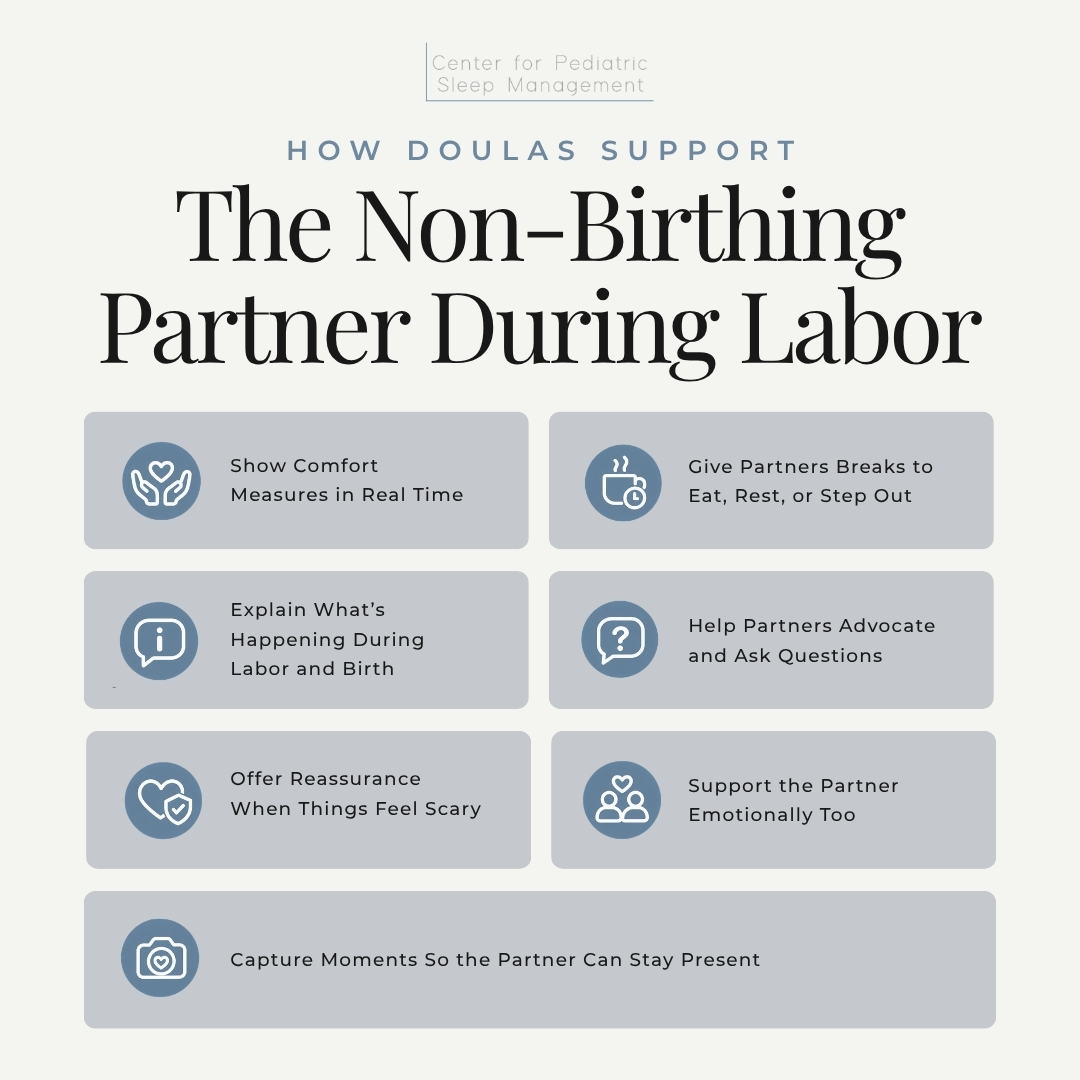
Helping Partners Advocate and Ask Questions
Especially in hospital settings, there can be a lot going on during labor and delivery. You may feel unsure about what questions to ask the medical team, or how to advocate for your birth preferences at the moment.
A doula can remind you of items in your birth plan and help you think of questions to ask. They also provide general support and guidance, while making it clear that they’re not there to make decisions for your family.
Supporting the Partner Emotionally Too
Birth is an emotional and powerful experience for everyone present, including the non-birthing parent. Sometimes witnessing your partner in labor can be pretty overwhelming. This is where your doula can offer you a moment of emotional support. Think: a reassuring comment, a pat on the back, or a reminder to take a deep breath.
Capturing Moments So the Partner Can Stay Present
Some non-birthing parents tell me that if they could go back, they’d do things differently during their partner’s birth. They would forget taking any photos or videos so they could just be present in the moment.
Other parents love documenting their partner’s birth and wouldn’t have it any other way! Either way, a doula can take a few photos or record a few moments. Handing off the camera takes that burden off your plate, so you can be as present as you’d like.
Why Is Doula Support During Labor Important for Non-Birthing Partners
Having a doula can help non-birthing parents feel more empowered and equipped to support their partner during labor and delivery. And research backs up the benefits of having a doula, too. Check out this evidence-based article for more on continuous labor support.
Partners Often Feel Helpless or Unprepared
Especially for first-time parents, labor and delivery can feel foreign and scary. You’re witnessing something you’ve never seen before, and you may be unsure of how to best support your partner. This can leave you feeling helpless. Doulas can help by explaining what’s going on, showing you helpful support techniques, and filling in any knowledge gaps.
Labor Can Last Many Hours (and Partners Need Rest Too)
Labor can last quite a while, especially for first-time parents. And even if your partner’s labor doesn’t drag on, it can be an emotionally and physically exhausting experience for you too. Doulas provide continuous labor support. That support can free you up to squeeze in a quick snooze if you missed out on some shuteye the night before.
It Lowers Stress and Anxiety for Both Partners
Continuous support during labor can help lower stress for the birthing person, and for their partner, too. After all, it’s easier to stay calm when you’re equipped with knowledge, insight, and guidance.
It Can Lead to a More Positive Birthing Experience for the Whole Family
Having a doula present can also improve the overall birthing experience. A 2017 Cochrane systematic review pooled the results of 26 randomized controlled trials. It found that continuous support during labor may:
- Increase the chance of a vaginal birth without forceps or a vacuum
- Shorten labor
- Lower the chance of a C-section or an assisted vaginal birth
- Reduce the use of pain medication, including epidurals
- Lower the chance of a low Apgar score (a quick newborn health check) at five minutes
- Reduce negative feelings about the birth experience
The review found no evidence of harm from continuous labor support. It also suggested that support was most effective at lowering C-section rates when the support person was a doula. The same was true in settings where epidurals weren’t routinely available.
To be clear about what the evidence does and doesn’t show: much of this is rated low-quality evidence. Think of these as promising benefits rather than guarantees. A doula supported birth isn’t a promise of a specific outcome. Still, the direction of the research is encouraging for the whole family.
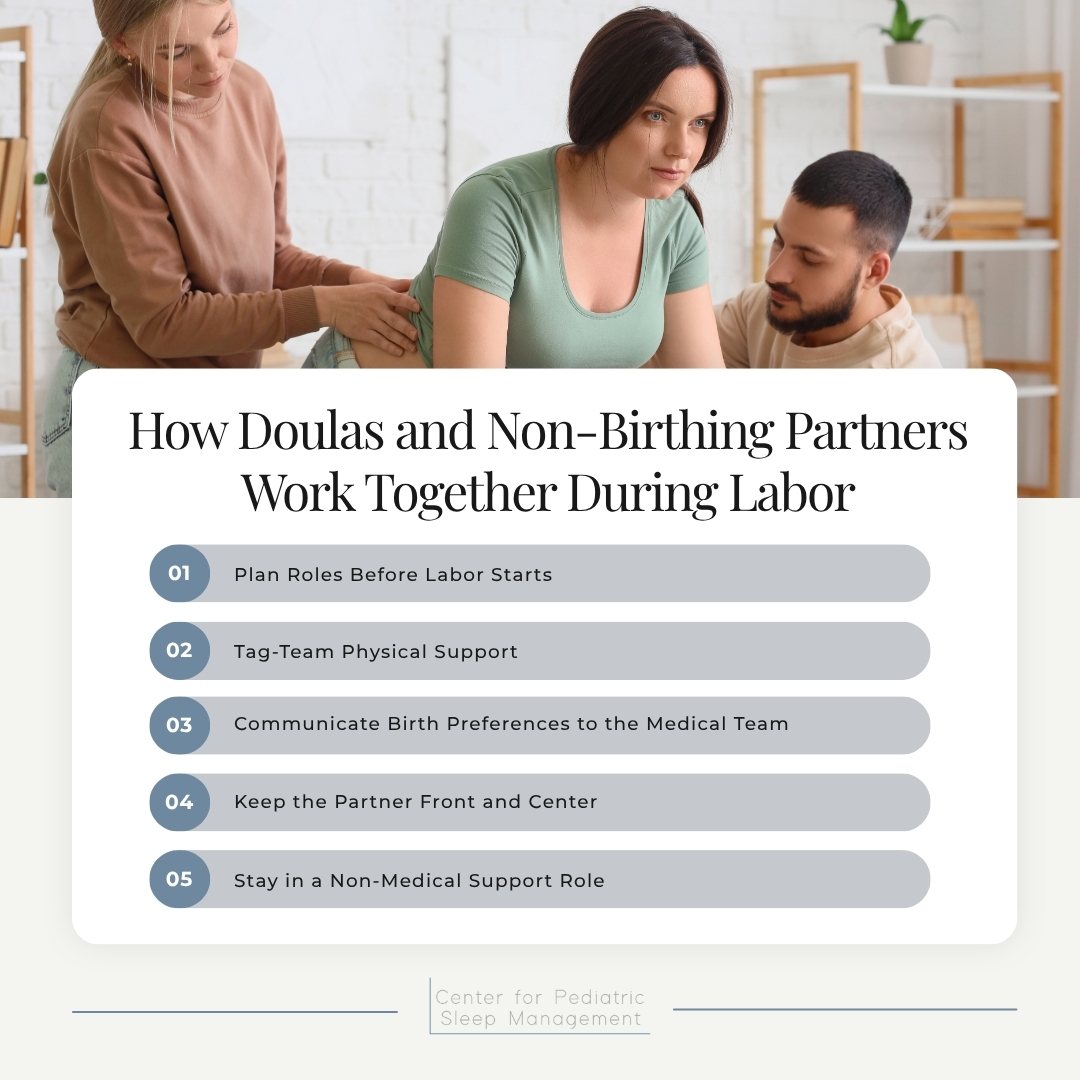
How Do Doulas and Non-Birthing Partners Work Together During Labor
One of the biggest misconceptions I hear about doulas is that they swoop in to replace the non-birthing parent. Nothing could be further from the truth!
A good doula won’t try to steal your thunder. Instead, they’ll help fill in knowledge gaps and empower you with birth support techniques. They’ll also help you advocate for your preferences and support you emotionally, so you can show up for your partner.
Planning Roles Before Labor Starts
This partnership starts long before delivery day. During prenatal meetings, doulas can help expectant partners find meaningful ways to support their partner during labor and delivery.
Tag-Teaming Physical Support
Depending on the type of physical support you’re providing, it can get tiring to do it continuously. Having your doula tag-team with you can help make sure you’re not burning yourself out before the big finale!
Communicating Birth Preferences to the Medical Team
Doulas can help remind you of your preferences during labor. They also encourage you to voice these preferences to your care providers.
Keeping the Partner Front and Center
While doulas play a critical role during labor and delivery, they understand the importance of staying in their lane. They’re happy to encourage you when times get tough and answer any questions you might have. But when it’s time for the baby to make their grand entrance, doulas step aside to give you and your partner the moment.
Staying in a Non-Medical Support Role
Doulas don’t cross over into providing any medical care or advice. They’re not trained or credentialed to do this. And they know that your care providers are the best people to answer any medical questions or concerns you might have. Knowing exactly where that line sits is part of what makes a doula trustworthy.
How Doulas Prepare Partners Before Labor
Of course, doulas play a big role on delivery day. Here are some ways they can help non-birthing parents prepare before the big day:
- Prenatal meetings: Meeting with your partner’s doula ahead of time helps you get to know them. You can also figure out how you’d like them to support you and your partner. Prenatal appointments give you the chance to ask questions and voice any concerns ahead of time. That way, you can feel comfortable walking into the delivery room.
- Practicing comfort measures: Your partner’s doula can show you birth support techniques like hip squeezes, labor positions, and counterpressure during contractions. You’ll be prepared to help ease your partner’s discomfort on delivery day.
- Talking through fears: Voicing your fears out loud can help defuse some of their power. Talking them through with your partner’s doula can help you plan how to cope when (or if!) they rear their ugly heads.
- Making a birth plan together: Your partner’s doula can help you both map out your ideal labor and delivery scenario. They’ll also remind you to leave wiggle room for changes.
- Packing the hospital bag: You’re likely going to be the one lugging the hospital bag around. Your partner’s doula may have suggestions for items that can make a hospital birth a little more comfortable.
You don’t need to have every detail perfect. Plans flex, and that’s allowed.
How Doulas Support Partners After Birth
For many families, introducing a doula into the mix doesn’t stop at delivery day. Postpartum doulas support new (and experienced!) parents in those first weeks (and months). They can help with feeding routines, household tasks, and settling in as a family. Many also take over the night shift so parents can sleep.
For non-birthing parents, a postpartum doula can help build your confidence in soothing your newborn. They can also give you insight into ways you can best support your partner’s recovery.
It also helps to know the signs that your partner (or you) may need extra help. Not sure what normal postpartum adjustment looks like (emotionally and physically) vs. what’s cause for concern? Check out my articles on post-birth warning signs and “Baby Blues vs Postpartum Depression”.
When you support your partner through recovery, you’re building your family together.
Tips for Non-Birthing Partners Working With a Doula
Here are a few tips to keep in mind:
- Meet with your doula ahead of time. It’s important to feel connected and at ease with the professional who’ll be supporting you through one of life’s biggest moments.
- Talk about your role. Discuss your hopes and concerns about supporting your partner so your doula can offer the most fitting guidance.
- Lean on your doula in the moment. In the thick of things, it’s okay to rely on your doula’s expertise and step-by-step support. You don’t have to do it all on your own.
- Remember to care for yourself. Make sure you’re eating, drinking water, and resting as much as you can. You can’t pour from an empty cup!
- Be ready to adapt. Births rarely go exactly according to plan. Think on your feet and embrace changes as they come.
Doula and Partner FAQs
Will a Doula Replace My Role as a Partner?
Nope! Your doula will never replace you or step over you. They’re there to offer support, so you can step into your role feeling confident and empowered.
Do Partners Need a Doula if They Took a Birth Class?
Birth classes and doulas complement each other nicely. Birth classes provide helpful information. Doulas offer real-world, in-the-moment support to help you put what you’ve learned into practice.
Can Family Members Be in the Room With a Doula?
In most cases, yes! Many doulas are experienced in collaborating with family members. They help make sure that everyone has a role to play in a way that feels cohesive and not overwhelming. Just check your hospital’s or birth center’s policy on how many support people can be in the room.
Do Doulas Support Same-Sex and Non-Traditional Couples?
Of course! A skilled doula will bring the same level of dedication, compassion, and understanding to all families.
Becoming a Birth or Postpartum Doula, and Growing That Career With the CPSM
Wondering what comes next? If you’re curious about becoming a postpartum doula or birth doula, start by comparing a few doula training programs. (Psst… growing your doula or newborn care business? Be sure to check out my resource for doulas and newborn care specialists, too!)
Interested in learning how birth workers can earn a sleep consultant certification to grow their business?
At the Center for Pediatric Sleep Management (CPSM), we don’t certify doulas. What we do to help birth workers is turning their passion into a profitable business.
For doulas, that means adding behavioral sleep consulting for babies and toddlers to your services. Why? Because the same parents you supported during delivery may need your help down the road when their baby won’t sleep.
If this sounds like something you’d be interested in, learn more about everything our sleep consultant certification course has to offer. Prefer to chat it out first? Schedule a discovery call with me, Jayne Havens.
Not ready to jump in just yet? Start with our free ebook, Launching Your Career as a Sleep Consultant.
Warmly,
Jayne Havens
Founder, the CPSM

Considering A Career in Sleep Consulting?
Download our free e-book filled with information on what sleep consultants do and how running a sleep consulting business might fit into your life.