
Jayne Havens is a certified sleep consultant and the founder of Snooze Fest by Jayne Havens and Center for Pediatric Sleep Management. As a leader in the industry, Jayne advocates for healthy sleep hygiene for children of all ages. Jayne launched her comprehensive sleep consultant certification course so she could train and mentor others to work in this emerging industry.

Meet Jayne Havens
Interested in Becoming a
Sleep Consultant?
Join Our Free Facebook Group
Motherhood, Ambition, and Defining Success with Joan Lunden
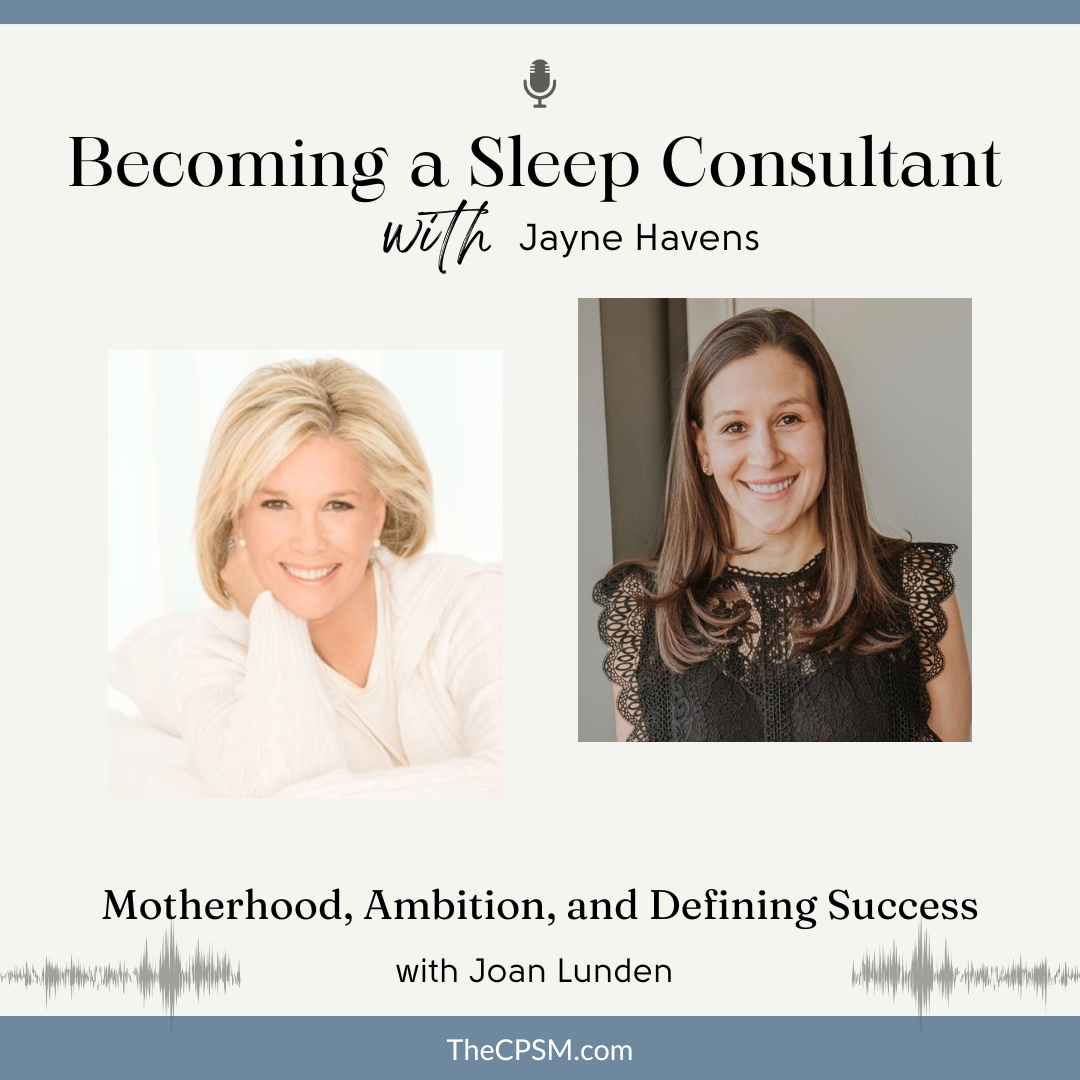
Motherhood, Ambition, and Defining Success
with Joan Lunden
When I interviewed Joan Lunden live on stage in Baltimore a few months ago, I never expected our backstage conversation would lead to this podcast episode.
As we chatted before taking the stage, I shared a bit about my work as a sleep consultant, my online sleep consultant certification program, and of course this podcast. To my surprise, she asked if she could be a guest.
Needless to say, I didn’t hesitate to say yes.
Joan has spent decades in the public eye, but what I was most interested in wasn’t her career highlights. I wanted to hear what it was really like to build an ambitious career while raising six children, long before there was much of a roadmap for working mothers.
In this conversation, we talk about:
- Navigating the judgment that often comes with making unconventional career choices
- Why women shouldn’t feel like they have to choose between meaningful work and motherhood
- How Joan has defined success at different stages of her life and career
- Why leading with service ultimately creates the greatest impact
While Joan’s career may have looked very different from ours, I think you’ll find that many of the questions she wrestled with are the same ones women are still asking today.
Is it okay to love motherhood and still want something that’s just yours?
Can you build a meaningful career without sacrificing your family?
How do you define success when you’re trying to balance it all?
I hope you enjoy my conversation with Joan Lunden.
Links:
Website: Joan Lunden
Instagram: @therealjoanlunden
If you would like to learn more about becoming a Sleep Consultant, please join our Facebook Group: Becoming A Sleep Consultant
CPSM Website: Center for Pediatric Sleep Management
Book a free discovery call to learn how you can become a Certified Sleep Consultant here.
Transcript:
Intro: Welcome to Becoming a Sleep Consultant! I’m your host Jayne Havens, a certified sleep consultant and founder of both Snooze Fest by Jayne Havens and Center for Pediatric Sleep Management.
On this podcast, I’ll be discussing the business side of sleep consulting. You’ll have an insider’s view on launching, growing, and even scaling a sleep consulting business. This is not a podcast about sleep training. This is a podcast about business building and entrepreneurship.
A few months ago, I had the opportunity to interview Joan Lunden live on stage in front of about 350 people at an event hosted by the Jewish Library of Baltimore.
It was such a fun experience, but my favorite part actually happened before we ever walked out onto the stage. While we were backstage waiting to be introduced, Joan asked me about my work. I told her all about my sleep consulting business, Snooze Fest, and that I also train others to do this work through my online course, Center for Pediatric Sleep Management.
While we were chatting, I also mentioned that I host the Becoming a Sleep Consultant podcast, which is really all about business building and entrepreneurship. I told her that I love to discuss what it looks like to juggle work and motherhood, and the mindset that it takes to have a successful career.
Then she surprised me. She looked at me and said, “I’d love to be a guest on your podcast. Would you have me on?” I couldn’t believe it. Of course, I said yes. And today’s episode is that conversation.
When I sat down with Joan, what I really wanted to explore wasn’t just her incredible career. I wanted to hear about the woman behind it. How did she navigate building such a demanding career while raising six children? How did she handle the judgment that inevitably came with making unconventional career choices? In many ways, she helped normalize the idea that women didn’t need to choose between building a career and raising a family.
Now, your life may not look anything like Joan’s, and mine certainly doesn’t either. But I think you’ll hear that many of the questions she faced are still the same ones that women are asking themselves today.
Is it okay to love motherhood and still want something that’s just yours?
Can you build a meaningful career without sacrificing your family?
How do you define success when it feels like you’re being pulled in 100 different directions?
I hope you enjoy my conversation with Joan Lunden.
Jayne Havens: Joan, welcome to the Becoming a Sleep Consultant podcast. It’s so nice to see you again, and thank you for being here.
Joan Lunden: It’s my pleasure.
Jayne Havens: So we recently had the opportunity to chat when I interviewed you in Baltimore, and I left that conversation wishing that we had had more time together.
I’m excited to continue it because I really want to focus on something that I think will really resonate with my audience. Most of my listeners are women who are building businesses while raising families. They’re trying to create meaningful work that fits into their lives and not the other way around.
One of the stories that you shared in your book that really stood out to me was the story about you bringing your babies to the set of Good Morning America. I couldn’t help but think that you were doing a version of what so many women are striving for today. What gave you the confidence to stop worrying about whether people approved and simply decide that you were going to build your career in a way that worked for your family?
Joan Lunden: Well, first of all, I’m a normal woman, so I didn’t stop worrying about whether people approved or not. I was petrified to ask the network if I could bring my baby to work.
In 1979, when I got the call from my agent saying, “ABC just called. They’re offering you the job to come permanently to GMA, and ultimately you’re going to be the host.” And then 20 minutes later, my phone rang, and it was my gynecologist saying, “Congratulations.” And I honestly never, ever had the thought, “Oh man, that would have been so great, but bad timing.” I immediately thought, “All right, I got to figure out how to do this.” And I knew I wanted to breastfeed because I’d interviewed La Leche League experts. And even though my mom was like, “You’re going to what?” because, remember, she had me in the ’50s, you know. Back then, it was just different.
And so I said to my agent, “Would you call the executives at ABC and tell them that I’m going to be breastfeeding?” Now, remember, in 1979, that was one of the words that the FCC did not allow you to say on television: breast or breastfeeding. He was like, “You’re kidding me. You want me to make that call?” But he did.
Kudos to ABC. In all honesty, they had had a host that didn’t really get along with David Hartman, and so she wasn’t around that much, and there was kind of a revolving door. They just wanted to get the show kind of back on track. They wanted my tush in that chair come September, when the whole fall lineup was announced. I think that’s what was in the forefront of their brains. It was like, “Whatever she wants, just tell her yes.” I think that’s how it happened, quite honestly. I don’t think there was any big conversation about, “Oh, we got to support working moms.”
But they said yes, and they’re like, “Okay, what do you need?” And I said, “I need a little dressing room next to mine so I can put a crib in it and have a baby nurse in the beginning, and a nanny come and sit there while I’m on the air.” And, “Fine, fine.” They gave it to me. I think that they thought that was going to be the best-kept secret. I really do. And they told me, like, the first day I came in with Jamie in my arms and we did a press conference after the show, “Don’t mention that you have a baby upstairs because all of these reporters, they’ll think that you could never do your job.” I was like, “Okay.”
I mean, I hadn’t really planned on bringing it up. But the first question was from Time magazine: “We hear you’re bringing your baby to work. How did you work that out with ABC?” And it didn’t take very long for everyone in that room, including all the ABC executives and PR people, to understand that was the breaking story that day: that a major media company was allowing a woman to bring her baby to work because she was breastfeeding.
And, you know, we talked before, and she said, “You were really one of the first ones to be kind of trailblazing this working mom idea.” And I said to you, “I was, but I didn’t realize it.” And that’s really the honest truth.
I was kind of putting one foot in front of the other. I got this great big job, and I had this new baby. By the way, I’d never babysat a day in my life. I almost thought it was bizarre that they allowed me to take this little thing out of the hospital and that they anticipated that I would keep this baby alive.
She was seven weeks old when I swaddled her up that morning and got in the car. They sent a limousine. I was in the back of the limousine and breastfeeding her on the way in on the 50-minute drive into Manhattan and reading my 80-page script. You know, left breast first hour, right breast second hour, so that by the time I got there, I knew everything that was planned for the morning.
I still wasn’t so convinced that the staff and everyone was going to embrace this idea. But seemingly, they did. And I think it’s just because I showed up every day prepared. I did my interviews, and I didn’t screw up. I didn’t have any issues, and I didn’t make anybody else’s job harder because of what I was doing. I think that’s just kind of how it happened. I had transparent conversations with the powers that be at ABC.
I think it’s fair to say that the audience kind of flipped out over this. Because I think they realized they were witnessing a huge societal change, and I was just symblematic of it. I think that’s when the conversation started to happen about women having jobs outside of the home, and we’re going to have to figure out, “How do we do both?” That whole conversation. I started understanding that I was kind of at the front of that conversation. And our ratings soared. People loved it. I mean, any fears that had been anticipated just didn’t turn out to be the case.
I went into my bosses at one time, and I said, “I need you to understand that along with this baby, which seems to be doing pretty nice for our ratings, I need to be there for doctor’s appointments. And then later on, I need to be there for parent-teacher conferences.” And every time I had that conversation with them, I said, “I’m here to say, that I’m going to give you 150%, not 100%. 150%. I am all in. But the caveat is that I do have certain things that my children require that I will have to be at. They won’t be optional. They won’t be debatable. I have to be at them.”
I think because I had those honest conversations with them in a co-venture spirit, and not a “I need this, give it to me,” or I didn’t lay my mommy problems in the lap of my boss. I talked with my bosses about how I could handle my responsibilities as a mom and not interfere with what they needed me to do. Because that’s all a boss really cares about.
And that’s what I always say to women. When you get that wonderful baby news that you can’t wait to tell everybody, that you think is so wonderful, your boss may not think it’s so wonderful. Because to them, it’s a pain in the ass. They’re going to have to figure out, “How do I still run my office? How do I still get all the work done that you do if you’re going to be gone?”
And so I always advise women to talk to the other women in their office and maybe figure out how some job sharing can go along, or whatever it is. It’s just not necessarily to lay your good news into a boss’s lap because it’s not good news for them.
Jayne Havens: Right. When people talk about working motherhood, usually, the conversation tends to center around what our careers are taking away from our children. Looking back now, what do you think your children gained from seeing their mother pursue work that she genuinely really loved?
Joan Lunden: I’ve actually asked my girls this question. I have three older girls. I had them all during my 20-year tenure at GMA. They are now 38, 43, and 45. And then, of course, I have twins who are 23 and twins who are 21.
But when I asked the older girls, because they’re the ones where I got up every morning— I was out of the house before they ever awakened. They would come down, according to my nanny, which obviously I had a nanny forever. She said they would come down in the morning to have breakfast, and they would usually go over and kiss me on the TV. And then she said, quite honestly, they would ask to change to cartoons.
I’ve asked them the question, and they’ve said, “Really, honestly, Mom, you were at everything that mattered. You were at every parent-teacher conference and school event. You were at our dance recitals. You were at horse shows. You were at everything. You weren’t there in the morning, and you weren’t there at the pickup line.” And they said, “It really didn’t make any difference to us.”
They said that, “What made a difference to us is that we watched you handle an enormous job while being a mommy, in our eyes, a complete mommy to us. And you showed us that a woman can have a job. In fact, in your case, two or three different jobs at once.” Because I was always doing, like, God knows how many other things in addition, and writing books. She said, “And that was really good for us because it gave us what we could expect of ourselves in our life.”
I’ve said, “Did it impact you negatively in any way?” Because I worried. I always, you know— you read my most recent book, Life Beyond the Script. It’s my memoir of my life. I wanted to make sure I put in not just all the great things that I’ve done, but the challenges along the way. Some of those challenges were figuring out how to be a mom and have this enormous job at the same time.
One day, I came— I knew that there was, like, a little party in the classroom. I had the car bring me up from New York City to the school. When I walked into the classroom, all these other moms who didn’t have jobs outside the home were arranging all the cookies and muffins and brownies that they had made at home. One of them turned to me and said, “Oh, don’t worry, Joan. We know that you can’t be part of this.”
My daughter Lindsay—it was her class—and I thought, “Did she just hear that? How did that play in her mind?” I mean, those are the things that we can’t help but think and feel. And, by the way, remember to this day, how many— what did I just say? She’s going to be 43. I mean, so much so that I related it in my book because it was one of those little concerns that kind of live in the back of your head.
Did I impact them negatively in any way? I think my end result has to be no. I don’t think I did. I think that the tradeoff— look, women can’t make this decision anymore today. Most families need the second income. So this is not really something optional that we’re talking about. So the challenge is, how do you do it so that, A, you don’t negatively impact the children?
That’s not the only important thing. It’s also so that you retain your sanity and that you don’t become incredibly resentful—and resentful of your husband. Because there’s a lot of husbands these days— I don’t know about yours. I met him. He seems like a great guy. There are a lot of men who are great guys and pitch in a lot more. I’m just here still to say we are wired differently.
A guy gets up and thinks, “What am I going to wear today? The blue suit or this? Should I work out before office or after the office? Do I have lunch with that client today?” Those are the things he’s thinking. We wake up and say, “Where did I put her ballet shoes? She’s going to need them for ballet class after school. Did I pack the bag? Oh my gosh. I need a present for so-and-so’s birthday.” We’re going through this list of things that we need to make sure of for our children.
And also, “Do I need to stop by the grocery store on the way home? Or should I take something out of the freezer for dinner?” It’s a crazy-long list that we have to go through. Check, check, check, check, check before we put our feet on the floor.
So I just think that we all have to realize that that’s our existence. And it’s hard sometimes not being a little resentful. And if you become resentful, I think it’s important for people like me to come on and say, “It’s normal.” Don’t beat yourself up for it. You would be almost inhuman if you didn’t have those feelings.
Jayne Havens: Everything you just shared is so relatable. I was raised by a stay-at-home mom, so my life dream was literally to stay home with my kids. I tell people I wanted to be first in line in carpool. I wanted to drive a Mercedes station wagon.
Literally, when I was a child, this was my dream: first in line in carpool, Mercedes station wagon, have the best snacks for my kids, pick them up, take them to tennis lessons, ballet, lacrosse, whatever, bring them home, make them dinner. That’s all I wanted to do in life.
I had a really successful career after college, and I literally gave it up to be home with my kids. Because that’s what I always wanted to do. My dad was like, “What are you doing? You make really good money. How are you quitting your job? What is wrong with you?” I just was following my mother’s lead. That’s what I wanted to do. And I did it for many years, and I was really happy.
And then, at some point, I started to feel like I wanted something more for myself. I wanted to feel like I was contributing financially to our household income. I wanted to use my brain in a way that made me feel smart and highly functioning. I was like, “I don’t want to just be singing ‘Old MacDonald’ and living vicariously through my kids’ adorable outfits that they’re wearing to preschool.” I wanted something more. And starting a business was what allowed me to do that.
It really did have to shift the dynamic in my household. Because, as you said, my husband actually 100% had that mentality that you referenced. His brain was just, “What suit am I wearing? What meeting do I have today?”
Joan Lunden: It’s the way they’re wired.
Jayne Havens: And as my business grew, I had to say to him, “Look, I am working really hard, probably just as many hours as you are at this point. I need some help. I need you to think about some things. I need you to just realize that it’s maybe just as much your responsibility as mine to handle some of the things in the house, manage the kids.”
What you reference about all those things that we moms think about all the time, we call that emotional labor. Have you heard that term?
Joan Lunden: No.
Jayne Havens: There was an article that came out years ago. I don’t want to quote which magazine because I might be wrong. But there was a whole article about emotional labor and the weight that women carry in their brains about all the things related to the home, to our children. And this is on top of careers.
Joan Lunden: Yeah, it’s a lot.
Jayne Havens: It’s a lot, right? And so, so many women are trying to figure out, “How do I be a good mom, have a successful career, not forget to buy that birthday present for the kid in my kid’s class?” It’s just never-ending. We want to also just be happy too, right? We want to have happiness.
Joan Lunden: We deserve to be happy just like our husbands. We deserve to be able to have a career where we can feel like we’re accomplished, where we can have the satisfaction that we’re making an income, that we’re contributing, but we can just be creative and feel like we’re making our mark on the world. We have just as much right to have that. It’s just harder. It’s harder for us.
Jayne Havens: I want to go back to that story you shared where you showed up at your daughter’s preschool class and the mom made you feel like, “Oh…” Like that wouldn’t have been something that you would have done.
I’m wondering if you had any sort of embarrassment or— I feel like shame is a really strong word. But I’m thinking back to when I decided that I wanted to go back to work, right? I was a stay-at-home mom for about four years before deciding that I wanted to start my own business and go to work. On some level, I felt embarrassed to say that because what a privilege to be home with my children. What a privilege to get to experience all of those moments firsthand. And here I was saying, “No, I don’t want that. I want to work.”
I’m wondering if you felt any guilt or shame or embarrassment about wanting to be that person that had the big job and also be a mom at the same time.
Joan Lunden: I used to hear a lot of it. I mean, people don’t hold back in terms of criticism. We used to get it in boxes of mail. My assistants, my wonderful assistants, did protect me from a lot of it then. These days, there is no protection. Like, you just see it on social media every day. I can post a picture, and 100 women will say, “Oh, you look so great. You look so happy.” And then there’s a woman who says, “I think you looked a lot better with your hair short. You look too old with your hair long. Who’s your plastic surgeon?”
Like, really? Seriously? Sometimes my older daughters say, “Don’t engage. Never engage.” But sometimes you just can’t help it. And I’m saying, “I look the way I do because I stay engaged, and I’m busy doing things that I enjoy. You got to try it.”
But back then, there was a certain amount of— I don’t know if I would call, well, maybe embarrassment could be a word, but shame, I think, is really the word. And I did feel those feelings when I walked into a classroom, into that kind of situation, and they said things like that. It made me angry at them.
Jayne Havens: Did you want to justify your ambition, or did it just sort of hurt your feelings and you move on?
Joan Lunden: It just hurt my feelings. I mean, what was I going to say? I don’t know what I would have said, particularly to them, without looking like I was having to justify myself. Or I wasn’t looking to pick a fight with the other mothers of the other kids. Because I already— let’s be honest, I already wasn’t part of that little pool of women who were constantly doing carpool and having the kids over after school. I wasn’t part of them, so I was already kind of the outsider. And I felt that.
But at the same time, when you say that you felt guilty because you wanted to have a career in addition to being a mom, I’m going to say it once again. There are men and women in the world. Why should men be the only ones that get to have a career that fulfills them, that earns income, where they have an opportunity to save people, to legislate laws, to do whatever they do, and we don’t? I don’t buy that.
And, you know, I’m sure there are those out there that will say, “Yeah, but you produce. You reproduce, so therefore that delineates you and gives you your job.” I don’t know. I’ve just never bought into that. I don’t think it’s fair.
I can honestly say—and there might be some women out there who take issue with me on this—but I don’t think that I would have enjoyed my life the way I have and that I would have had these feelings at this point in my life of fulfillment. Of having this incredible career and the opportunities to do everything I did—to cover five presidents and five Olympics and three royal weddings and interview King Charles, which, by the way, he was Prince Charles at the time. I’m grateful that I’ve had these opportunities.
And that has given me this platform. Let me take it one step farther. By doing that and working really hard, doing that gave me this platform—which I have been using starting up with my days at GMA, but certainly with the 25 years after—to advocate for women and women’s health and breast cancer and seniors and senior care, and going to Washington and fighting for legislation to protect women and breast cancer and seniors. Those things are incredibly fulfilling to me. And I think they’re important. I don’t even know if there’s a guy around somewhere that would have done them like I did them.
Jayne Havens: Definitely not.
Joan Lunden: So I don’t think it’s fair that women should ever beat themselves up because we wanted to have that life.
Jayne Havens: Everything you just shared makes me also think about working a traditional 9 to 5 versus choosing entrepreneurship, right? Making a choice to start your own business, it’s a choice. You don’t have to have—
Joan Lunden: It’s also hard.
Jayne Havens: It’s also really, really hard, yeah.
Joan Lunden: Really hard.
Jayne Havens: You don’t have to have your own business. You can just go work a regular job. You can go have a 9 to 5. Choosing to start your own business is something you get to do. It’s really hard. It’s really overwhelming, but it affords you the opportunity to maybe have some more flexibility or to earn a different level of income or whatever that looks like. It sort of feels very similar to that choice that women make about not working versus working. Like, we can do whatever it is that we want to do. I firmly believe that. And we get to make those choices for ourselves.
And, you know, there’s a lot of noise on the internet these days that is very different, I think. You know, it would be so interesting if you were doing all of this in the age of social media, right? If every decision you made in your career had been judged on Instagram, that would have been really interesting.
Joan Lunden: Thank God that I was, you know, on the air to that extent during the ’70s, ’80s, and ’90s, and not the 2020s.
Jayne Havens: When I first started my business and I created an Instagram profile for my business, I just kept thinking, like, “Is this embarrassing? What are people going to say about me? What are people going to think?” And that was my own… that was my own…
Joan Lunden: That’s your own— so what that is, in my opinion, Jayne, is that’s a boundary that we create in our mind. It was put there by tradition, by what we saw in our past, what we saw our mother and our aunts and other women. And so we create that boundary. That’s our boundary. Nobody else put it there. We put it there. And people do this all the time. They put boundaries that say, “I’m this in a career, and I can’t do anything else.” That’s not true. And if you get let go… I mean, there’s this wonderful, wonderful saying: “You can get fired from your job, but you can’t get fired from your gift.”
So we all have certain gifts, and we can acquire new ones. We can acquire new talents, new sets of skills. We live in a world today where, between AI and just this incredibly morphing industrial complex where companies are going out of business or scaling back, people today are going to have to reinvent themselves over and over and over again.
I saw a statistic the other day that said a 35-year-old today could have already had 12 jobs. It’s like, that is mind-blowing. Our parents, if they went into a job at a company, they might have stayed at that company for their entire lives until they got the gold watch when they were 65. It’s such a different world now. People are going to have to accept this, that they’re going to probably have to change jobs over and over again. And it’s really uncomfortable because nobody likes change, and it’s always scary. Am I going to be good at something else?
You kind of have to be willing to suck at something in order to— what’s the saying? “I have to be willing to not be good at something in order to get the chance to learn how to be good at something.” That is something that’s going to be kind of the motto of the world that we’re all going to be living in from now on. Between young people coming into a job world that is crazy hard to get into, to the other end of the spectrum where people at 65 would normally retire that are saying, “Uh, wait a minute. I might live another 30 years. Okay. I can’t retire.”
And then if the company makes them retire, they have to find something else to do. So they’re going to have to reinvent themselves, and they are going to stay in the workforce, which makes it harder for the young people to get into the workforce.
This is just the new world that we’re all going to live in. I think it requires us sometimes—everybody—to be a little bit more creative, and a little bit more flexible, and a little bit more willing to think outside the box. And none of those things kind of come easy, but I think they’re going to be required of all of us.
Jayne Havens: Yeah. What’s next? If you’re not done, what’s the next big thing? What are you working on?
Joan Lunden: So I think the last time I saw you, you asked me, “Is this it? Are you going to write any more books?” So this is my chance for a blatant plug.
This is my 11th book. They’ve all been about chapters in my life. This one is about my entire life. I’m very proud of it because I did some really unusual things. I put QR codes. So I include video in this book. First time anybody’s kind of done that in a memoir. And I told you, “Uh, nah. This is probably the caper.” Well, I woke up the other day and, just based on all the feedback I’ve gotten from women over the course of the last four months going and doing all these book events, I just woke up and I had another book in my head.
Jayne Havens: Seriously?
Joan Lunden: Yes, and it was 6:00 in the morning. I thought, “Why do I have to… I don’t need to be up at 6:00.” And I thought, “I know, but I’ve got this book in my head.” And sometimes that’s what writing is all about, is when you have something to say and something that you think will either help people or entertain them, and that you just have to put it out there.
I came down to my office and opened up my laptop. My husband called me the next day, and he’s like, “Hi, what are you doing? Are you about ready to drive up to camp?” Because I’m usually up in Maine at this point, because he runs summer camps up there. And I said, “Well, I’m just at my laptop. I’m just doing some work.” He said, “What work?” He said, “I thought you were all done right now. You were going to take two months off.” I was quiet.
He said, “Oh. Please tell me you’re not starting another book.” And I said, “I just woke up with one in my head.” He said, “I don’t get it. I, like, really don’t get it. I thought this was, like, the capper of an incredible career.” I said, “But it was my 11th book. Isn’t there something to be said for an even dozen?” So I think I don’t have a choice. And it’s going to be about women and aging and reinvention, and it’s going to be incredibly irreverent and funny. I expect women to laugh until they wet their pants.
Jayne Havens: I’m so excited. I think that someone like you, you just are leading with passion and excitement for what you do, right? Like, when you love your work and it brings you joy and it keeps your mind feeling alive, then it’s really hard to stop, right?
Joan Lunden: Because it’s really good to keep your cognitive thinking. And anyone my age, because I’m 75, the most important thing is that we want to keep our cognitive thinking.
But you know, one of the things as I was starting to write this new book, one of my first thoughts is that it’s really weird being the same age as old people. Because I always thought of this age as being old. And now I’m here, and I’m happy that we live in a world where today you can still kind of be this vibrant, energetic, kind of youngish, active person when you’re this age. You know, I’m grateful for that.
Jayne Havens: Has your definition of success evolved?
Joan Lunden: Oh, yeah. I think when you’re young and starting out, your definition of success is to make a lot of money, if you can. And then, as you get older, I think that, for me, like in 40s and 50s, my definition of success was being able to have a family and be a mom and have a job at the same time. I think that was my definition of success, and feel like I was good at both of them and that I was succeeding at both of them.
Today, I will tell you that my definition of success is very much wrapped up in the difference that I’m able to make in the world and in the lives of other people and in my advocacy. Because everybody, when they think of me, they think of the big, shiny 25 years in the national spotlight. And finally, for me now, for the first time, I can look at the last 25 years where my advocacy has given me these opportunities to really make a difference in the lives of seniors or in the lives of women or in the lives of breast cancer patients. I think my definition of success has very much evolved.
Jayne Havens: I think that’s a great share. Most of the people who are listening to this podcast, they get into this line of work because they want to make a difference.
Joan Lunden: Yeah.
Jayne Havens: And I think that’s really special, right? Like, they’re coming from careers where maybe they are making a difference, but they’re not feeling fulfilled or happy in their work. And then they get to transition to work that is hopefully really fulfilling and meaningful and really is making a difference in the lives of the families that they’re supporting. I feel like the people who are most successful in the field of sleep consulting and parent coaching, the people who have the most success are the ones who truly are in it for helping. Like, they’re truly in it to serve.
Joan Lunden: Yeah, because they want to make life for another family feel comfortable and happy and warm and cozy.
Jayne Havens: And when they lead with that energy, when they lead with that energy and that feeling, when they truly believe, “I am in this work to help people. I’m in this work to make a difference,” that’s when the money comes. And so I’m really glad that you shared that. Because when people are first starting, a lot of the time they’re like, “Success is defined by how many clients did you have this month, or how much income did you generate?”
Joan Lunden: It comes after.
Jayne Havens: Yeah, that comes after. So if you can lead with the, “I want to help people. I want to serve. I want to make a difference,” then the money comes, I think.
Joan Lunden: You know, my dad, as you know, was a cancer surgeon. He graduated from Loma Linda University. And Loma Linda University, out in California, when they graduate— I was asked to give the commencement speech there to the graduating class of their medical school on the 75th anniversary of my dad graduating from there. And believe me, that was, like, the most important speech I ever wrote in my entire life.
I remember talking to these young people, saying, “This school you’re graduating from is different than most schools. You aren’t just told, ‘You’re a doctor now. Go get a practice and make a lot of money.’ You are literally told to go out and serve your community. That is your mission. That is the goal that they set for you. That is how you leave here.”
That was how my father thought. And that is what he kind of imbued in me—that my goal in life was to educate myself, was to go out into the world, see how other people live, see what other people needed in the world, and to see in what way could I try to make a difference in that world. That was the mission that he set forth for me.
I always thought it would be following in his footsteps, and I thought for sure I’d be a doctor. Until I was ready to go away to college, it never occurred to me that I wouldn’t be a doctor. And it was only because I went to work in a hospital right before going away to my freshman year of college that I found out really quick, “Nah, stitches and scalpels are probably not going to be part of my career.”
It was disappointing to me to discover that because I do think it takes a certain kind of person, a certain personality, to be able to do that and make these life-or-death decisions in real time. I think I always kind of lived with a little bit of a regret that I didn’t— I lost my dad when I was 13. But in my mind, he expected me to be a doctor. I think I always lived with a little bit of a regret that I didn’t follow in his footsteps.
And I feel like in the last 25 years, I’ve had the opportunity, thankfully, gratefully, to have all these opportunities as an advocate in the health field to kind of, like, take the baton from him and run and kind of pass that torch. So, to me, again, that’s kind of how I evolved to this idea of what is success. Did I live up to that mission that my dad, who I was so in awe of as a young girl—that, I think, that expectation that he had for me…
Jayne Havens: It sounds like he imparted a little bit of a value system on you, right?
Joan Lunden: Oh, yeah.
Jayne Havens: And so you didn’t literally become a doctor, but you took that set of values and you went out and made a difference in your own really unique way. I think you did a really great job.
Joan Lunden: Well, thanks.
I remember we used to have a doctor on Good Morning America. Some people, if they’re fans of GMA, will remember. His name is Dr. Tim Johnson. People every now and then criticized him for being a TV doctor. But he came on all the time. He was also a doctor in real life. But he came on all the time and would explain things that were the stories that were coming out in the news about different medical conditions.
I remember one day when somebody was asking him about, “How do you deal with all these people who criticize you for being a TV doctor?” And he said, “You don’t just have to have a scalpel in your hand to keep people healthy.” And that really resonated with me at that moment, that I was impassioned, obviously, about disseminating health information. I used to hog all the health stories at GMA, admittedly, and they knew it. And they gave them to me because they knew that I loved them.
When I left GMA, a lot of people don’t realize I’ve done 11 different TV shows since I left GMA. But they just weren’t on the network in the morning, so people didn’t see them. I’ve got one on right now on PBS called Second Opinion, a health show, and almost all of them have been involved in health. So I kind of focused the lens in, as I left GMA, on what I felt most impassioned about. I did those shows, but they also led me to the tremendous amount of advocacy.
There are more ways. A person needs to hear it somewhere, the information that says to them, “I need to go to the doctor.” “Oh my gosh, I just heard on TV, on a blog, on Jones’ Facebook page, on whatever…” A woman hears me say, “You need to go and get this. You need to know whether you have dense breast tissue. Call your radiologist.” They wouldn’t have known it if there weren’t people out there saying it. So I think it’s just important that there are people disseminating health information so that the folks listening know, or are encouraged, or are motivated to actually go to a doctor when they need one.
I think the media and the health disseminators hold hands with the medical profession. I’m not sure one could necessarily live without the other.
Jayne Havens: Right. Not everybody is going to get that one-to-one individualized attention to receive all of that knowledge. And that’s why TV and even social media can be a really beautiful thing. There is a time and place for influencers who are using their platform to educate people really wisely.
I mean, I think about people in my field who are supporting families one-to-one and doing a really great job. And then they’ve also amassed a really large audience, whether it be on YouTube or on Instagram, and they’re sharing this information with the masses. And that’s just as important, right? Because not everybody’s going to get to speak to them. Not everybody’s going to get to speak to them one-to-one. And so if they can hear a sound bite and say, “Oh, that sounds a lot like my baby. That might be what’s going on with my baby,” how special is that?
Joan Lunden: Absolutely.
And it’s a shame that we live in a world now with the internet that people can parade themselves out there as experts. It’s made it very difficult for the public to be able to discern what’s the real advice, what’s the smart, healthy, proper, fact-based, research-based advice? And what’s some person that’s claiming to be an expert and maybe even delivering information to try to get you to think a certain way? We live in a complicated world, and I’m afraid to say that I don’t think we can put the toothpaste back in the tube.
Jayne Havens: We can’t.
Joan Lunden: We can’t. So hopefully, they go for people who are kind of known to be the experts and not just some blogger who came on board and is giving out not factual-based information. I know it’s hard for people today.
Jayne Havens: It’s really, really hard.
Before we wrap up, I want to give you another opportunity to share a little bit more about your book, book number 11. You can buy it anywhere—we all know that—but share a little bit about the book.
Joan Lunden: I started writing this book, like, 12 years ago. Then I got diagnosed with breast cancer, and I felt compelled to write a book about that, just like I wrote a book about losing weight and about change when I left Good Morning America. I learned early on, I think in that period of time where I was kind of at the forefront of working moms, I started becoming aware of how it’s important for us to share our stories. When we share our stories, other people can be inspired and motivated. They can learn, or they can just get hope because, “Oh, somebody else that I think is up there on this pedestal has the same problem that I do.”
And then, after writing Had I Known about breast cancer, I became so involved in women’s health. I felt a need to write a book about women’s health through the decades. And I wrote my last book, Why Did I Come Into This Room? A Candid Conversation About Aging.
And then I went back to my legacy memoir. I wrote it completely. My publisher looked at it and said, “This is an autobiography, kind of a compilation of everything you’ve done. Kind of like Joan Lunden reporting on Joan Lunden’s life, which I would expect from you. Your readers want a memoir. They want you to take them into the moments in your life.”
So I teamed up with a memoirist, a person who writes novels and memoirs, and we rewrote the book. It took us a year and a half. And I’m so glad I put the year and a half into it because it ended up being— I’m a voracious reader, and I love things like historical fiction, like a book that takes you into someone else’s life, and you’re like living in their life while you’re reading the book. You go to bed at night, and you can’t wait to get back in and find out what happened to them. I think I ended up with a book like that, except about my life, so I’m very happy.
And then I got the idea. Because I also put lots of pictures in, because I know people are used to kind of consuming me visually. I decided I could put video in this book. Most of my life is on video. I got the idea to put the QR codes in, and I got permission to do it. And so now I not only can tell a story about a chapter in my life, but at the end of the chapter, I can put QR codes so they can hover their phone over it. Or if they’re reading on an iPad, they can click on it and the video opens up. It’s really fun. People, I think, are having a lot of fun consuming it almost as like an interactive memoir.
Jayne Havens: It’s really, really special. Show it again.
Joan Lunden: Yeah, it’s called Joan: Life Beyond the Script. A lot of your listeners are probably figuring out now how to live their life beyond the script.
Jayne Havens: Yeah, it was really fantastic. I read it on, I think, like a five-hour plane ride to Vegas while I was going on spring break with my kids.
Joan Lunden: They can listen to it, too. It’s on audio.
Jayne Havens: Yes, it’s really fantastic. I want to just thank you again for giving me the opportunity to interview now not once, but twice. And I just, you know, I’m so much more comfortable this time, I think, just because I’m comfortable with podcasting. But I have to say out loud that it is an overwhelming feeling to interview the person who’s famous for interviewing others. But you have, both times now, made me feel so comfortable to sit in the seat where I get to—
Joan Lunden: That’s because you’ve been terrific both times, Jayne.
Jayne Havens: Thank you. I’m so grateful for the opportunity. And now even more people will get to hear your stories, which is just fantastic. So thank you.
Joan Lunden: By the way, that’s the skill set of an interviewer, is to make the person feel comfortable. And that is something that’s important for all of your listeners who are trying to go into your line of work, is to make the people feel comfortable that they’re dealing with.
Jayne Havens: I try my best over here, but you’re the true professional. Thank you, Joan. We’ll have to keep in touch.
Joan Lunden: Absolutely. Bye-bye. Thank you.
Outro: Thank you so much for listening to this episode of the Becoming a Sleep Consultant Podcast. If you enjoyed today’s episode, it would mean so much to me if you would rate, review, and subscribe. When you rate, review, and subscribe, this helps the podcast reach a greater audience. I am so grateful for your support.
If you would like to learn more about how you can become a certified sleep consultant, head over to my Facebook Group, Becoming a Sleep Consultant or to my website thecpsm.com. Thanks so much, and I hope you will tune in for the next episode.
Thank you for your message.
We will contact you shortly!