

What Does a Sleep Specialist Do? Understanding the Profession

Picture a sleep specialist, and you probably imagine someone in a white coat, watching you sleep through a pane of glass while you are wired up for the night. While that’s one kind of specialist, it’s not the only kind. And for a lot of people, it’s not even the right kind!
The truth is, there are two very different paths a sleep specialist can take, and the one you need depends entirely on what is actually keeping you up. Some specialists work on the physical and medical side of sleep. Others work on the habits, thoughts, and routines behind poor sleep. While medical sleep specialists diagnose sleep disorders, behavioral sleep specialists identify them.
This distinction matters. When poor sleep starts chipping away at your quality of life, you want to land in front of the professional who has the education, certification, and qualifications to help you find relief. As we discuss at The CPSM, this matters even for the littlest of sleepers, as a baby or toddler who doesn’t sleep affects the whole family.
In this post, I am breaking down exactly what each type of sleep specialist does, for adults and for children, so you can figure out which one fits your situation.
What Does a Sleep Specialist Do?
A sleep specialist helps people who struggle to fall asleep, stay asleep, or feel rested during the day. That’s the simple version. However, if you’ve listened to “What It Actually Takes with Jayne Havens,” then you know the sleep industry is much more nuanced than that.
“Sleep specialist” is really an umbrella term for two different kinds of professionals. Some work on the physical and medical side of sleep. They look at what is happening in your body, run tests, and treat conditions with a clear medical cause. Others focus on the behavioral side, the habits, routines, and thought patterns that quietly wreck your sleep night after night. (Just as we do at the CPSM, which you can learn more about in “What Is a Pediatric Sleep Coach and How Do You Become One?”)
While one aims to diagnose and treat sleep disorders, the other aims to identify them. Additionally, while they can both dramatically improve sleep patterns, they do so in entirely different ways. Understanding this ultimately saves you from wasting time, money, and energy on the wrong kind of help.
This is just as true for babies and toddlers. When a child is not sleeping, the cause is often behavioral, including things like inconsistent routines, sleep associations, or a schedule that no longer fits their age. This is exactly why Certified Child Sleep Consultants exist, why we focus on this at the CPSM, and what we’ll touch on more below.
Medical Sleep Specialist vs Behavioral Sleep Specialist
This is the part worth slowing down for, because it is where most people get sent in the wrong direction.
A medical sleep specialist handles the physical and diagnostic side of sleep. These are physicians, often pulmonologists, neurologists, or psychiatrists, who completed additional training in sleep medicine. They are the ones who order a sleep study, interpret the results, and treat physical conditions like obstructive sleep apnea, sometimes with equipment or medication.
A behavioral sleep specialist works on the other side entirely. Rather than starting with tests, they dig into the habits, routines, and thoughts driving your sleep problems. Their main tool is formally known as cognitive behavioral therapy (CBT), a type of talk therapy that helps identify and change thoughts and behaviors contributing to poor sleep. For adults, this often looks like reducing stimulating activities before bed, limiting time spent awake in bed, and building healthier sleep habits. For children, however, that focus is on creating calm bedtime routines and collaborating with certified sleep consultants to establish age-appropriate sleep habits. (More on this below!)
For most people whose sleep struggles are habit-driven, this is a better, faster, and less invasive starting point. You can learn more about this concept in my podcast, Becoming a Sleep Consultant with Jayne Havens, as I discuss similar hurdles with other entrepreneurs in the sleep space.
So… How do you know which specialist you need? It usually comes down to whether your sleep problem has a physical cause or a behavioral one. Let’s explore more below:
When a Medical Sleep Specialist Is the Right Call
When there are signs of a physical disorder, it’s important to consider visiting a medical sleep specialist. This can include snoring loudly, gasping or stopping breathing during sleep, or a feeling of constant exhaustion. In these cases, it’s important to rule out an underlying sleep disorder, such as obstructive sleep apnea, before focusing on behavioral sleep strategies.
The same standard applies for children. If a baby or toddler snores heavily, gasps, or shows signs of a physical issue, it’s worth having a conversation with their pediatrician or medical sleep specialist first.
The same is true for children. If a baby or toddler snores heavily, gasps, or shows signs of a physical issue, that is a conversation for the pediatrician or a medical sleep specialist first.
When a Behavioral Sleep Specialist Is the Right Call
Sometimes, trouble sleeping isn’t the result of a sleeping disorder or medical condition. In most cases, it’s completely behavioral! More specifically, chronic trouble falling asleep, a racing mind at bedtime, or broken sleep habits with no clear physical cause can all be signs that point to behavioral sleep disruptions.
For babies and toddlers in particular, this is the category in which many sleep struggles fall into. Think: frequent night wakings, fighting bedtime, or short naps no matter how hard you try to change your routine. This is exactly where a pediatric sleep consultant can help.
Are you a parent dealing with similar difficulties? Visit my guide, “Top 3 Reasons to Hire a Certified Pediatric Sleep Consultant” for guidance. Or, if you’re someone interested in making a meaningful difference in exhausted, confused, and overwhelmed parents’ lives, learn more in my post, “How to Become a Certified Sleep Consultant on Your Terms.”
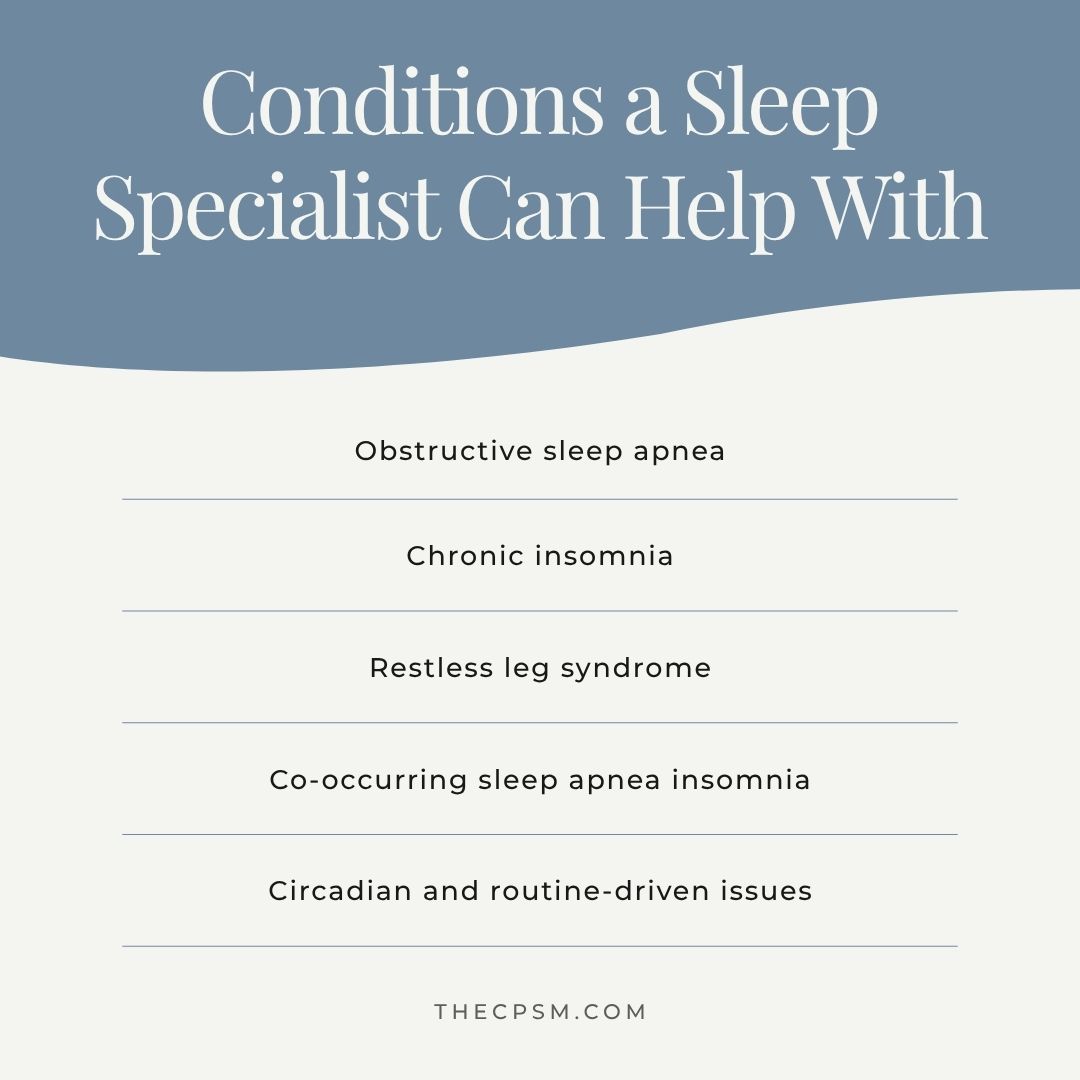
Conditions a Sleep Specialist Can Help With
Sleep specialists, between the two types, treat a wide range of conditions. Here are the most common ones and which lane they usually fall into:
- Obstructive sleep apnea: A physical condition where breathing repeatedly stops during sleep. Firmly medical.
- Chronic insomnia: Ongoing trouble falling asleep or staying asleep with no physical cause. Strongly behavioral.
- Restless leg syndrome: An uncomfortable urge to move the legs at night. Usually medical, sometimes managed jointly.
- Co-occurring sleep apnea insomnia: When obstructive sleep apnea and insomnia show up in the same person at once. Often needs both lanes working together.
- Circadian and routine-driven issues: Disrupted schedules, shift work, and screen habits that throw off your internal clock. Largely behavioral.
The pattern is simple. Physical, structural problems lean medical. Habit and thought-driven problems lean behavioral.
In babies and toddlers, the behavioral side looks a little different, but the principle remains the same. The most common struggles are frequent night wakings, early-morning rising, short or skipped naps, bedtime resistance, and sleep that falls apart during regressions and big developmental leaps.
And here’s the good news: in most cases, none of these difficulties indicate a medical condition or sleep disorder. They are behavioral and routine-driven, which is exactly why pediatric sleep consultants can make such a fast, dramatic difference for exhausted families.
Looking for relief? I provide helpful, reassuring guidance in my post, “Infant Sleep Training Methods Sleep Consultants Use.” For parents, this can give you a better understanding of what to expect. For aspiring sleep consultants, the information in the post serves as foundational knowledge you’ll learn during certification.
What Happens at Your First Appointment
What happens first depends on which specialist you see, and the difference tells you a lot about how each one works.
With a behavioral sleep specialist, the first appointment is a conversation, not a test. They dig into your sleep patterns, your sleep habits, your daily routine, your stress levels, and how much screen time you are getting before bed. They want the full picture of your life, because that is where the answers usually live. No wires, no lab.
With a medical sleep specialist, the path often runs through testing. If they suspect a physical disorder, they may order a sleep study to measure what your body is doing overnight. It is a more clinical starting point, aimed at ruling in or out a physical cause before anything else. Either way, the goal is the same: understand why your sleep quality is suffering so you can create a plan.
A pediatric sleep consultant works much like the behavioral path, just centered on the child and the family. The first conversation digs into the baby’s schedule, wake windows, nap routine, sleep environment, and the habits around bedtime. Most importantly, pediatric sleep consultants need to know how parents want to approach this new method. There is no test and no lab, just a detailed picture of the child’s days and nights so the plan actually fits that family. This is the kind of intake we train every consultant to run at CPSM.
For those interested, visit our exclusive community dedicated to aspiring sleep consultants. Here, you can connect and learn about the work from other professionals and curious entrepreneurs.
How a Behavioral Sleep Specialist Treats Sleep Problems
Here is where the behavioral approach really earns its reputation.
The centerpiece is cognitive behavioral therapy for insomnia, usually shortened to CBT-I. It is widely considered the gold-standard treatment for chronic insomnia, and it is not just opinion. The American Academy of Sleep Medicine recommends CBT-I as the first-line treatment for chronic insomnia in adults, ahead of medication.
CBT-I works by addressing the thoughts and behaviors that interfere with healthy sleep. For example, stimulus control strengthens the connection between your bed and sleep, while healthy sleep habits and routine adjustments help regulate your body’s internal clock. CBT-I also includes cognitive techniques that help reduce unhelpful thought patterns and nighttime worry. Ultimately, it’s easier to fall asleep and stay asleep.
To be clear, this does not replace medicine where medicine is needed. Physical disorders like sleep apnea genuinely require medical treatment, and a good behavioral specialist will tell you so. But for the millions of people whose sleep issues come down to habits and stress rather than biology, addressing the behavior is what finally fixes the sleep problems for good.
For babies and toddlers, the behavioral approach shifts to fit their age and development. Instead of adult CBT-I, a pediatric sleep consultant leans on age-appropriate sleep training methods, consistent and predictable routines, the right schedule and wake windows, and a healthy sleep environment. Most importantly, they do so while coaching and educating parents through the process night by night.
The methods range from gradual, parent-present strategies all the way through to extinction, matched to what feels right for each family. That whole behavioral toolkit for little ones is exactly what we teach at CPSM. You can learn more about this approach in my post, “The Secret to Sleep Training: No, You Don’t Have to ‘Cry It Out.’”
What Training Does a Sleep Specialist Have?
Credentials look very different across the two paths, and it is worth understanding before you book with anyone.
On the medical side, sleep specialists are physicians who complete additional training in sleep medicine, typically a 12-month fellowship after their main residency. They then earn board certification through one of the member boards of the American Board of Medical Specialties. Historically, the American Board of Sleep Medicine certified these specialists directly through 2006, and the American Academy of Sleep Medicine still sets the standards for the field and accredits sleep centers today.
The behavioral side runs on a different track. Clinical behavioral sleep specialists are often psychologists with specialized training in delivering CBT-I. Alongside them is a growing group of sleep consultants and coaches who focus specifically on building healthy sleep habits and routines, frequently for babies, toddlers, and families.
This consulting route is not a medical credential, and it does not pretend to be. It is a certification-based path for people who want to help families improve sleep without going to medical school. If that path interests you, here is a clear guide on sleep consultant certification. Additionally, learn more about what the work actually looks like in “What Does a Sleep Consultant Do?”
When Should You See a Sleep Specialist?
See a sleep specialist when poor sleep sticks around past a few weeks, when sleep problems start hurting your quality of life, or when trouble falling asleep or staying asleep becomes your normal instead of a rare bad night. These are signs that you could benefit from a professional’s advice, techniques, and tailored plan for your needs.
And for most habit-driven sleep struggles, the behavioral path is the natural first step. It is less invasive, it gets to the root of the problem, and the results tend to last.
The same logic applies to your child. If your baby or toddler is waking constantly, fighting every nap, or rising before dawn, and your pediatrician has ruled out anything medical, a pediatric sleep consultant is the natural next step. You do not have to wait until everyone in the house is running on empty to ask for help.
Drawn to the behavioral side of sleep? It might be your next career.
Sleep is more than how many hours you get a night; it’s your brain’s chance to rest, rejuvenate, and refresh. And if you’re not getting the restorative sleep your body needs, seeking the right support can make all the difference. However, if reading this inspired you to want to be the one helping sleep-deprived, exhausted, and confused individuals, that pull is worth paying attention to.
At the Center for Pediatric Sleep Management, our self-paced online course teaches you the science of infant and toddler sleep, the methods consultants actually use, and the business skills to build a practice of your own, all with lifetime access to the materials and our community. To be upfront, this is a coaching and consulting path focused on babies and families, not a medical or clinical credential.
Curious whether it is the right fit for you? Schedule a free discovery call with me, Jayne Havens, and I will answer every question you have. Not quite ready? Download our free ebook for an honest look at what this career really involves.

Considering A Career in Sleep Consulting?
Download our free e-book filled with information on what sleep consultants do and how running a sleep consulting business might fit into your life.