

What Is a Sleep Specialist Called? A Career Path Breakdown

Around one in three adults doesn’t get the recommended amount of uninterrupted sleep each night. This could be due to trouble falling asleep or even problems staying asleep. Over time, that kind of chronic sleep deprivation takes a real toll on mental health, energy levels, and cognitive function. And yet many people have no idea where to turn when sleep problems become a serious issue.
That’s where sleep specialists come in. Sleep specialists are medical doctors who diagnose and treat sleep disorders. They focus on obstructive sleep apnea, restless leg syndrome, insomnia, and chronic fatigue. Despite how common these conditions are, many people aren’t sure who exactly to turn to or what kind of professional to look for.
In this post, I’m breaking down exactly what sleep specialists are called, what they do, and what the path to becoming one looks like. By the end, you’ll have a clear enough picture to decide whether this career direction is the right fit for you.
Before diving in, I want to draw an important distinction. A sleep specialist and a sleep consultant are not the same thing. Sleep specialists are licensed medical professionals who undergo clinical training.
Sleep consultants, on the other hand, specialize in infant and pediatric sleep science and work with families in an unregulated industry. Both roles matter, but they are very different careers with very different journeys.
What Is a Sleep Specialist Called? A Career Path Breakdown
Sleep specialists go by a few different names. You may hear people call them a sleep medicine physician, a sleep doctor, or a board-certified sleep specialist. Most people use the designation sleep medicine specialist, a title doctors earn after completing fellowship training in sleep medicine.
It’s worth understanding that sleep medicine is a subspecialty, not a standalone degree. That means anyone pursuing this path must first earn a medical degree and complete a residency before specializing further. It’s a long road that requires significant time, financial investment, and dedication.
There are some people who want to help people improve sleep quality, but don’t want to go down the clinical medical path. That’s where becoming a sleep consultant is much more accessible. The path is more straightforward, the startup costs are low, and it gives you the freedom to build a business on your terms. To learn more about what that path looks like, check out my post “How to Become a Sleep Consultant.”
What Does a Sleep Specialist Do?
A clear picture of what sleep specialists actually do helps you decide whether it’s the right career path. In general, their work includes:
- Examining and analyzing patients’ sleep patterns and sleep quality
- Diagnosing and treating clinical sleep disorders
- Ordering and interpreting diagnostic tests like sleep studies and home sleep apnea tests
- Prescribing treatment options, including medications and medical devices
- Creating a treatment plan to help patients improve sleep quality
- Referring patients to other specialists, such as ear, nose, and throat physicians, neurologists, pulmonologists, or cognitive behavioral therapists, when needed
Not quite sure whether you’re more interested in becoming a sleep specialist or a sleep consultant? Listen to my podcast episode, “Beyond the Side Hustle: Building a Thriving Full-Time Sleep Consulting Business with Danielle Green!” In it, Danielle and I discuss how the right path reignited her “why.”
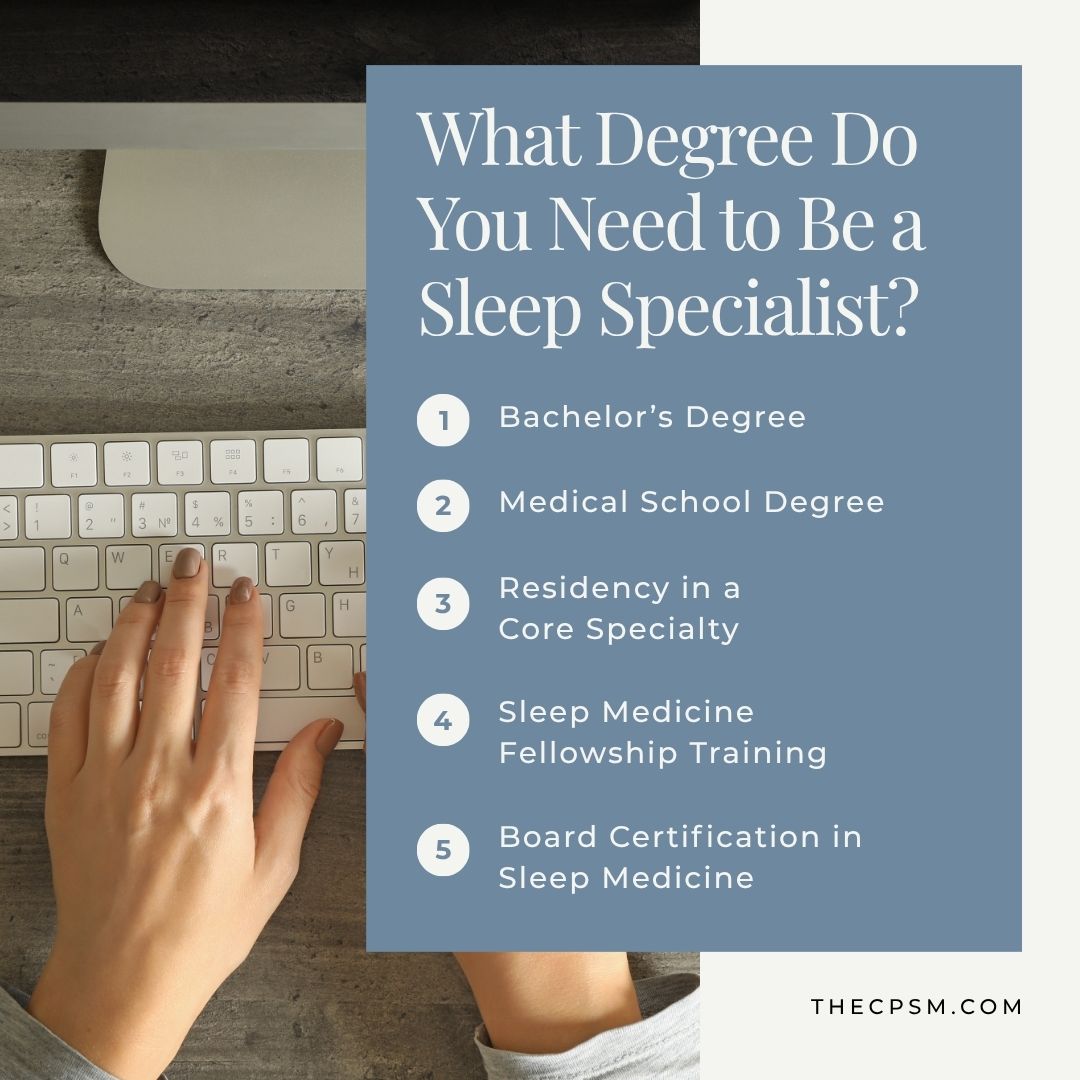
What Degree Do You Need to Be a Sleep Specialist?
Bachelor’s Degree
The journey starts with an undergraduate degree. There’s no required major, but most aspiring sleep medicine physicians follow a pre-med track. The coursework typically includes biology, chemistry, organic chemistry, physics, and math. Strong academic performance and MCAT preparation are the priorities during this stage.
Medical School Degree
Medical school leads to either an MD (Doctor of Medicine) or a DO (Doctor of Osteopathic Medicine). Students spend the first two years mostly in classrooms and labs, covering anatomy, physiology, pharmacology, and pathology.
The final two years shift to clinical rotations across various specialties in hospitals and clinics. This provides students with hands-on exposure to real patient care before they specialize further.
Residency in a Core Specialty
After medical school, aspiring sleep specialists complete a residency in a primary specialty that connects to sleep medicine. Common pathways include internal medicine, family medicine, pediatrics, neurology, psychiatry, and anesthesiology.
Sleep Medicine Fellowship Training
Following residency, physicians complete an ACGME-accredited sleep medicine fellowship, which is typically one year long. During the fellowship, they train in diagnosing and managing sleep disorders, interpreting sleep studies, and working with patients across different age groups.
Board Certification in Sleep Medicine
The final step is passing the Sleep Medicine Certification Exam. Prior to 2007, the American Board of Sleep Medicine offered this certification. Today, member boards of the American Board of Medical Specialties administer the exam. Once certified, sleep specialists must maintain that certification through ongoing education and periodic recertification.
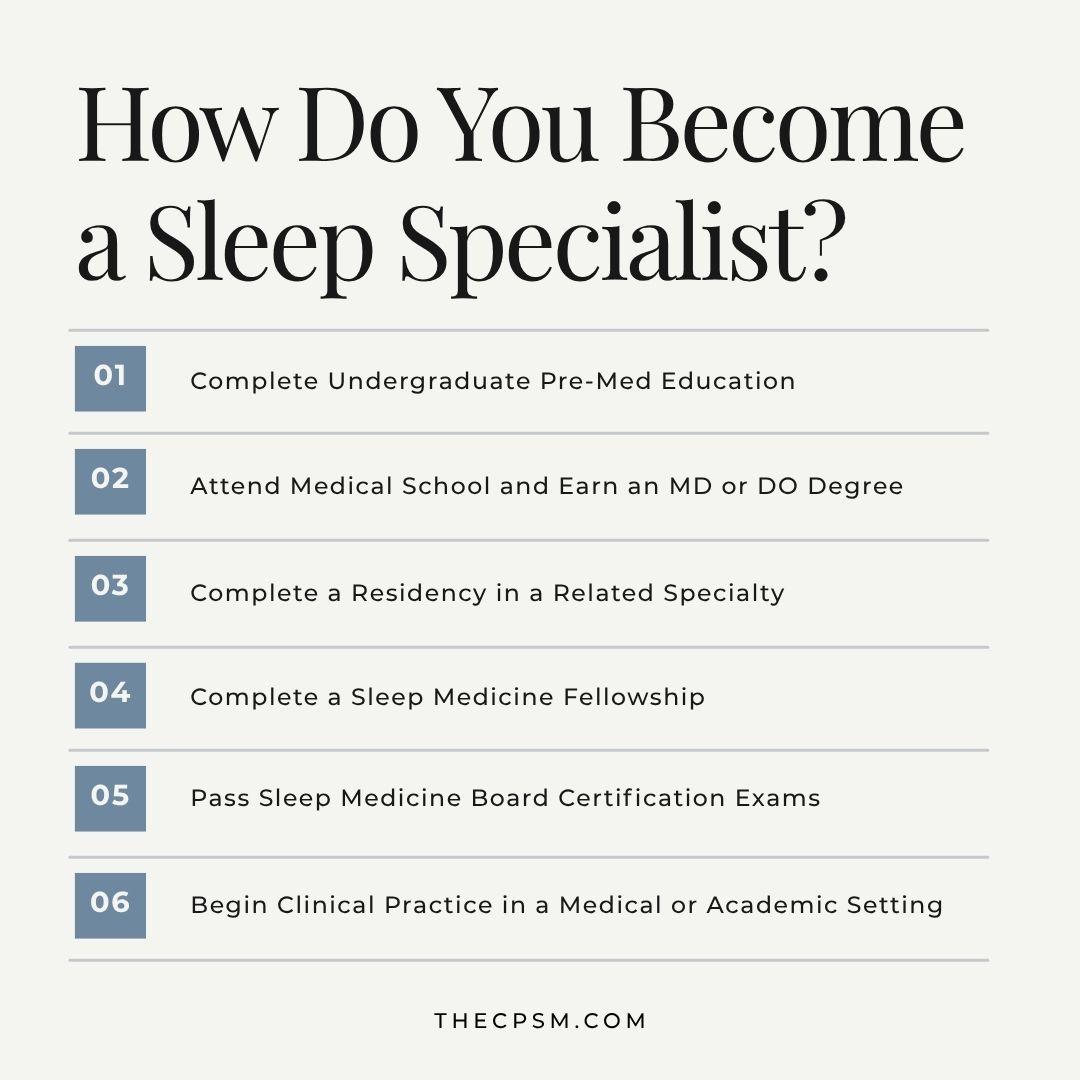
How Do You Become a Sleep Specialist?
Complete Undergraduate Pre-Med Education
The path to becoming a sleep specialist begins with a bachelor’s degree. Most students follow a pre-med track to prepare themselves for medical school. Maintaining a strong GPA is important since medical school admissions are highly competitive.
During this phase, students also prepare for the MCAT, gaining clinical experience through volunteering or shadowing patients. They also involve themselves in clinical research during this time. Building a track record of leadership or community service can ultimately strengthen medical school applications. The most serious applicants work on all of these fronts simultaneously.
Attend Medical School and Earn an MD or DO Degree
Many widely regard medical school as one of the most demanding academic experiences in any profession, and that reputation is well-earned. Long study hours, frequent high-stakes exams, and learning to absorb enormous volumes of information define the first two preclinical years.
The clinical years that follow are a different kind of challenge. Students rotate through hospitals and clinics, work long shifts, and report to attending physicians and residents. It’s demanding in a way that the classroom years aren’t, and it’s also where the work starts to feel real.
Year four brings the residency application process through the Match. This is a centralized system that pairs medical school graduates with training programs across the country. Match Day, when placements are revealed, is one of the most anticipated and memorable moments of the medical training journey.
Complete a Residency in a Related Specialty
Residency is where the transition from student to practicing physician happens. This is one of the most demanding stretches of the entire training journey. Residents typically work 60 to 80 hours per week, with overnight shifts, on-call duties, and weekend rotations.
As residents progress, they take on more responsibility, begin supervising junior trainees, and develop deeper expertise in their field. For those interested in sleep medicine, residency is also a good time to start laying that groundwork. You can do this through electives, research projects, or building relationships with sleep specialists at their institution.
Complete a Sleep Medicine Fellowship
Fellowship is generally more focused and manageable compared to residency. Hours are more predictable, typically around 50 to 60 per week. Additionally, the clinical work narrows significantly as fellows focus specifically on sleep medicine.
Fellows rotate through sleep labs, outpatient sleep clinics, and inpatient consultation services. They spend a significant portion of the year interpreting sleep studies, which requires developing a pattern recognition skill set. This only comes from reviewing hundreds of cases over time.
Most fellowship programs also include scholarly requirements, such as completing a research project or presenting at a national conference. The good news is that most fellows secure their first attending position before their fellowship years end.
Pass Sleep Medicine Board Certification Exams
Board preparation typically begins during fellowship and intensifies in the months leading up to the exam. Because ABMS member boards offer the test every other year, there’s real pressure to be ready when the window opens. Most candidates study for three to six months before taking the exam.
Passing the boards isn’t the finish line, though. Maintenance of Certification is an ongoing commitment that continues throughout a physician’s career. They require continuing medical education credits, periodic knowledge assessments, and regular practice improvement activities.
Begin Clinical Practice in a Medical or Academic Setting
The transition from fellow to attending physician is significant. The first year or two as an attending is often spent adjusting to the pace of independent practice. You will focus on building a patient panel and developing referral relationships with primary care physicians and specialists.
The field draws many sleep specialists because it offers a more predictable schedule than many other medical specialties. There are limited overnight calls and a strong focus on outpatient care. Over time, attending physicians may develop subspecialty interests, take on leadership roles, or become involved with professional organizations.
Why Sleep Consultants Is a Meaningful Path for Aspiring Sleep Professionals
As I mentioned previously, sleep specialists and sleep consultants prioritize entirely different age groups and continuing education requirements. However, for those who are passionate about improving sleep but don’t feel called to the traditional medical route, there’s another path worth serious consideration.
Becoming a sleep medicine physician requires years of higher education, residency, fellowship training, board certification, and significant financial investment. While that path is right for some, it’s far from the only way to make a meaningful impact in the sleep space.
That’s where The CPSM comes in.
The CPSM Sleep Consultant Certification Course provides a more accessible, business-minded path for those who want to support families through better sleep without spending years in clinical training. Rather than preparing students for hospital systems, The CPSM equips future sleep consultants with the education, tools, and mentorship needed to build a career helping families navigate real-world sleep challenges.
For aspiring entrepreneurs, career changers, or parents seeking flexibility, our course represents a practical, purpose-driven alternative. The goal isn’t to become a physician. Instead, it’s to become a confident, well-prepared sleep consultant with the training and tools to create lasting results for families and a business that aligns with your lifestyle.
You can learn more about this process in my podcast, Becoming a Sleep Consultant with Jayne Havens.
Become an infant sleep consultant in a fraction of the time with the Center for Pediatric Sleep Management.
Sleep specialists are commonly known as sleep doctors or sleep medicine specialists. And becoming one requires more than a decade of training, significant financial investment, and a full medical education. That path is not the right fit for everyone, and that’s completely okay.
For those interested in building an income or making a meaningful impact on families’ lives, the CPSM sleep consultant certification course is a practical solution. The course covers sleep science for babies and includes a dedicated section on launching and growing your own consulting business. You’ll walk away with the knowledge, tools, and community support you need to actually get started.
Not sure if this is the right path for you? Schedule a discovery call with me, Jayne Havens, founder of CPSM and certified sleep consultant. We’ll talk through what the career looks like, what the course covers, and whether it’s the right fit for where you want to go.