Interested in becoming a sleep consultant?

Jayne Havens is a certified sleep consultant and the founder of Snooze Fest by Jayne Havens and Center for Pediatric Sleep Management. As a leader in the industry, Jayne advocates for healthy sleep hygiene for children of all ages.
Jayne launched her comprehensive sleep consultant certification course so she could train and mentor others to work in this emerging industry.

Meet Jayne Havens
Ready to Start?
Become a Certified Pediatric Sleep Consultant
Turn your passion for helping families into a flexible career you can build from home.
Free Guide
A closer look into what sleep consultants do, and how this career could fit into your life.
From Software Engineer to Sleep Consultant with Divya Adibhattla
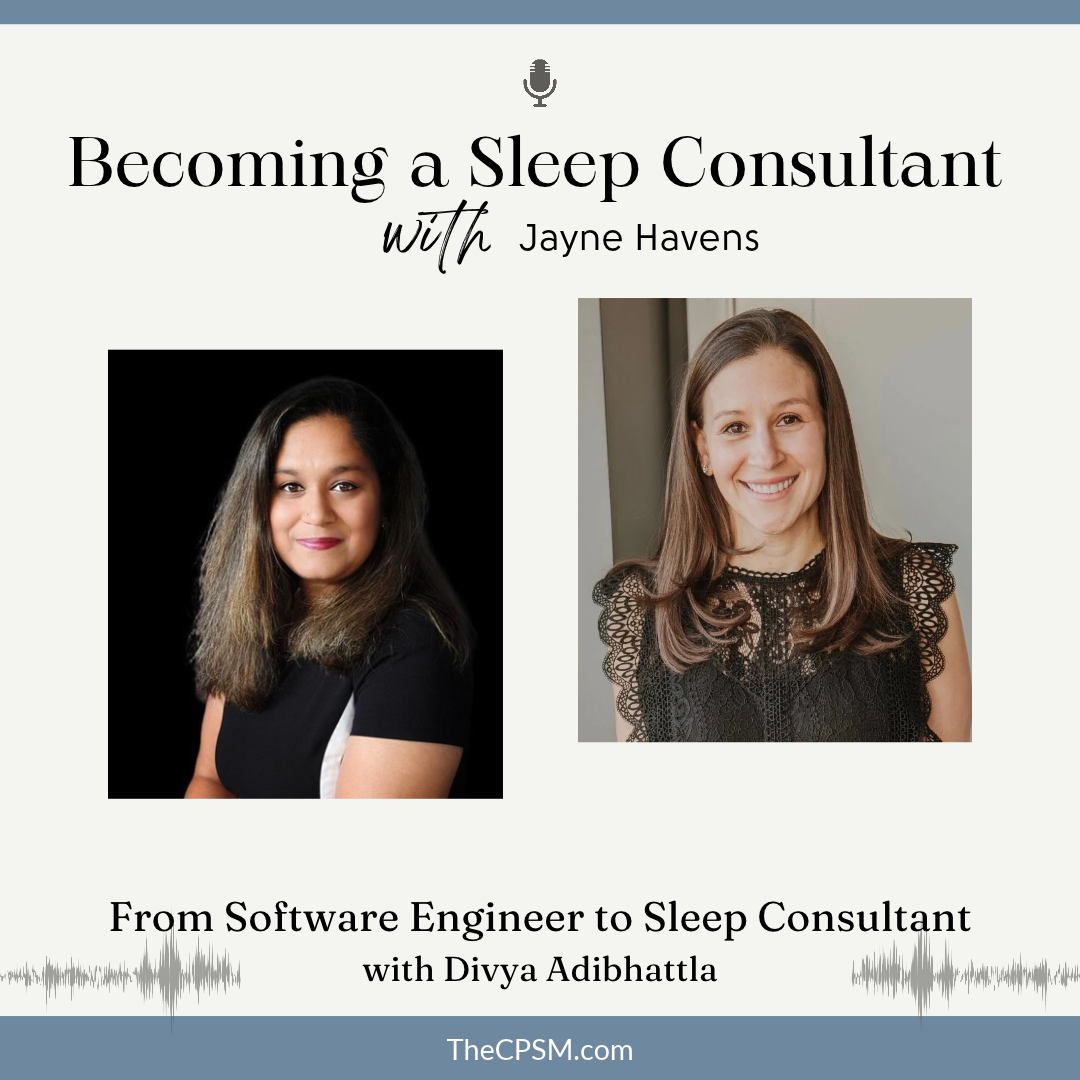
From Software Engineer to Sleep Consultant
with Divya Adibhattla
When Divya enrolled in CPSM, she wasn’t worried about the sleep piece. She knew she could help families. What she didn’t know was how to run a business, or how parents would ever find her.
A year later, she is proud to be running a successful sleep consulting business, and her days look completely different. She works a few focused hours a day and spends the rest of her time with her kids.
What I love most is how much her confidence has grown. Divya stopped trying to do things the way everyone else does them and built a business that feels like her. She knows her worth, and she has figured out how to attract her ideal client.
Divya didn’t come into this with any business experience. She figured things out as she went, and now she has a business and a life she can be really proud of!
Links:
Website: Calm and Courageous Sleepers
Instagram: @calm_and_courageous_sleepers
If you’d like to learn more about becoming a Sleep Consultant, please join our Facebook Group: Becoming A Sleep Consultant
CPSM Website: Center for Pediatric Sleep Management
Book a free discovery call to learn how you can become a Certified Sleep Consultant here.
Transcript:
Intro: Welcome to Becoming a Sleep Consultant! I’m your host Jayne Havens, a certified sleep consultant and founder of both Snooze Fest by Jayne Havens and Center for Pediatric Sleep Management.
On this podcast, I’ll be discussing the business side of sleep consulting. You’ll have an insider’s view on launching, growing, and even scaling a sleep consulting business. This is not a podcast about sleep training. This is a podcast about business building and entrepreneurship.
Jayne Havens: Divya, welcome to the Becoming a Sleep Consultant podcast. I’m so glad you’re here today.
Divya Adibhattla: Hey, Jayne. Thank you for having me. Likewise.
Jayne Havens: Tell us a little bit about your background. What were you doing professionally before becoming a sleep consultant?
Divya Adibhattla: So, before becoming a sleep consultant, I was working as a software engineer in IT. I have worked in big tech. I have worked in the mid-sized companies, and that’s what I was doing full-time. I was working in the backend systems. I was coding, and yeah, like a typical Silicon Valley IT person, that’s what I was doing.
Jayne Havens: And then you get this idea to become a sleep consultant, which feels totally on the other end of the spectrum from what you were doing professionally. What drew you to this line of work?
Divya Adibhattla: So, I do have two kids of my own, and I have struggled with my older kid for sleep for almost four years. And yet, I did not believe it would be good to invest in a sleep consultant. With my daughter, I did invest in one, and I saw how she was putting us in line as she grew. Because she would be like, nobody should be going into her room because that’s a sleep space. It’s not a place for playing. She would be like, even though she was not able to talk, she was able to very clearly communicate and say that she needs to go into the crib because it’s time.
When I saw this, and I was seeing the difference in personalities for both my kids, I was like, “I should do this to all the other parents.” There were a lot of kids around me who were not sleeping. I didn’t have an intention that they would hire me as a sleep consultant the minute I got certified. I knew that would be a struggle, but then I was like, I really wanted to do this for the other parents and for the community that didn’t know that something like a sleep consultant exists.
Jayne Havens: So, you started your sleep consulting business while you were still working full-time in IT. What did it look like to juggle both your 9-to-5 and then your children, and then also trying to grow this little small business of yours?
Divya Adibhattla: I definitely wanted to do this as something on the side. I never had the intention of doing this full-time. I could not imagine this a year ago when I actually enrolled in the course. All I wanted to do was have like two or three clients, and that’s about it. It wasn’t easy for me, but I did have some time on hand because I live in the Bay Area. I had a lot of time to commute. I was doing carpooling with a colleague, and I would do the videos and the audio of the course when I am driving, and I would read the textbooks and everything when my colleague was driving.
So that’s how I actually finished the course. Most of my initial discovery calls would be during my commuting time, and the rest of the handling the parents and talking to them and guiding them and everything would be after my kids went to sleep. Because I am in the West Coast, it puts me in a very good location because when I’m working with East Coast clients or Central Time clients, my kids are not back from school yet. So that’s how I was doing it.
Jayne Havens: And now you’re actually in the position to be able to work on this full-time, which I think is a little bit of a blessing, right?
Divya Adibhattla: Yes.
Jayne Havens: What does it look like day to day now that you have all of these hours to focus on your business?
Divya Adibhattla: I do have a lot of hours to focus on the business. I try not to do that because the whole reason I’m doing this full-time is also so that I’m able to spend time with my family, which I could not by any means do when I was in IT.
So I would not have calls after 12:00 because after that, my kid comes home. My daughter still goes to the preschool, and she comes back at 5:00. And 12:00 to 5:00 is the time that I get to spend with my son one-on-one. So if I have a podcast interview, if I have a discovery call, if I need to work on my contracts or a sleep plan or anything, I do that between 8:00 and 12:00, and that’s it. That’s the time that I’m giving unless I have an in-person client. But that’s after my kids go to bed, so that’s in the night.
The rest of the day, from 12:00 to 8:00, is with my family. So instead of working eight hours, I’m spending eight hours with my family now. That’s how the script has flipped.
Jayne Havens: I think that that’s really beautiful. People ask me all the time. You know, I support a lot of families per month. I run Center for Pediatric Sleep Management. I volunteer. I am involved with my kids’ school. I am an involved parent, and people always ask me, “How do you have time for all of this?”
I actually think that if you’re productive in the hours that you allot for your business or for anything else, there are so many hours in the day, like, when you actually are thoughtful about it. I love that you have this concrete four-hour window that you’re really committed to your business. And then outside of that, you’re focused on your family or you’re focused on whatever else that you want to do. That is your life.
And when people tell me that they just don’t have any time, I just call BS because there’s so much time. There is so much time. I still, I play tennis three times a week. I take my kids places after school. I have so much time, and I also work a ton. So I don’t know. I just think there are so many hours in a day.
Divya Adibhattla: That’s true because I have been spending— like, I pick my kid from school. We walk. That’s how close we are. So we pick my son from school, and I spend two hours in the park with him. And I’m like, wow. I couldn’t have thought of something like this before. I eat lunch with my son, and that’s, oh my God, that’s such a blessing for me.
Jayne Havens: I really truly love this for you. I really do. And I know that gaining your confidence or increasing your confidence has been a big part of this journey for you. How would you describe what that looked like when you first started your business versus where your confidence lies now?
Divya Adibhattla: So when I was actually enrolling in the course, I did not think that I’ll have enough clients, and I didn’t know how to get to them because I knew nothing about running a business. Nobody in my family has run or owns a business, so I had no clue that, oh, like, how are these parents going to find me?” That was my biggest struggle.
Over the past year, I have learned that there are many ways in which people can find you, and you don’t have to do everything. You can pick what you want and how you want people to find you, and they will come and find you. So I think that’s how the story has changed for me.
Because, let’s say, social media. I will not go and put myself on social media. I know there are a lot of CPSM grads who have done this wonderfully using social media. I listen to them, but I don’t feel that I can do it or I don’t want to do it. So that’s not what I’m going to do, and that’s not how I’m going to find the clients. My thing is something else, and I’ll go a different route. I would might as well go to Target and talk to a mom and say that, “Hey, you know what?” There’s a baby right there. “Is your baby sleeping? Here is my card.” I can do that, but I can’t do social media.
So I have been able to find the difference and the methods that exist, and that’s how my confidence has changed, I would say.
Jayne Havens: Is that what you’re doing? You’re just connecting with moms and maybe other professionals as well in real life as much as possible to grow your business?
Divya Adibhattla: Yeah. I mean, I’m not walking up to Target. That was an example. I’m not really doing that. But yeah, I do cold calling to pediatrician offices. I find different podcasts and I pitch the people if I can go on their podcast because I believe that it’s very important to put myself out there. I know I don’t want to do it through social media, but there has to be some path where parents know that someone like me exists.
I go to hospitals. I work with doulas. I partner with a lot of doulas in my community, and I have been able to tell them that, “Hey, you know what? If you are working with a 10-week-old, why don’t you tell the parent that I can take it from here and I can help them?” Because not all the doulas would focus on sleep shaping or sleep training in the initial weeks. Surprisingly enough, I have a lot of parents who call me in person at the 10-week mark. So more than sleep training, I am doing a lot of sleep shaping with the parents. And it doesn’t end in two weeks, so it’s like a long-term contract that I have with them.
Jayne Havens: I love that you’ve carved out this little niche for yourself, especially with that in-person work. Correct me if I’m wrong, but I don’t think it was your intention to do so much in-person work when you enrolled in CPSM, right? Especially because you were working full-time.
Divya Adibhattla: Yes.
Jayne Havens: I think your intention was really to support families virtually, which I know you are doing, but you’re also taking in-person clients.
Tell me about what that felt like when you first started. What was it like to go into a family’s home and provide in-person, hands-on support?
Divya Adibhattla: For me, yes, I wanted to do this virtually only, but I also like the money on the in-person side, to be honest. And then some parents, they like the hand-holding and the guidance that comes in person. So I did have a family of a 10-week-old. Somehow, that’s the age that I’ve been working with a lot.
But my first in-person client was in the neighborhood. She was like, “Can you please come and help us because we have an older kid with special needs who cannot tolerate any crying in the household? So that’s what you need to work around.” For me, I was like, okay, I’ll go ahead and do that. I’ll try my best. It was easy because a 10-week-old is not going to cry as much as a 16-week-old or an 8-month-old. So I was like, yeah, I will be able to do it.
Again, it all comes back to where I am located. A lot of parents here start working at the 10-week mark. They get a 10-week paternity leave or a maternity leave, and they want sleep in place right from the 10-week mark. So that’s why I am getting a lot of work. These are the parents that I’m looking for, whom I know that it’s going to be a lot of help for them. So when I walk into their house, I feel that they also have the confidence in me because they let a stranger enter their house.
Jayne Havens: Are you enjoying it? Like, do you actually like going to people’s homes and doing the work in person?
Divya Adibhattla: I meet a lot of good people. I have walked out of two contracts already because I have not met with the right fit. But I’m also in the space where I can say no to a client, so I think that is fine. I walk in and I see that a lot of people are involved. It’s not just sleep shaping and not just coaching the parents, but it feels like every decision I make is being questioned by the grandparents. I keep explaining to them, and they’re not here to understand the concept, but they’re just here to defend whatever I’m doing. So I’m like, okay, this may not work. We should reconnect after some time.
Because mostly, when I go to somebody’s house, grandparents are there. Because I’m working with 10-week-olds, and a lot of times they come to help. But I do find where they are very supportive. They are like, “Oh, okay, you know what? We have forgotten what we did with our kids, so you do what you do because you are an expert in this.” So when I get that kind of a welcoming, I enjoy it. I feel at home. They don’t need to tell me that. I’ll just go and feel at home, and I’ll do everything for them.
Jayne Havens: What I’m sensing in you is such an increased sense of confidence. And if I remember back to when you first started, you definitely, I think you always had your confidence when it came to the sleep piece. You always knew that you were good at sleep training, and you’re always good at coaching parents. I think you always had that, if I remember correctly from the very beginning. But your sort of insecurities or nervous feelings all stemmed from, “How am I going to establish myself as a successful business owner,” right?
Divya Adibhattla: Yeah.
Jayne Havens: And I think, what are you, almost exactly a year in at this point, right?
Divya Adibhattla: Yes.
Jayne Havens: And just to see the transformation, that you are just so confident, confident enough to acknowledge when a family is not the right fit for you, that that’s okay. The family has every right to want to parent in the way that they want to parent, and you are there to support in a certain way. And if those two interests are colliding in any way, then that’s okay. It’s just not the right fit.
I think that that’s something that’s really hard for new business owners to really step into, that confidence in the beginning. And it just takes time. And I love that you— I feel like you have arrived. You are feeling like, I know what I’m doing. I’m good at this. Take me or leave me, right?
Divya Adibhattla: Yeah. And also, because initially, we do not have— I think this is a problem with a lot of people who may start off in the beginning. Because people will come and bargain you for the prices of your service. And I would be like, I was charging 500 at the time. After a retreat, I upped my prices because that’s what everybody told me to do. So I was like, okay, I’m going to go and up my prices. That’s fine. And it’s just working fine. Nobody has bargained with me ever since.
At the 500-mark, people were like, oh, 500 is a bit too much. Can you go a little bit lower? Can you give us some discount? And I would be like, “Oh, okay, how much do you want to pay?” And then someone at the retreat told me, “You’re not begging them for the money. You are providing them service, and that’s what they are paying you for. So feel confident in that aspect.” And I was like, that is so true. I don’t need to tell them or give them a discount.
Now I am in a position where I can tell the parents that, “Hey, you know what? This is my price. I specialize in this. But if this is difficult for you, I am happy to redirect you to someone who charges lesser.” They’re like, “Oh, okay, we’ll go ahead.” Like, “It’s okay. We’ll make the payment.” I’m like, thank you very much.
Jayne Havens: I seriously love this so much. And for people listening, Divya’s referring to the Nurture Nap Network retreat that we hosted this past summer in Denver. We had about, I think, maybe 35 sleep consultants and parent coaches all come together to network and connect and learn from one another. And I know that it was a really transformative experience for you. I know that you really almost didn’t come. Like, you weren’t going to.
Divya Adibhattla: That is so true. Like, I cannot imagine not going to that. Because I wouldn’t have taken this full-time if I did not come to the retreat. That’s for sure. I feel that I saw how all these women, like, they did find what is good for them and how they run their business. A lot of people are doing in-person, but doing it in different ways. And that’s when I was like, get to thinking that, okay, is this what I want to do? Is this not what I want to do?
Like, I wouldn’t do in-person for a toddler. I’ll happily do it. Because, again, I tell the parents that, hey, your child needs to know that you’re the authority in the household, not somebody else. They’ll listen to me as long as I’m there, and then they’ll stop listening to you when I am not there. So that’s not what we want to happen, right?
And same thing, like, 10-week-old. I don’t do the two-weeks package or just three nights and do it. Because that’s not how it’s going to work. Sleep is going to change so much from 10 weeks to 16 weeks for them. So I go twice a week and I coach the parents along the way. And the feeding quantity changes, the timings change, and then we talk about everything else over the week. So that’s how I’m working for younger kids.
Jayne Havens: Yeah, so that was actually going to be one of my questions. One thing that I’m most curious about, as somebody that doesn’t provide in-person sleep training support, is how you balance being there and doing everything for them versus being there and coaching them to understand what to do so that when you’re not there, they can continue on with everything that you’ve put into place, right?
What is your process for that? Are you, for the first couple of nights, doing everything and hopefully they’re watching you? Or are you giving them tools and asking them to put it into place themselves? What does that look like for you?
Divya Adibhattla: So before I go, I ask them what they do during the day and during the night, and what they’re doing when the child is fussing, how they are reacting to it. So that gives me a sense if the parents are still in any trauma from the birth or not, and how they’re going to deal with it. Some moms are like, “Oh, we are so okay with crying.” Then I’m like, “Okay, then we’ll do this quickly.” But some parents are very sensitive to it. Some babies have reflux.
I work with whatever is their situation. I gather the information. I go, and then I talk to them about it. For the first time I go, it’s almost an hour, hour and a half. They have so many questions because the baby is still new. And some babies are not yet vaccinated by then, so they have all these lot of questions, and we work through that.
Usually, they either write it up on the paper and they put it on the counter. That’s where I do all the editing, and I’ll do what happened during the night. Or they have this Huckleberry app, which is great, but not everybody needs to pay for it. But yeah, so I’ll just put all the information there, and I’ll see what is happening.
During the day, I can go back and track in the app what they are doing with the baby. I tell them every three hours, three ounces. Sometimes they are not able to catch up to it. Then I’m like, “Okay, this didn’t work, so this is what you need to correct for tomorrow. This is what we need to do during the night,” and they’ll do it.
So if it’s a 10-week-old that I’m working with, I will not do continuous nights. I’ll do one night, let’s say a Monday, and then I’ll do a Wednesday or a Thursday. And then during all the rest of the days in between, the parents will keep doing whatever I ask them to do, make any corrections that are needed. Then I go in and I’ll take over. It’s also like a break for them, but it’s also more like they know that, okay, somebody’s going to come and monitor. And it needs to be in place, so we need to do the homework.
That’s how I am doing it right now. Unless it’s someone who is more than four months old, I’ll go three nights. I’ll do it for them. They can see, learn, and then the virtual thing continues for the rest of the two weeks.
Jayne Havens: I love that you’ve figured all of this out.
Are there any skills or experiences from your corporate career that have really served you well as a sleep consultant and business owner?
Divya Adibhattla: I like to give the parents an example of what my previous client did. I do have images from the Huckleberry app or, like, from the paper that I’m working with. Let’s say I started working with someone at eight weeks old. I show them the document and I tell them; this is what an ideal 10-week-old is going to look for you. So imagine this is what you want, and this is very ideal. And then we are going to go ahead and, like, what is going to happen?
So I’ll tell them, and I’ll show them a record of how their night is looking right now and what the difference is going to be. So that gives them a good relief. Like, okay, my baby was waking up every three hours, and now only once in the middle of the night. That’s great.
And I show them how the day is going and how that’s a good reflection of the night. I will tell them that, see how well the day was and how well the night went because you did good during the day. And sometimes if you slipped during the day, it’ll reflect in the night. So I’ll show them the differences and the statistics. So we don’t need to talk too much when it comes to that. They’ll see, and they can figure it out, and they’ll realize and they’ll try to put in the work.
Jayne Havens: One thing I love about your business is it seems to me—I was poking around your website earlier today—that you really have brought your math brain into your work as a sleep consultant, right? A lot of the language that you use on your website is, like, data-driven sleep architecture. I love that language, and I think it’s very specific and it’s very unique to you.
You know, if I compare your business to mine, I do nothing with data in my business. I don’t talk about the numbers and the minutes and the hours. I don’t track any of that. And it doesn’t mean that my way is better than yours or your way is better than mine. I think it’s just a different way of looking at it. It’s a different way of coaching families, and it’s also just a different way to market yourself, right?
Divya Adibhattla: Yeah.
Jayne Havens: Like, this is who you are and you’re utilizing it to your advantage in your work as a sleep consultant.
Divya Adibhattla: And also the clients that I’m working with.
Jayne Havens: Okay, fair.
Divya Adibhattla: Most of the clients that I work with, I understand that this is the language that they will understand. They’re all in tech here in Silicon Valley. This is what they are doing too. So when I say that this is the system and you need to follow this, they’ll do it. And if I tell them that, “Hey, this is how it’s going to look like for you if you do something like this,” this is what they do for a living, so they understand. Sometimes they’re very surprised that babies also work that way. I’m like, yeah, you can see this, right? And they’re like, “Okay, sure. Let’s go.”
Jayne Havens: Honestly, I’m so proud to hear you talk about your business this way. Even just that, you know, here I am thinking that the way that you’re talking about your business is really about yourself, and you corrected me that it’s really maybe not. I mean, it is a little bit.
Divya Adibhattla: It is.
Jayne Havens: It is. Because I think you have that in you. But also, it’s more about your client, and I think that’s so smart. It’s so savvy. Because really, when we are talking about our work, we should be speaking into the way that our ideal client thinks about all of this, right? And that’s really what you’ve honed in on. You’ve figured out who your ideal client is, and you understand the way their brain works. Because I think yours kind of works the same way a little bit, right? And so you’re speaking their language, and that’s beautiful. That’s really smart.
I think that’s something— I don’t know if you figured that out right away or if that was something that you figured out along the road. But yeah, right, like, you didn’t know that day one, right? Like, you had to come to that conclusion after months and months and months of speaking to families and maybe not connecting with them in the way that you wanted to, right?
Like, maybe you had lots of conversations where you just weren’t finding the language that turned things on in their brain. And now you’ve developed this communication strategy that when you speak to your ideal client, they totally eat up what you’re saying. They totally understand where you’re coming from because you’re speaking into the way that their brain works. I think that’s brilliant.
Divya Adibhattla: Thank you.
Jayne Havens: You should be really proud. You should be really proud.
Divya Adibhattla: Thank you.
Jayne Havens: Looking back on the version of yourself who was just launching a business a year ago, what else do you know now that you wish you had known then?
Divya Adibhattla: It’s very common, but I think that I shouldn’t really have focused more on how will I get the clients, how will I get a client. But I should have more, like, I think that that is— I mean, it’s a learning, but I also wasted a lot of energy and time in that area.
But I think that now I feel it’s more important that you invest in the learning. It doesn’t end with just one CPSM course, and then you’re doing great. No, everybody keeps learning. I do see that with our grads. So just keep learning. And like gardening, plant your seeds and it’s going to grow. I think that’s what I’m learning. I am doing a lot of podcasts, as I have mentioned. So I’m like, somebody will hear it someday and they will come to me. So it doesn’t have to be— they don’t need to hire me, but at least people know what I think and what I’m talking about.
These are the things that I should be focusing on rather than just going to each person and looking for, “Hey, do you want a sleep coach? Do you want a sleep coach?” I also have a personal PR agent, my son. He goes and tells everybody in school, “My mom is an engineer and a sleep coach. She helps babies sleep.” So I’m like, okay, good. That’s a free PR agent for me there. But yeah, I think that’s what I should be doing. Or anybody who’s new should be doing that. Focus more on the learning and investing in the right place, and identify where you want to invest.
I also got certified as a doula because I started working with a lot of newborn babies, or sleep shaping aspect of it. So it’s very important for me to know the reflux. It’s very important for me to know what happens when they are vaccinated and how they are going to behave if we are working during that period, and also how the mom must be feeling about it because she’s so new into this thing as a mom herself. So that’s why I got certified as a doula. That’s also how I get to talk to a lot of doulas and get into my clientele.
Jayne Havens: I think that everything that you’re doing now in your business is just so smart, and I wish people would listen to me and do this from the beginning.
There’s so much work to be done in the beginning just to get yourself to a place where you’re actually really good at this work, right? Like, when you first become certified, it doesn’t matter how good your education is. On some level, you have to just speak to a lot of moms. You have to experience a handful of families, whether it’s pro bono or your first few clients. You just have to get— you got to roll up your sleeves and get your hands dirty a little bit. You have to be willing to talk to a lot of people before you’re good at talking about what you do, right?
Like, if you don’t actually have conversations— and I love that you’re out there podcasting because it really gives you an opportunity to hone in on your language and your communication strategies and how to talk about yourself in a way that you want to hear on the other side, right?
Divya Adibhattla: Yes.
Jayne Havens: And there’s no shortcut to all of that. You can’t cut corners. You just have to put in the work and put in the time, and I love that you’ve figured that out. The way that I see it, even though you’ve grown so much in the past year, you’re still just a baby in your business.
Divya Adibhattla: Oh, yes.
Jayne Havens: Right? Like, your business is still a baby and you’re still growing. And now that you have some more things figured out, I think things are going to accelerate for you. I’m really excited to see that.
Before we wrap up, do you want to share your website, social media? Anything you want to share?
Divya Adibhattla: Yeah, my business is called Calm and Courageous Sleepers. It’s for the parents, not the babies. That’s why I named it that way, because the parents need to be calm and bold enough to put their babies in their own room. The website is www.calmandcourageoussleepers.com. And my Instagram, maybe you can put it in the show notes, but it’s the same words, @calm_and_courageous_sleepers, with underscore between each of the words.
Jayne Havens: Perfect. I will make sure that all of that goes into the show notes. Divya, this was so great having this conversation with you today. Maybe people will see a video, but most likely, they’ll just watch or listen to an audio of our conversation, so they can’t see that I’m smiling ear to ear, so happy and so proud of you. I’m wishing you much continued success, and we’ll have to have another conversation in the next six months to a year from now.
Divya Adibhattla: Sure. Thank you. Thank you for having me. I was also looking forward to coming on this podcast.
Jayne Havens: Such a treat for both of us.
Divya Adibhattla: Yes.
Outro: Thank you so much for listening to this episode of the Becoming a Sleep Consultant Podcast. If you enjoyed today’s episode, it would mean so much to me if you would rate, review, and subscribe. When you rate, review, and subscribe, this helps the podcast reach a greater audience. I am so grateful for your support.
If you would like to learn more about how you can become a certified sleep consultant, head over to my Facebook Group, Becoming a Sleep Consultant or to my website thecpsm.com. Thanks so much, and I hope you will tune in for the next episode

Considering A Career in Sleep Consulting?
Download our free e-book filled with information on what sleep consultants do and how running a sleep consulting business might fit into your life.
FrEE DOWNLOAD
Thank you for your message.
We will contact you shortly!